Getting It Fixed for Free
Reparación gratis
Emma brings the kettle and her receipt to the store. Jack confirms that the repair is covered, so she can get it fixed for free.
Emma lleva el hervidor y el recibo a la tienda. Jack confirma que la reparación está cubierta por la garantía, así que pueden arreglarlo gratis.
Diálogo8
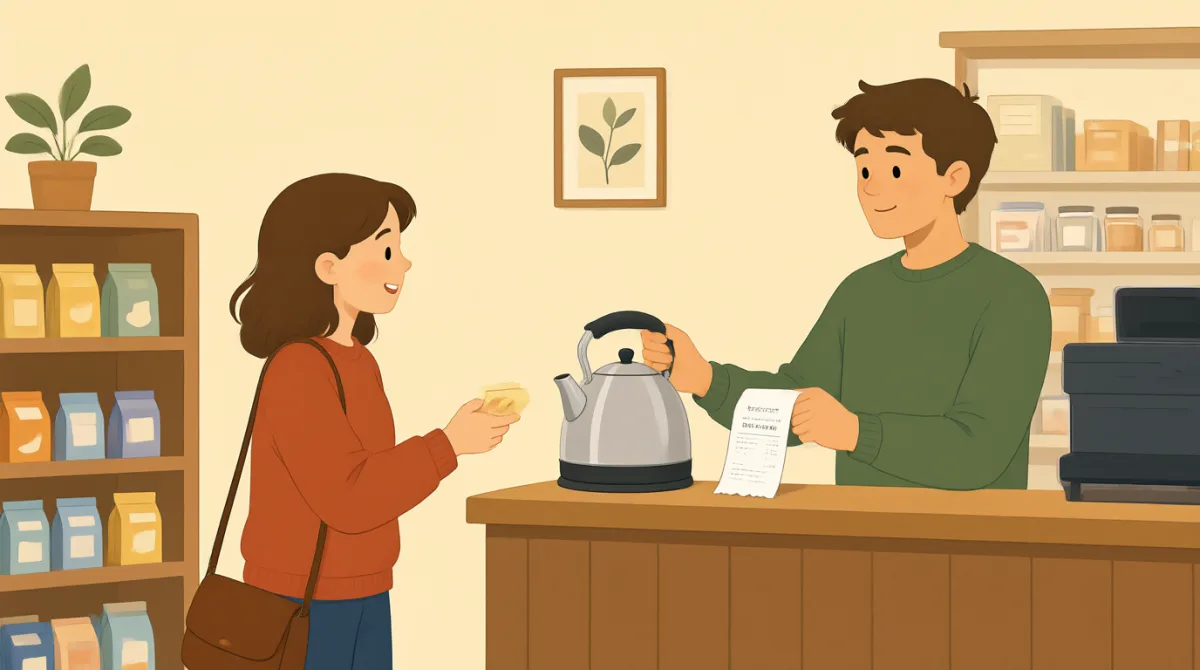

Hi, Jack. My kettle stopped heating, so I brought it in with my receipt.
Hola, Jack. Mi hervidor dejó de calentar, así que lo traje con el recibo.

Thanks. Let me check the receipt and your warranty papers.
Gracias. Déjame revisar el recibo y los documentos de la garantía.
I bought it a few months ago. Is the repair covered?
Lo compré hace unos meses. ¿La reparación está cubierta?
Yes, it is. The warranty covers this problem, so the repair is free.
Sí. La garantía cubre este problema, así que la reparación es gratis.
That’s great! Do I need to leave the kettle here?
¡Qué bien! ¿Tengo que dejar el hervidor aquí?
Yes. We’ll send it to our repair center and call you when it’s ready.
Sí. Lo enviaremos a nuestro centro de reparaciones y te llamaremos cuando esté listo.
How long will it take? I use it every morning.
¿Cuánto tardará? Lo uso todas las mañanas.
It usually takes about a week. We’ll let you know if it takes longer.
Normalmente tarda alrededor de una semana. Te avisaremos si tarda más.
Vocabulario8
- stopped heatingdejó de calentar
This means the kettle no longer gets hot. Use it to describe an appliance that has stopped working properly.
Significa que el hervidor ya no se calienta. Úsalo para describir un electrodoméstico que ha dejado de funcionar correctamente.
- brought it inlo traje a la tienda
This means Emma took the kettle to the store. You can use “bring it in” when taking an item to a shop or service center.
Significa que Emma llevó el hervidor a la tienda. Puedes usar “bring it in” (traerlo a la tienda) cuando llevas un artículo a una tienda o a un centro de servicio.
- receiptrecibo
A receipt is the paper or message that shows what you bought and how much you paid. You may need it when asking for a repair or refund.
Un recibo es el papel o mensaje que indica qué compraste y cuánto pagaste. Puede que lo necesites al pedir una reparación o un reembolso.
- warranty papersdocumentos de la garantía
These are documents that give details about the product’s warranty. A store may check them to see if a repair is covered.
Son documentos con información sobre la garantía del producto. La tienda puede revisarlos para comprobar si la reparación está cubierta.
- Is the repair covered?¿La reparación está cubierta?
This asks whether the warranty pays for the repair. You can use this question when checking if a repair will cost you money.
Esta pregunta sirve para saber si la garantía cubre el costo de la reparación. Puedes usarla para averiguar si tendrás que pagar.
- leave the kettle heredejar el hervidor aquí
This means to leave the kettle at the store for a while. You can use “leave [item] here” when a shop needs to keep something for repair.
Significa dejar el hervidor en la tienda por un tiempo. Puedes usar “leave [item] here” (dejar [artículo] aquí) cuando una tienda necesita quedarse con algo para repararlo.
- repair centercentro de reparaciones
A repair center is a place where people fix broken products. A store may send an item there for service.
Un centro de reparaciones es un lugar donde arreglan productos averiados. Una tienda puede enviar allí un artículo para que lo reparen.
- takes about a weektarda alrededor de una semana
This means something usually needs around one week to finish. Use “takes about [time]” to ask or answer how long a process needs.
Significa que algo suele necesitar aproximadamente una semana para terminarse. Usa “takes about [time]” (tarda aproximadamente [tiempo]) para preguntar o responder cuánto dura un proceso.
Frases clave8
- 1
My kettle stopped heating, so I brought it in with my receipt.
Mi hervidor dejó de calentar, así que lo traje con el recibo.
This explains what went wrong and what Emma brought to the store. You can reuse the pattern “My [item] stopped [working], so I brought it in.”
Esta frase explica qué problema hubo y qué llevó Emma a la tienda. Puedes reutilizar el patrón “My [item] stopped [working], so I brought it in.” (Mi [artículo] dejó de [funcionar], así que lo traje a la tienda).
- 2
Is the repair covered?
¿La reparación está cubierta?
This is a simple way to ask if a warranty includes a repair. You can use it when you want to know whether you will have to pay.
Esta es una forma sencilla de preguntar si la garantía incluye una reparación. Puedes usarla para saber si tendrás que pagar.
- 3
The warranty covers this problem, so the repair is free.
La garantía cubre este problema, así que la reparación es gratis.
This explains that the warranty includes the problem and that there is no cost for the repair. You can use the pattern “The warranty covers [problem], so [service] is free.”
Esta frase explica que la garantía cubre el problema y que la reparación no cuesta nada. Puedes usar el patrón “The warranty covers [problem], so [service] is free.” (La garantía cubre [problema], así que [servicio] es gratis).
- 4
Do I need to leave the kettle here?
¿Tengo que dejar el hervidor aquí?
This asks whether the store needs to keep the item. You can replace “the kettle” with another item, such as “my phone” or “the jacket.”
Esta pregunta sirve para saber si la tienda necesita quedarse con el artículo. Puedes sustituir “the kettle” por otro artículo, como “my phone” o “the jacket”.
- 5
We’ll send it to our repair center and call you when it’s ready.
Lo enviaremos a nuestro centro de reparaciones y te llamaremos cuando esté listo.
This tells the customer what will happen next. You can use it to explain a service process and when you will contact someone.
Esta frase le explica al cliente qué pasará después. Puedes usarla para describir un proceso de servicio y decir cuándo te pondrás en contacto con alguien.
- 6
How long will it take?
¿Cuánto tardará?
This is a common question about how much time something needs. Use it when asking about a repair, delivery, or other process.
Esta es una pregunta habitual para saber cuánto tiempo necesita algo. Úsala para preguntar por una reparación, una entrega u otro proceso.
- 7
It usually takes about a week.
Normalmente tarda alrededor de una semana.
This gives an approximate time for something to finish. You can change “a week” to another time, such as “two days” or “an hour.”
Esta frase da un tiempo aproximado para que algo termine. Puedes cambiar “a week” por otro período, como “two days” o “an hour”.
- 8
We’ll let you know if it takes longer.
Te avisaremos si tarda más.
This means the store will contact Emma if the repair needs more time. You can use “We’ll let you know if…” to promise an update.
Significa que la tienda se pondrá en contacto con Emma si la reparación necesita más tiempo. Puedes usar “We’ll let you know if…” (Te avisaremos si…) para prometer que mantendrás a alguien al tanto.