The Kettle Breaks
El hervidor se estropea
A few months later, Emma's kettle stops heating. She checks the warranty papers and asks Mia what to do next.
Unos meses después, el hervidor de Emma deja de calentar. Ella revisa los documentos de la garantía y le pregunta a Mia qué debe hacer ahora.
Diálogo9
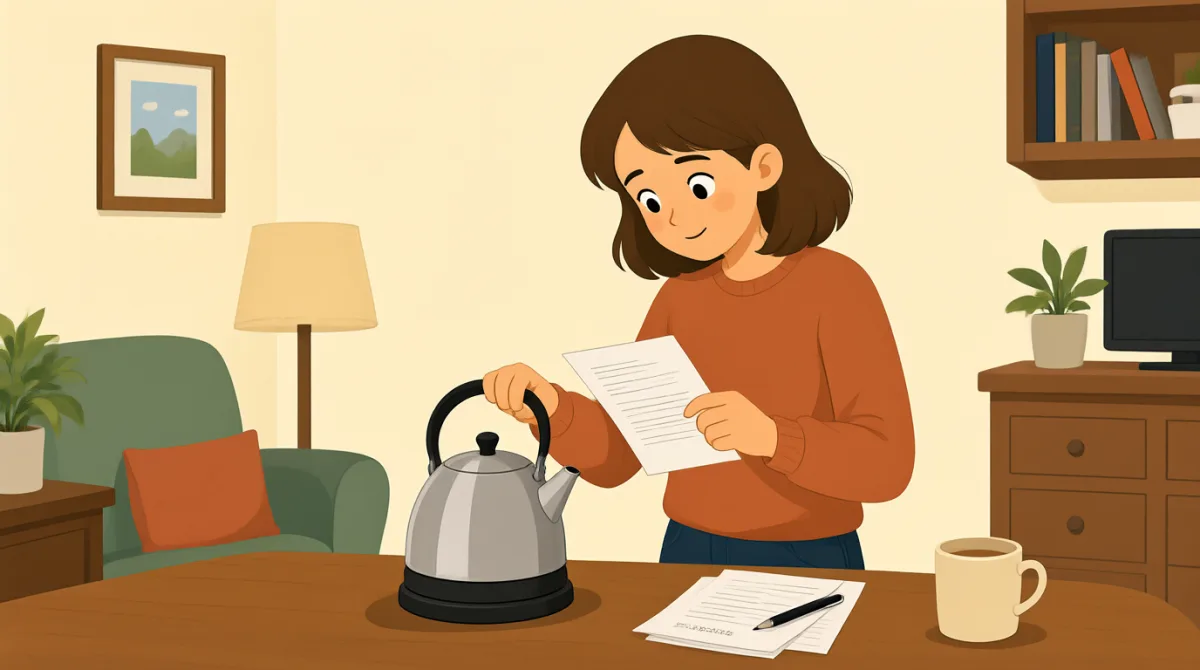

My kettle stopped heating this morning. It was working fine last night.
Esta mañana mi hervidor dejó de calentar. Anoche funcionaba perfectamente.

Oh no. How long have you had it?
Vaya. ¿Cuánto tiempo hace que lo tienes?
A few months. I think it still has a warranty.
Unos meses. Creo que todavía tiene garantía.
Did you check the warranty papers? They should say what to do.
¿Revisaste los documentos de la garantía? Ahí debería decirte qué hacer.
I did. It says the warranty covers problems with the kettle.
Sí. Dice que la garantía cubre los problemas del hervidor.
Good. Does it tell you where to call or take it?
Bien. ¿Te dice dónde llamar o adónde llevarlo?
It says to call customer service before I bring it to the store.
Dice que llame al servicio de atención al cliente antes de llevarlo a la tienda.
Then call them today. Keep your receipt and warranty papers nearby.
Entonces llámalos hoy. Ten a mano el recibo y los documentos de la garantía.
I will. I hope they can fix it for free.
Lo haré. Espero que puedan arreglarlo gratis.
Vocabulario8
- stopped heatingdejó de calentar
This means the kettle no longer gets hot. Use “stopped” plus an -ing verb to say that something no longer does an action.
Significa que el hervidor ya no se calienta. En inglés, usa “stopped” más un verbo terminado en -ing para decir que algo ya no realiza una acción.
- a few monthsunos meses
This means several months, but not a long time. You can use it to say how long you have had something.
Significa varios meses, pero no mucho tiempo. Puedes usar esta expresión para decir cuánto tiempo hace que tienes algo.
- warranty papersdocumentos de la garantía
These are documents that explain what the warranty covers and what to do if a product has a problem.
Son documentos que explican qué cubre la garantía y qué hacer si un producto tiene algún problema.
- covers problemscubre los problemas
This means the warranty includes certain problems and may help pay to fix them. You can use “covers” to ask what protection a warranty provides.
Significa que la garantía incluye ciertos problemas y puede ayudar a pagar su reparación. Puedes usar “covers” para preguntar qué protección ofrece una garantía.
- customer serviceservicio de atención al cliente
This is the team you contact when you need help with a product or service. You can call customer service to ask what to do.
Es el equipo al que contactas cuando necesitas ayuda con un producto o servicio. Puedes llamar al servicio de atención al cliente para preguntar qué hacer.
- bring it to the storellevarlo a la tienda
This means to take the kettle to the store. Use “bring it to” when explaining where you need to take something.
Significa llevar el hervidor a la tienda. En inglés, usa “bring it to” para explicar adónde tienes que llevar algo.
- keep your receiptguardar el recibo
This means to save your proof of purchase. You may need it when returning or getting help with a product.
Significa conservar el comprobante de compra. Es posible que lo necesites para devolver un producto o recibir ayuda con él.
- for freegratis
This means without paying any money. You can use it to ask whether a repair or service has no cost.
Significa sin pagar nada. Puedes usar esta expresión para preguntar si una reparación o un servicio no tiene costo.
Frases clave7
- 1
My kettle stopped heating this morning.
Esta mañana mi hervidor dejó de calentar.
Use this sentence to explain a problem with an appliance. You can replace “kettle” and “heating” with another item and problem.
Usa esta oración para explicar un problema con un electrodoméstico. Puedes sustituir “kettle” y “heating” por otro artículo y problema.
- 2
How long have you had it?
¿Cuánto tiempo hace que lo tienes?
This is a useful way to ask how long someone has owned or used something. Use “How long have you had” with an item.
Es una forma útil de preguntar cuánto tiempo hace que alguien tiene o usa algo. En inglés, usa “How long have you had” seguido del objeto.
- 3
I think it still has a warranty.
Creo que todavía tiene garantía.
Use this sentence when you believe a product may still be covered by a warranty. Replace “it” with the product you are talking about.
Usa esta oración cuando creas que un producto todavía podría estar cubierto por una garantía. Sustituye “it” por el producto del que estás hablando.
- 4
Did you check the warranty papers?
¿Revisaste los documentos de la garantía?
This is a simple way to ask whether someone looked at the warranty information. You can replace “warranty papers” with another document.
Es una forma sencilla de preguntar si alguien consultó la información de la garantía. Puedes sustituir “warranty papers” por otro documento.
- 5
It says to call customer service before I bring it to the store.
Dice que llame al servicio de atención al cliente antes de llevarlo a la tienda.
Use this to explain instructions you found in a document. You can change the actions and destination to match the instructions.
Usa esta oración para explicar instrucciones que encontraste en un documento. Puedes cambiar las acciones y el destino para que coincidan con las instrucciones.
- 6
Keep your receipt and warranty papers nearby.
Ten a mano el recibo y los documentos de la garantía.
This is a helpful instruction to save important documents where you can find them. Replace the documents with anything someone may need for a call or visit.
Esta es una instrucción útil para guardar documentos importantes en un lugar donde puedas encontrarlos. Sustituye los documentos por cualquier cosa que alguien pueda necesitar para una llamada o una visita.
- 7
I hope they can fix it for free.
Espero que puedan arreglarlo gratis.
Use this sentence to express hope that someone will repair something at no cost. Replace “they” and “it” with the people and item you mean.
Usa esta oración para expresar que esperas que alguien repare algo sin cobrarte. Sustituye “they” y “it” por las personas y el objeto a los que te refieres.