Asking What’s in Season
Nachfragen, was gerade Saison hat
Emma asks David, a local farmer, which fruits and vegetables are fresh and in season. He recommends a few choices for her meals.
Emma fragt David, einen Bauern aus der Gegend, welches Obst und Gemüse frisch ist und gerade Saison hat. Er empfiehlt ihr ein paar Zutaten für ihre Mahlzeiten.
Dialog7
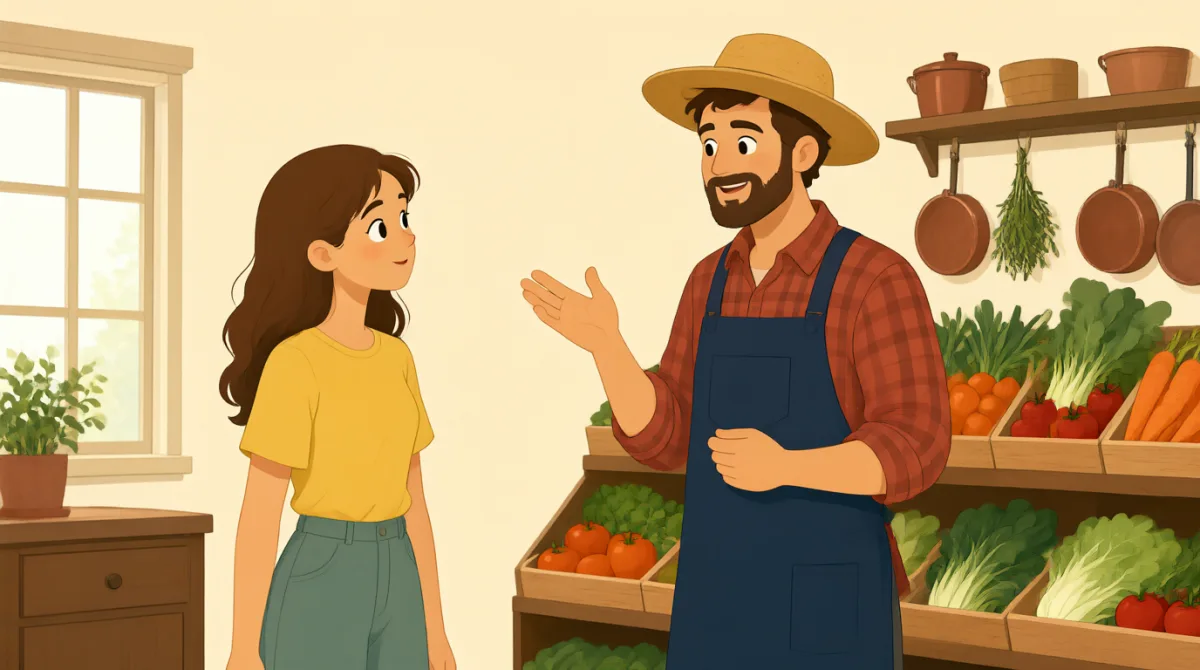

Hi, David. What fruits and vegetables are fresh and in season today?
Hallo, David. Welches Obst und Gemüse ist heute frisch und hat gerade Saison?

The strawberries are sweet, and the peas came in this morning.
Die Erdbeeren sind süß, und die Erbsen sind heute Morgen angekommen.
Those sound good. Are the tomatoes ready to eat now?
Das klingt gut. Sind die Tomaten schon reif?
Yes, they’re ripe. You can take some home for a salad.
Ja, sie sind reif. Du kannst welche für einen Salat mit nach Hause nehmen.
Great. What would you recommend for a simple dinner tonight?
Toll. Was würdest du für ein einfaches Abendessen heute empfehlen?
Try the peas with fresh potatoes. They’re both local and easy to cook.
Probier die Erbsen mit frischen Kartoffeln. Beides kommt aus der Gegend und ist einfach zuzubereiten.
Thanks! I’ll get some potatoes and strawberries, too.
Danke! Ich nehme auch ein paar Kartoffeln und Erdbeeren.
Wortschatz8
- in seasonin season
This describes fruits or vegetables that are growing and ready to eat at a certain time of year.
Damit beschreibt man Obst oder Gemüse, das zu einer bestimmten Jahreszeit wächst und reif zum Essen ist.
- came incame in
Here, this means the peas arrived at the market today. You can use it to talk about new products arriving.
Hier bedeutet das, dass die Erbsen heute auf dem Markt angekommen sind. Du kannst den Ausdruck verwenden, wenn neue Waren eintreffen.
- riperipe
Ripe means ready to eat. You can use it to ask or say whether fruit is ready.
„Ripe“ bedeutet, dass etwas reif und bereit zum Essen ist. Du kannst damit fragen oder sagen, ob Obst schon reif ist.
- take some hometake some home
This means to buy or get some and bring it home. Use it when talking about food you want to bring with you.
Das bedeutet, etwas zu kaufen oder mitzunehmen und nach Hause zu bringen. Verwende den Ausdruck, wenn du über Lebensmittel sprichst, die du mitnehmen möchtest.
- recommendrecommend
To recommend something is to suggest it because you think it is a good choice. You can ask, “What would you recommend?” when you want advice.
„To recommend“ bedeutet, etwas vorzuschlagen, weil du es für eine gute Wahl hältst. Wenn du um einen Rat bitten möchtest, kannst du fragen: “What would you recommend?” (Was würden Sie empfehlen?)
- simple dinnersimple dinner
A simple dinner is an easy meal to prepare. You can use this phrase when asking for an easy meal idea.
Ein „simple dinner“ ist eine einfache Mahlzeit, die sich leicht zubereiten lässt. Mit diesem Ausdruck kannst du nach einer unkomplizierten Essensidee fragen.
- locallocal
Local means from the area nearby. You can ask whether food is local to learn where it comes from.
„Local“ bedeutet, dass etwas aus der näheren Umgebung stammt. Du kannst fragen, ob Lebensmittel aus der Gegend kommen, um herauszufinden, woher sie stammen.
- easy to cookeasy to cook
This describes food that does not take much effort to prepare. Use it when talking about convenient meals.
Damit beschreibt man Lebensmittel, die sich ohne großen Aufwand zubereiten lassen. Verwende den Ausdruck, wenn du über unkomplizierte Mahlzeiten sprichst.
Wichtige Sätze8
- 1
What fruits and vegetables are fresh and in season today?
Welches Obst und Gemüse ist heute frisch und hat gerade Saison?
Use this question at a market to ask what produce is fresh now. You can replace “fruits and vegetables” with a specific type of food.
Mit dieser Frage kannst du auf einem Markt fragen, welche Produkte gerade frisch sind. Du kannst “fruits and vegetables” durch eine bestimmte Lebensmittelart ersetzen.
- 2
The strawberries are sweet, and the peas came in this morning.
Die Erdbeeren sind süß, und die Erbsen sind heute Morgen angekommen.
This sentence describes the taste of one food and when another arrived. Use the pattern to share details about fresh products.
Dieser Satz beschreibt den Geschmack eines Lebensmittels und wann ein anderes angekommen ist. Mit diesem Satzmuster kannst du Einzelheiten über frische Produkte mitteilen.
- 3
Are the tomatoes ready to eat now?
Sind die Tomaten schon reif?
Use this question to check whether produce is ripe and ready. You can replace “the tomatoes” with another fruit or vegetable.
Mit dieser Frage kannst du überprüfen, ob Obst oder Gemüse reif und verzehrfertig ist. Du kannst “the tomatoes” durch ein anderes Obst oder Gemüse ersetzen.
- 4
You can take some home for a salad.
Du kannst welche für einen Salat mit nach Hause nehmen.
This is a helpful suggestion about how to use food. You can replace “for a salad” with another meal or dish.
Das ist ein hilfreicher Vorschlag, wie man ein Lebensmittel verwenden kann. Du kannst “for a salad” durch eine andere Mahlzeit oder ein anderes Gericht ersetzen.
- 5
What would you recommend for a simple dinner tonight?
Was würden Sie für ein einfaches Abendessen heute empfehlen?
Use this polite question when you want a meal suggestion. You can change “a simple dinner tonight” to another meal or occasion.
Mit dieser höflichen Frage kannst du nach einem Essensvorschlag fragen. Du kannst “a simple dinner tonight” durch eine andere Mahlzeit oder einen anderen Anlass ersetzen.
- 6
Try the peas with fresh potatoes.
Probier die Erbsen mit frischen Kartoffeln.
This is a simple way to suggest two foods that go well together. You can replace the foods with other ingredients.
So kannst du ganz einfach zwei Lebensmittel vorschlagen, die gut zusammenpassen. Du kannst die Lebensmittel durch andere Zutaten ersetzen.
- 7
They’re both local and easy to cook.
Beides kommt aus der Gegend und ist einfach zuzubereiten.
This sentence gives two reasons to choose the foods. Use “They’re both…” to describe two things with shared qualities.
In diesem Satz werden zwei Gründe genannt, warum man die Lebensmittel auswählen sollte. Mit “They’re both…” kannst du zwei Dinge beschreiben, die dieselben Eigenschaften haben.
- 8
I’ll get some potatoes and strawberries, too.
Ich nehme auch ein paar Kartoffeln und Erdbeeren.
Use this sentence to say what you have decided to buy. “I’ll get…” is a natural way to choose items while shopping.
Mit diesem Satz kannst du sagen, was du kaufen möchtest. “I’ll get…” ist eine natürliche Art, beim Einkaufen auszuwählen, was du mitnimmst.