Getting the Keys
Die Schlüssel abholen
Emma meets the landlord, David, at her new apartment. She gets the keys and asks when she can move in.
Emma trifft den Vermieter David in ihrer neuen Wohnung. Sie bekommt die Schlüssel und fragt, wann sie einziehen kann.
Dialog8
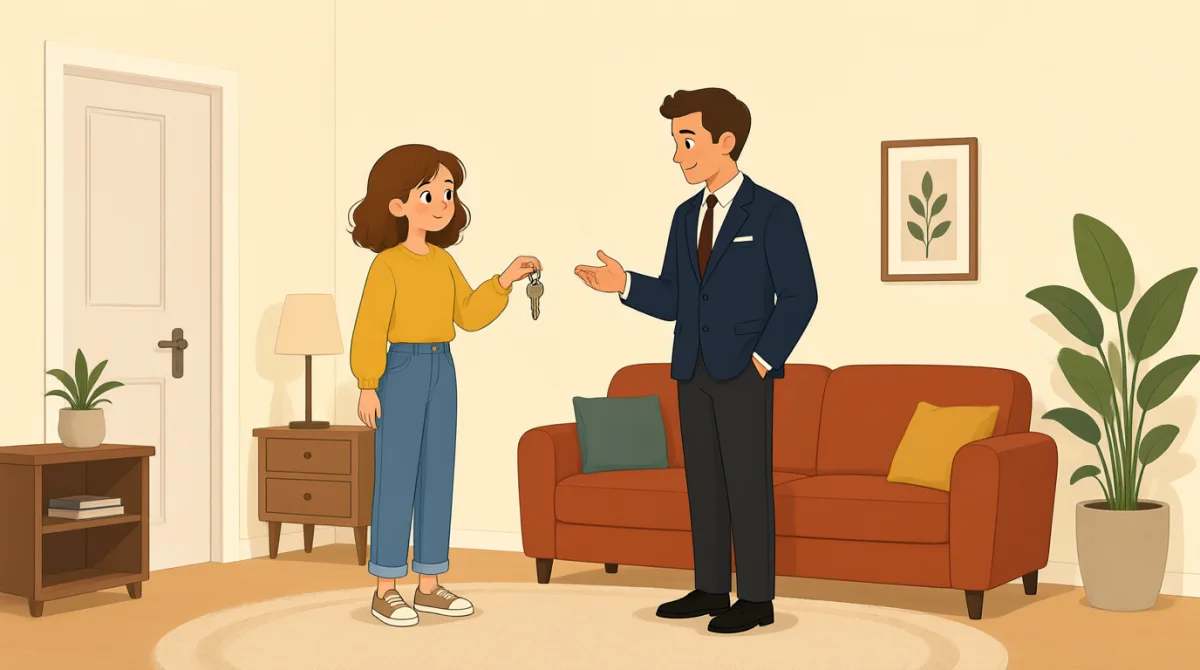

Hi, I’m Emma. I’m here to get the keys for my new apartment.
Hallo, ich bin Emma. Ich bin hier, um die Schlüssel für meine neue Wohnung abzuholen.

Hi, Emma. I’m David, the landlord. Welcome! Here are your keys.
Hallo, Emma. Ich bin David, der Vermieter. Willkommen! Hier sind Ihre Schlüssel.
Thanks! Which key is for the front door?
Danke! Welcher Schlüssel ist für die Haustür?
This one is for the front door. The small one is for your apartment.
Dieser hier ist für die Haustür. Der kleine ist für Ihre Wohnung.
Great. When can I move in? Can I move in today?
Super. Wann kann ich einziehen? Kann ich heute einziehen?
Yes, you can move in today. The apartment is ready for you.
Ja, Sie können heute einziehen. Die Wohnung ist bezugsfertig.
That’s great! Is there anything I need to do first?
Das ist toll! Gibt es noch etwas, das ich vorher erledigen muss?
Just keep these keys safe. Call me if you have any questions.
Passen Sie einfach gut auf diese Schlüssel auf. Rufen Sie mich an, wenn Sie Fragen haben.
Wortschatz7
- get the keysdie Schlüssel abholen
To receive the keys to a home or apartment. You can use this phrase when you arrive at a new place.
Die Schlüssel für ein Haus oder eine Wohnung entgegennehmen. Diese Wendung kannst du verwenden, wenn du an einem neuen Wohnort ankommst.
- landlordder Vermieter
The person who owns a home or apartment and rents it to someone.
Die Person, der ein Haus oder eine Wohnung gehört und die es an jemand anderen vermietet.
- front doordie Haustür
The main door at the entrance of a home or building.
Die Haupttür am Eingang eines Hauses oder Gebäudes.
- move ineinziehen
To start living in a new home. You can ask, “When can I move in?”
In einem neuen Zuhause zu wohnen anfangen. Du kannst fragen: “When can I move in?” (Wann kann ich einziehen?)
- ready for youbezugsfertig
Prepared for you to use or enjoy. Here, it means the apartment is ready for Emma to live in.
So vorbereitet, dass du etwas benutzen oder genießen kannst. Hier bedeutet es, dass Emma in der Wohnung wohnen kann.
- keep these keys safegut auf diese Schlüssel aufpassen
To take care not to lose or damage the keys. Use this phrase when reminding someone to look after something important.
Darauf achten, die Schlüssel nicht zu verlieren oder zu beschädigen. Mit dieser Wendung kannst du jemanden daran erinnern, auf etwas Wichtiges aufzupassen.
- if you have any questionswenn du Fragen hast
A polite way to offer help. You can use it to invite someone to ask for more information.
Eine höfliche Art, Hilfe anzubieten. Damit kannst du jemanden dazu einladen, nach weiteren Informationen zu fragen.
Wichtige Sätze7
- 1
I’m here to get the keys for my new apartment.
Ich bin hier, um die Schlüssel für meine neue Wohnung abzuholen.
This is a useful way to explain why you have come somewhere. You can change “the keys” to another item or service you need.
So kannst du erklären, warum du irgendwohergekommen bist. Du kannst “the keys” durch einen anderen Gegenstand oder eine Dienstleistung ersetzen, die du brauchst.
- 2
I’m David, the landlord.
Ich bin David, der Vermieter.
This sentence introduces someone and explains their role. You can replace “the landlord” with another job or relationship.
Mit diesem Satz stellst du jemanden vor und erklärst, welche Rolle die Person hat. Du kannst “the landlord” durch einen anderen Beruf oder eine andere Beziehung ersetzen.
- 3
Which key is for the front door?
Welcher Schlüssel ist für die Haustür?
Use this question when you need to identify a key. You can replace “the front door” with another door or lock.
Verwende diese Frage, wenn du herausfinden möchtest, welcher Schlüssel der richtige ist. Du kannst “the front door” durch eine andere Tür oder ein anderes Schloss ersetzen.
- 4
When can I move in?
Wann kann ich einziehen?
This is a simple way to ask when you can start living in a new home. You can use “When can I…” to ask about the right time to do something.
So kannst du einfach fragen, wann du anfangen kannst, in einem neuen Zuhause zu wohnen. Mit “When can I…” kannst du nach dem richtigen Zeitpunkt für etwas fragen.
- 5
Can I move in today?
Kann ich heute einziehen?
Use this question to ask if something is possible today. Replace “move in” with another activity, such as “pick it up.”
Verwende diese Frage, um zu fragen, ob etwas heute möglich ist. Ersetze “move in” durch eine andere Tätigkeit, zum Beispiel “pick it up.”
- 6
Is there anything I need to do first?
Gibt es noch etwas, das ich vorher erledigen muss?
This is a useful question when you want to know if there are any steps to take before you begin. You can use it in many everyday situations.
Diese Frage ist nützlich, wenn du wissen möchtest, ob du vor dem Anfang noch etwas erledigen musst. Du kannst sie in vielen Alltagssituationen verwenden.
- 7
Call me if you have any questions.
Rufen Sie mich an, wenn Sie Fragen haben.
This is a friendly way to offer help and tell someone how to contact you. You can replace “Call me” with “Text me” or “Email me.”
So kannst du freundlich Hilfe anbieten und jemandem sagen, wie die Person dich erreichen kann. Du kannst “Call me” durch “Text me” oder “Email me” ersetzen.