Unpacking With a Friend
Auspacken mit einem Freund
Emma's friend Leo helps her unpack in the new apartment. They sort the boxes and decide where to put a few things.
Emmas Freund Leo hilft ihr, in der neuen Wohnung auszupacken. Sie sortieren die Kartons und entscheiden, wo ein paar Dinge hinkommen.
Dialog8
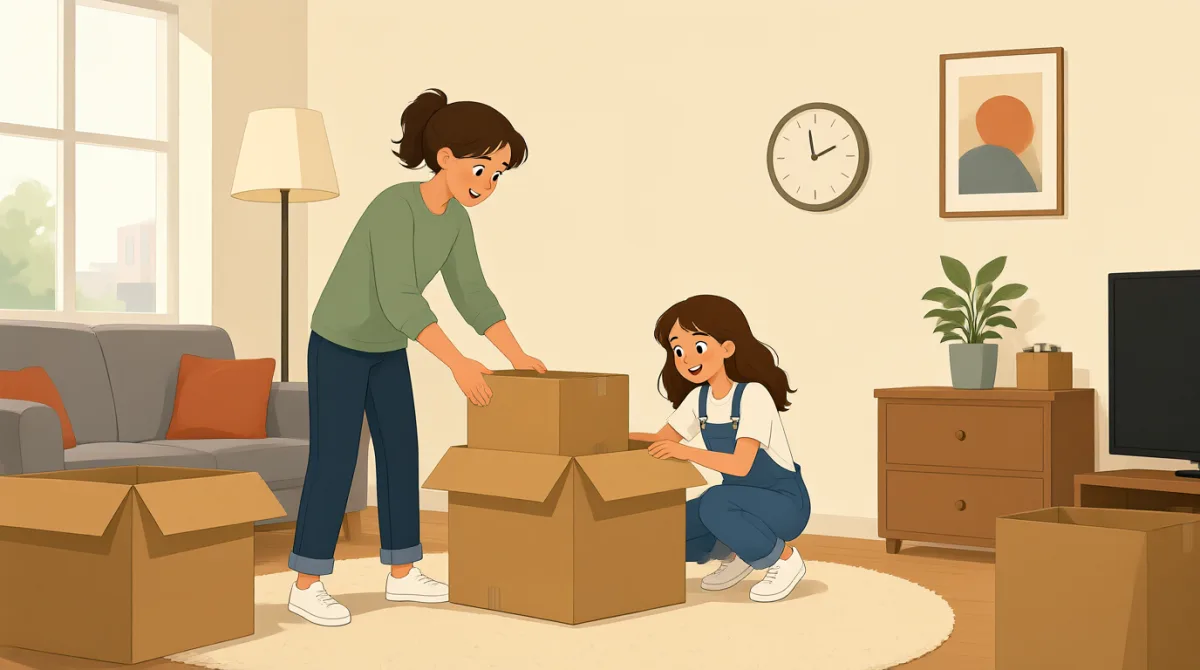

Thanks for helping me unpack, Leo. Let’s put the boxes in the living room.
Danke, dass du mir beim Auspacken hilfst, Leo. Lass uns die Kartons ins Wohnzimmer stellen.

Sure! This one says “kitchen.” Should I take it over there?
Klar! Auf diesem hier steht „Küche“. Soll ich ihn dort rüberbringen?
Yes, please. The plates and cups are in that box.
Ja, bitte. Die Teller und Tassen sind in dem Karton da.
Where do you want the small table? By the window or near the sofa?
Wo soll der kleine Tisch hin? Ans Fenster oder neben das Sofa?
By the window, please. I can put a plant on it later.
Bitte ans Fenster. Später kann ich eine Pflanze daraufstellen.
Good idea. This lamp can go next to the sofa. Is there an outlet there?
Gute Idee. Diese Lampe kann neben das Sofa. Gibt es dort eine Steckdose?
Yes, there is. Let’s open the big box and find the blankets.
Ja, gibt es. Lass uns den großen Karton aufmachen und die Decken suchen.
Here they are! We can make the bed after we finish these boxes.
Hier sind sie! Wir können das Bett machen, wenn wir mit diesen Kartons fertig sind.
Wortschatz8
- unpackauspacken
To take things out of boxes after you move. You can unpack your kitchen things first.
Dinge aus Kartons nehmen, nachdem du umgezogen bist. Du kannst zum Beispiel zuerst deine Küchensachen auspacken.
- put the boxesdie Kartons hinstellen
To place the boxes somewhere. You can say, “Let’s put the boxes in the living room.”
Die Kartons irgendwo abstellen. Du kannst sagen: „Let’s put the boxes in the living room.“ (Stellen wir die Kartons ins Wohnzimmer.)
- take it over therees dort rüberbringen
To carry something to another place. Use “take it” to refer to one thing you have already mentioned.
Etwas an einen anderen Ort tragen. Mit „take it“ beziehst du dich auf eine Sache, die du bereits erwähnt hast.
- by the windowans Fenster
Next to the window. Use “by” to say where you want to put furniture or other things.
Neben dem Fenster. Mit „by“ sagst du, wo ein Möbelstück oder etwas anderes stehen soll.
- next to the sofaneben dem Sofa
Beside the sofa. This phrase helps you describe where something should go.
Direkt neben dem Sofa. Mit dieser Wendung kannst du beschreiben, wohin etwas soll.
- outletSteckdose
A place in the wall where you plug in a lamp or another electrical item.
Eine Stelle in der Wand, an der du eine Lampe oder ein anderes elektrisches Gerät anschließt.
- open the big boxden großen Karton aufmachen
To remove or lift the top of the large box. You can use this phrase when you are ready to look inside.
Den Deckel des großen Kartons abnehmen oder hochheben. Diese Wendung passt, wenn du hineinschauen möchtest.
- make the beddas Bett machen
To arrange the blankets and sheets on the bed. People often make the bed after they finish unpacking.
Die Decken und Laken auf dem Bett ordentlich hinlegen. Viele machen das Bett, wenn sie mit dem Auspacken fertig sind.
Wichtige Sätze8
- 1
Thanks for helping me unpack, Leo.
Danke, dass du mir beim Auspacken hilfst, Leo.
Use this sentence to thank someone for helping you. You can replace “unpack” with another activity, such as “move” or “clean.”
Mit diesem Satz bedankst du dich dafür, dass dir jemand hilft. Du kannst „unpack“ durch eine andere Tätigkeit ersetzen, zum Beispiel „move“ oder „clean“.
- 2
Let’s put the boxes in the living room.
Let’s put the boxes in the living room.
Use “Let’s” to suggest doing something together. You can change the place to give a different direction.
Mit „Let’s“ schlägst du vor, etwas gemeinsam zu tun. Du kannst den Ort ändern, um eine andere Richtung anzugeben.
- 3
Should I take it over there?
Should I take it over there?
Ask this when you want to check whether someone wants you to carry something to a place. Replace “it” with the item you mean.
Mit dieser Frage findest du heraus, ob jemand möchte, dass du etwas an einen bestimmten Ort trägst. Ersetze „it“ durch den Gegenstand, den du meinst.
- 4
Where do you want the small table?
Where do you want the small table?
Use this question to ask where someone wants an item placed. You can replace “the small table” with another object.
Mit dieser Frage erkundigst du dich, wo jemand einen Gegenstand hinstellen möchte. Du kannst „the small table“ durch einen anderen Gegenstand ersetzen.
- 5
By the window, please.
By the window, please.
This is a polite, simple way to say where you want something. Replace “by the window” with another place.
So sagst du höflich und einfach, wo etwas stehen soll. Ersetze „by the window“ durch einen anderen Ort.
- 6
Is there an outlet there?
Is there an outlet there?
Use this question to check if a place has an electrical outlet. You can replace “an outlet” with another thing you need.
Mit dieser Frage prüfst du, ob es an einem Ort eine Steckdose gibt. Du kannst „an outlet“ durch etwas anderes ersetzen, das du brauchst.
- 7
Let’s open the big box and find the blankets.
Let’s open the big box and find the blankets.
Use “Let’s” to suggest doing two things together. You can name other items or boxes in the same way.
Mit „Let’s“ schlägst du vor, zwei Dinge gemeinsam zu tun. Du kannst auf dieselbe Weise andere Gegenstände oder Kartons nennen.
- 8
We can make the bed after we finish these boxes.
We can make the bed after we finish these boxes.
This sentence explains what you can do after another task is finished. Use “after we finish” to talk about a later activity.
Dieser Satz sagt, was du tun kannst, wenn eine andere Aufgabe erledigt ist. Mit „after we finish“ sprichst du über etwas, das später passiert.