Rain in the Night
Regen in der Nacht
Rain wakes Emma and Jack during the night, and they check that their things are dry. In the morning, they make a plan for the wet weather.
Regen weckt Emma und Jack mitten in der Nacht. Sie prüfen, ob ihre Sachen trocken sind. Am Morgen überlegen sie, was sie bei dem nassen Wetter machen können.
Dialog8
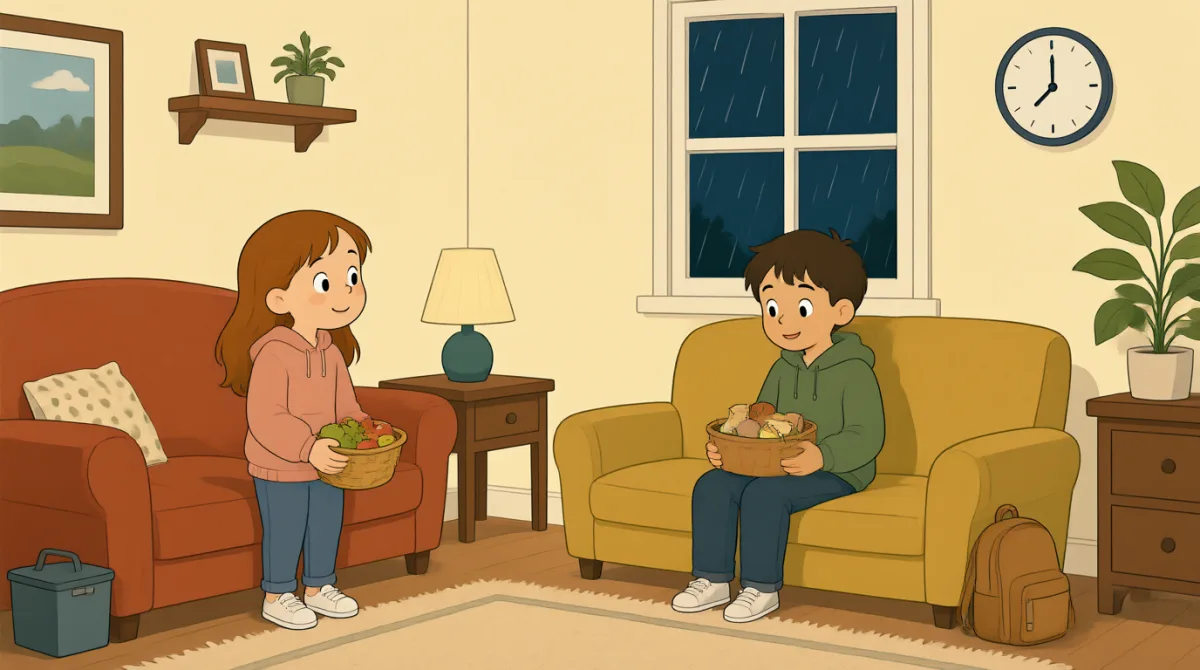

Jack, wake up! I hear rain hitting the tent. Is everything getting wet?
Jack, wach auf! Ich höre, wie der Regen aufs Zelt prasselt. Wird alles nass?

I’m awake. The tent feels dry inside. Let’s check our bags and food.
Ich bin wach. Innen fühlt sich das Zelt trocken an. Lass uns unsere Taschen und das Essen überprüfen.
My clothes are dry, but one corner of the tent is a little damp.
Meine Sachen sind trocken, aber eine Ecke vom Zelt ist ein bisschen feucht.
Move your bag away from that corner. I’ll put a towel on the floor.
Stell deine Tasche weiter weg von der Ecke. Ich leg ein Handtuch auf den Boden.
Good idea. The rain is still coming down hard. What should we do tomorrow?
Gute Idee. Es regnet immer noch in Strömen. Was sollen wir morgen machen?
Let’s check the weather in the morning. We can take a short walk if it stops.
Lass uns morgen früh den Wetterbericht checken. Wenn es aufhört, können wir einen kurzen Spaziergang machen.
And if it keeps raining, we can stay here and play cards.
Und wenn es weiterregnet, können wir hierbleiben und Karten spielen.
That works. Keep your shoes by the door, and we’ll see what morning brings.
Klingt gut. Stell deine Schuhe neben die Tür, dann schauen wir morgen früh, wie das Wetter ist.
Wortschatz7
- wake upaufwachen
To stop sleeping. Emma uses it to get Jack’s attention.
Nicht mehr schlafen. Emma sagt das, um Jacks Aufmerksamkeit zu bekommen.
- getting wetnass werden
Becoming covered with water. You can use this phrase to ask if rain is making your things wet.
Mit Wasser bedeckt werden. Mit diesem Ausdruck kannst du fragen, ob der Regen deine Sachen nass macht.
- dampfeucht
A little wet, but not completely soaked. You can use it to describe clothes, a tent, or a floor.
Ein bisschen nass, aber nicht völlig durchnässt. Damit kannst du Kleidung, ein Zelt oder einen Boden beschreiben.
- move your bag awaydeine Tasche weiter wegstellen
Put your bag in a different place, farther from something. Use this phrase to tell someone how to keep an item safe or dry.
Stell deine Tasche an einen anderen Platz, weiter weg von etwas. Mit diesem Ausdruck kannst du jemandem sagen, wie er einen Gegenstand schützen oder trocken halten kann.
- coming down hardin Strömen regnen
Raining heavily. You can use this phrase to describe strong rain.
Heftig regnen. Mit diesem Ausdruck kannst du starken Regen beschreiben.
- keeps rainingweiterregnen
Continues to rain. Use it to talk about rain that does not stop.
Nicht aufhören zu regnen. Damit kannst du über Regen sprechen, der einfach nicht aufhört.
- by the doorneben der Tür
Next to the door. You can use this phrase to say where to put or keep something.
Direkt neben der Tür. Mit diesem Ausdruck kannst du sagen, wo etwas hingestellt oder aufbewahrt werden soll.
Wichtige Sätze7
- 1
Is everything getting wet?
Wird alles nass?
This is a simple way to check if things are becoming wet. You can replace “everything” with “your clothes” or “the bags.”
So kannst du einfach fragen, ob Sachen nass werden. Statt „everything“ kannst du auch „your clothes“ oder „the bags“ sagen.
- 2
The tent feels dry inside.
Innen fühlt sich das Zelt trocken an.
Use this sentence to describe how a place feels. You can replace “the tent” with “the room” or “the car.”
Mit diesem Satz beschreibst du, wie sich ein Ort anfühlt. Statt „the tent“ kannst du auch „the room“ oder „the car“ sagen.
- 3
Move your bag away from that corner.
Stell deine Tasche weiter weg von der Ecke.
This gives a clear instruction to move something farther from a place. You can replace “your bag” and “that corner” with other items and locations.
Damit sagst du klar, dass etwas weiter von einem Ort entfernt werden soll. „Your bag“ und „that corner“ kannst du durch andere Gegenstände und Orte ersetzen.
- 4
What should we do tomorrow?
Was sollen wir morgen machen?
This is a useful way to ask for ideas or advice about a future plan. You can change “tomorrow” to another time.
So kannst du nach Ideen oder Ratschlägen für einen zukünftigen Plan fragen. Du kannst „tomorrow“ durch einen anderen Zeitpunkt ersetzen.
- 5
We can take a short walk if it stops.
Wenn es aufhört, können wir einen kurzen Spaziergang machen.
This suggests a possible plan with a condition. Use “if” to say what needs to happen first.
Damit schlägst du einen möglichen Plan vor, der von einer Bedingung abhängt. Mit „if“ sagst du, was zuerst passieren muss.
- 6
And if it keeps raining, we can stay here and play cards.
Und wenn es weiterregnet, können wir hierbleiben und Karten spielen.
This sentence offers a backup plan if the weather does not improve. You can use the same pattern to make plans for other situations.
Dieser Satz bietet einen Ausweichplan an, falls das Wetter nicht besser wird. Mit demselben Muster kannst du auch Pläne für andere Situationen machen.
- 7
Keep your shoes by the door, and we’ll see what morning brings.
Stell deine Schuhe neben die Tür, und dann schauen wir, was der Morgen bringt.
This gives a practical instruction and says you will decide later. “We’ll see what morning brings” means you will wait and find out what happens.
Damit gibst du eine praktische Anweisung und sagst, dass ihr später entscheidet. „We’ll see what morning brings“ bedeutet, dass ihr abwartet und herausfindet, was passiert.