Asking How to Take It
詢問服用方法
Emma asks Jack when and how often to take the medicine, and whether she should take it with food. Jack gives clear instructions and explains why it is important to follow them.
Emma 詢問 Jack 應該何時服藥、每天服用幾次,以及是否需要隨餐服用。Jack 清楚地說明了服用方法,並解釋遵照醫囑的重要性。
對話9
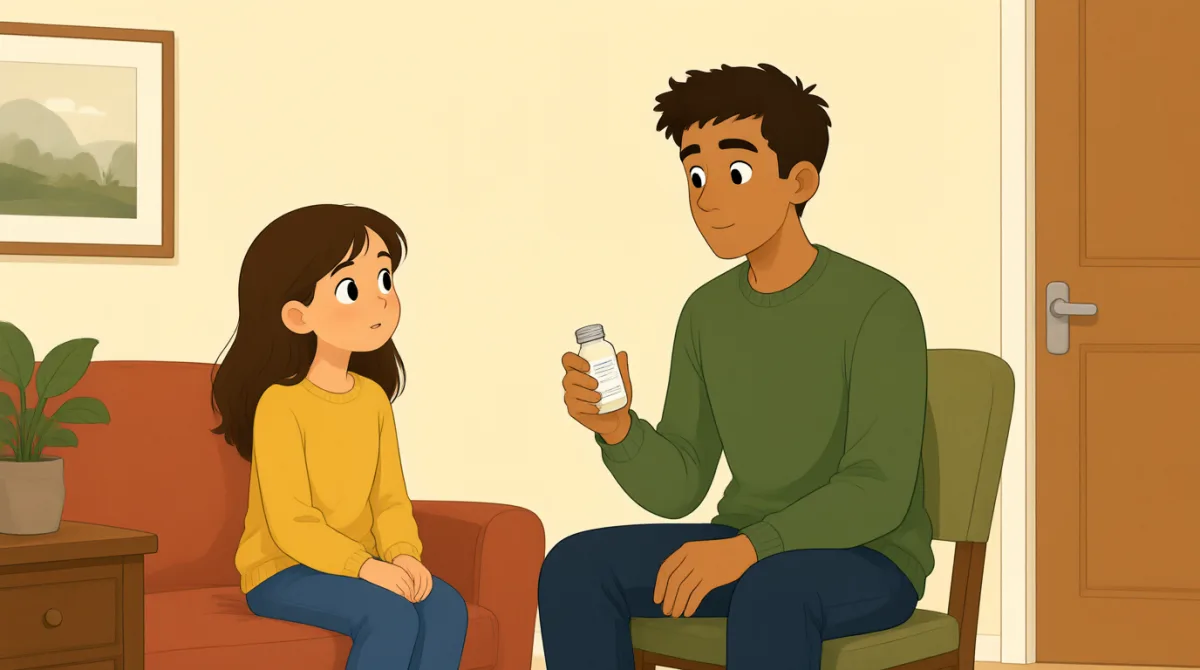

I picked up my prescription earlier, but I want to make sure I understand the directions. When should I take it?
我剛才取了處方藥,但想確認一下自己是否理解了用藥說明。我應該什麼時候服用?

Take one tablet twice a day, about twelve hours apart. Try to take it at roughly the same times each day.
每天服用兩次,每次一片,兩次之間大約間隔十二小時。儘量每天在差不多相同的時間服用。
Should I take it with food, or does that not matter? I usually skip breakfast when I’m rushing to work.
我應該隨餐服用嗎?還是無所謂?我趕著去上班時通常不吃早飯。
It’s best to take it with food or a glass of milk. That can help prevent stomach irritation, so don’t take it on an empty stomach.
最好隨餐服用,或者配一杯牛奶。這有助於減少胃部刺激,所以不要空腹服用。
Got it. If I forget a dose, should I take two tablets next time to catch up?
明白了。如果我忘了服藥,下次應該吃兩片補上嗎?
No, don’t double up. Take the missed dose when you remember, unless it’s nearly time for your next one; then skip it.
不,不要加倍服用。想起來時就補服漏掉的一次,除非快到下一次服藥時間了;那就跳過這次。
How long should I keep taking it? I’m feeling better already, so I was wondering if I could stop early.
我應該服用多久?我已經感覺好多了,所以想知道能不能提前停藥。
Finish the full course, even if you feel better. Stopping early can make the infection harder to treat, so follow the label.
即使感覺好些了,也要完成整個療程。提前停藥可能會讓感染更難治療,所以請按藥瓶標籤上的說明服用。
Okay, I’ll set reminders for morning and evening, and take each tablet with food. Thanks for walking me through it.
好的,我會設定早晚提醒,每次隨餐服藥。謝謝你耐心地給我講解。
詞彙7
- directions用藥說明
Instructions for how to take or use a medicine. You can ask someone to explain the directions if they are unclear.
關於如何服用或使用藥物的說明。如果說明不清楚,可以請別人解釋一下。
- twice a day每天兩次
Two times each day. This phrase is often used to describe how frequently to take medicine.
每天兩次。這個短語常用來說明服藥的頻率。
- twelve hours apart間隔十二小時
With twelve hours between one dose and the next. Use “hours apart” to explain the time between repeated actions.
兩次服藥之間相隔十二小時。可以用“hours apart”來說明重複進行某件事的時間間隔。
- on an empty stomach空腹
Without having eaten food. The phrase is often used when explaining whether medicine should be taken before or after a meal.
沒有吃東西。這個短語常用於說明藥物應該在飯前還是飯後服用。
- double up加倍服用
To take twice as much as usual, often to make up for a missed dose. In this dialogue, Jack says not to do this.
服用平時兩倍的量,通常是為了補上漏服的一次。在這段對話中,Jack 說不要這樣做。
- catch up補上;彌補
To make up for something missed or delayed. You can use it to ask whether you should take extra medicine after forgetting a dose.
補上錯過或延誤的事情。忘記服藥後,你可以用這個短語詢問是否應該多服一些藥來補上。
- full course整個療程
The complete period of treatment prescribed for an illness. This phrase is useful when discussing how long to take medicine.
針對某種疾病所開具的完整治療時長。討論需要服藥多久時,這個短語很實用。
關鍵句8
- 1
I picked up my prescription earlier, but I want to make sure I understand the directions.
我剛才取了處方藥,但想確認一下自己是否理解了用藥說明。
Use this to explain why you are asking for help with medication instructions. “I want to make sure I understand…” is also useful when checking any important information.
當你想說明自己為什麼要請人幫忙解釋用藥說明時,可以這樣說。“I want to make sure I understand…”(我想確認自己理解了……)也可以用來核實任何重要資訊。
- 2
Take one tablet twice a day, about twelve hours apart.
每天服用兩次,每次一片,兩次之間大約間隔十二小時。
This gives a clear amount and schedule. The pattern “Take [amount] [how often]” is useful for giving simple instructions.
這句話清楚地說明了用量和服藥時間安排。“Take [amount] [how often]”這個句型適合用來給出簡單的說明。
- 3
Should I take it with food, or does that not matter?
我應該隨餐服用嗎?還是無所謂?
This is a natural way to ask whether food affects how you should take something. You can reuse “Should I take it with…?” for other medication questions.
這是詢問食物是否會影響某種藥物服用方式的自然說法。你也可以把“Should I take it with…?”用在其他用藥問題中。
- 4
That can help prevent stomach irritation, so don’t take it on an empty stomach.
這有助於減少胃部刺激,所以不要空腹服用。
This explains a reason and gives a clear instruction. Use “That can help prevent…” to describe how an action may avoid a problem.
這句話說明了原因,也給出了明確的指示。可以用“That can help prevent…”來說明某種做法可能如何避免問題。
- 5
Take the missed dose when you remember, unless it’s nearly time for your next one; then skip it.
想起來時就補服漏掉的一次,除非快到下一次服藥時間了;那就跳過這次。
This sentence explains what to do after forgetting a dose and includes an exception. The structure “Do X, unless…; then…” is useful for giving conditional instructions.
這句話說明漏服後該怎麼做,並補充了例外情況。“Do X, unless…; then…”這個結構適合用來給出有條件的指示。
- 6
Finish the full course, even if you feel better.
即使感覺好些了,也要完成整個療程。
Use this to tell someone to continue a treatment for the prescribed time. “Even if” introduces something that does not change the advice.
用這句話告訴別人要按規定的時長繼續治療。“Even if”引出的情況不會改變建議。
- 7
Stopping early can make the infection harder to treat, so follow the label.
提前停藥可能會讓感染更難治療,所以請按藥瓶標籤上的說明服用。
This gives a reason for following the instructions. The pattern “X can make [something] harder to…” is useful for explaining possible consequences.
這句話說明了遵照用藥說明的原因。“X can make [something] harder to…”這個句型適合用來解釋可能造成的後果。
- 8
Okay, I’ll set reminders for morning and evening, and take each tablet with food.
好的,我會設定早晚提醒,每次隨餐服藥。
This sentence shows that the speaker understands and will follow the instructions. You can adapt “I’ll set reminders for…” when describing a plan to remember regular tasks.
這句話表示說話者聽懂了,也會遵照說明去做。描述如何提醒自己按時完成日常任務時,可以把“I’ll set reminders for…”改成適合自己的內容。