Talking About a Favorite Painting
Falando sobre uma pintura favorita
After seeing the exhibits, Emma and Jack talk about their favorite painting. They share what they liked about it.
Depois de ver as exposições, Emma e Jack conversam sobre sua pintura favorita. Eles contam o que gostaram nela.
Diálogo8
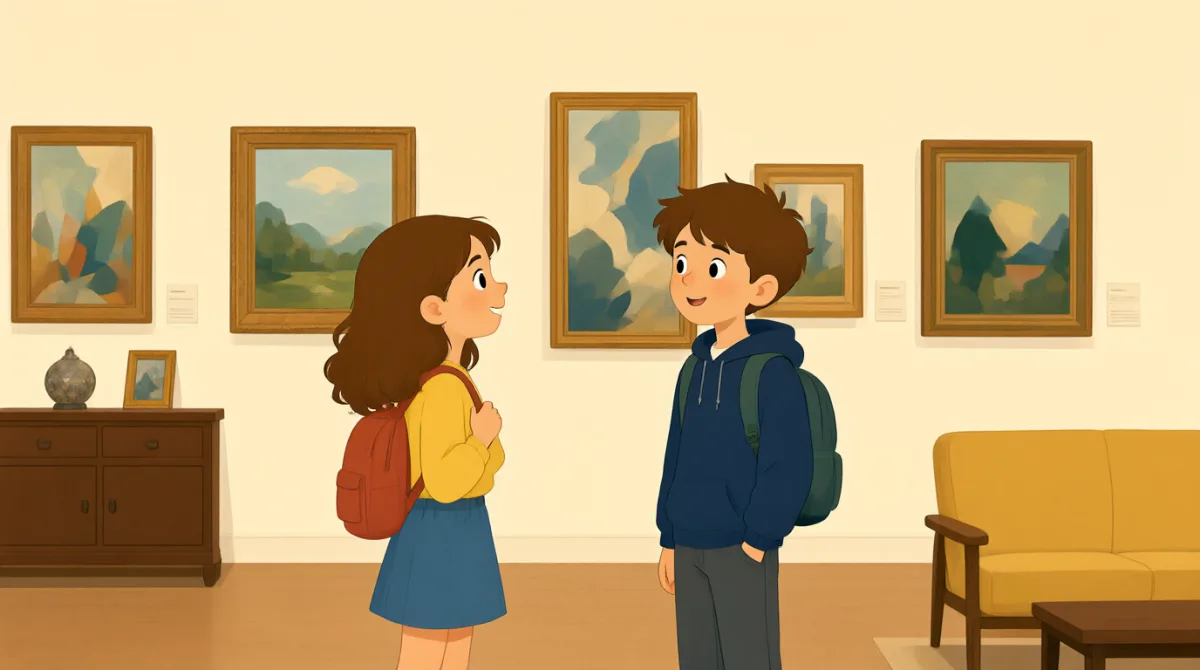

That blue painting was my favorite. The little boat looked so real.
Aquela pintura azul foi a minha favorita. O barquinho parecia tão real.

I liked it too. The colors were bright, but the scene felt peaceful.
Eu também gostei dela. As cores eram vivas, mas a cena transmitia tranquilidade.
Yes, and I noticed the waves near the boat. They looked like they were moving.
Sim, e reparei nas ondas perto do barco. Parecia que estavam se mexendo.
The artist did a great job. I wanted to look at it for a long time.
O artista fez um ótimo trabalho. Eu queria ficar olhando para ela por muito tempo.
Did you see the small house on the hill? I almost missed it.
Você viu a casinha no morro? Quase não reparei nela.
I saw it. It made me wonder who lived there.
Eu vi. Fiquei curioso para saber quem morava lá.
I wish we knew the story behind the painting. Maybe the sign said more.
Quem me dera saber a história por trás da pintura. Talvez a placa desse mais detalhes.
Maybe. We can read about it online later. I took a photo of the sign.
Pode ser. A gente pode pesquisar sobre ela na internet mais tarde. Tirei uma foto da placa.
Vocabulário8
- my favoritea minha favorita
This means the one you like best. Use it to say which painting or other thing you enjoyed most.
Isso significa aquilo de que você mais gosta. Use essa expressão para dizer qual pintura ou outra coisa você mais apreciou.
- looked so realparecia tão real
This means something seemed very lifelike. Use it to describe a picture or object that looks true to life.
Isso significa que algo parecia muito realista. Use essa expressão para descrever uma imagem ou um objeto que parece de verdade.
- felt peacefultransmitia tranquilidade
This means it gave you a calm feeling. Use it to describe a place, picture, or moment.
Isso significa que algo lhe passou uma sensação de calma. Use essa expressão para descrever um lugar, uma imagem ou um momento.
- did a great jobfez um ótimo trabalho
This means someone did something very well. Use it to praise an artist or another person's work.
Isso significa que alguém fez algo muito bem. Use essa expressão para elogiar o trabalho de um artista ou de outra pessoa.
- for a long timepor muito tempo
This means for a long period. Use it to say how long you looked at or did something.
Isso significa durante um período longo. Use essa expressão para dizer por quanto tempo você olhou para algo ou fez alguma coisa.
- almost missed itquase não reparei
This means you nearly did not notice or see something. Use it when a detail is easy to overlook.
Isso significa que você quase não percebeu ou viu algo. Use essa expressão quando um detalhe é fácil de passar despercebido.
- the story behinda história por trás
This means the background or events connected to something. Use it to ask about the meaning or history of a painting.
Isso significa o contexto ou os acontecimentos relacionados a algo. Use essa expressão para perguntar sobre o significado ou a história de uma pintura.
- read about itpesquisar sobre isso
This means to find information about something by reading. Use it when you want to learn more about a place, person, or artwork.
Isso significa buscar informações sobre algo por meio da leitura. Use essa expressão quando quiser saber mais sobre um lugar, uma pessoa ou uma obra de arte.
Frases-chave8
- 1
That blue painting was my favorite.
Aquela pintura azul foi a minha favorita.
Use this sentence to say which artwork you liked best. You can replace “blue painting” with another thing, such as “that sculpture” or “the landscape.”
Use esta frase para dizer de qual obra de arte você mais gostou. Você pode trocar “blue painting” por outra coisa, como “that sculpture” ou “the landscape”.
- 2
The colors were bright, but the scene felt peaceful.
As cores eram vivas, mas a cena transmitia tranquilidade.
This sentence describes two different qualities of a painting. Use “but” to connect a contrast, such as bright colors and a calm feeling.
Esta frase descreve duas características diferentes de uma pintura. Use “but” para ligar ideias contrastantes, como cores vivas e uma sensação de calma.
- 3
I noticed the waves near the boat.
Reparei nas ondas perto do barco.
Use this sentence to point out a detail you saw. Replace “the waves near the boat” with another feature or object.
Use esta frase para chamar a atenção para um detalhe que você viu. Troque “the waves near the boat” por outra característica ou objeto.
- 4
The artist did a great job.
O artista fez um ótimo trabalho.
This is a simple way to praise an artist's work. You can also use it to praise someone who did something well.
Esta é uma maneira simples de elogiar o trabalho de um artista. Você também pode usar essa expressão para elogiar alguém que fez algo bem.
- 5
I almost missed it.
Quase não reparei nisso.
Use this sentence when you nearly failed to see or notice something. It is useful for talking about small or hidden details.
Use esta frase quando você quase não conseguiu ver ou perceber algo. Ela é útil para falar de detalhes pequenos ou escondidos.
- 6
It made me wonder who lived there.
Isso me deixou curioso para saber quem morava lá.
Use this sentence to say that something made you curious. You can change “who lived there” to another question, such as “what happened there.”
Use esta frase para dizer que algo despertou a sua curiosidade. Você pode trocar “who lived there” por outra pergunta, como “what happened there”.
- 7
I wish we knew the story behind the painting.
Quem me dera saber a história por trás da pintura.
Use “I wish we knew” to express that you would like to have information you do not have. You can replace “the story behind the painting” with another unknown detail.
Use “I wish we knew” para expressar que você gostaria de ter uma informação que não tem. Você pode trocar “the story behind the painting” por outro detalhe desconhecido.
- 8
We can read about it online later.
A gente pode pesquisar sobre isso na internet mais tarde.
Use this sentence to suggest finding information on the internet at a later time. Replace “it” with the subject you want to learn about.
Use esta frase para sugerir que vocês procurem informações na internet mais tarde. Troque “it” pelo assunto que você quer conhecer melhor.