Asking About Local Honey
Perguntando sobre o mel local
Mia asks Grace where her honey comes from and how it tastes. She buys a jar after hearing how Grace uses it at home.
Mia pergunta a Grace de onde vem o mel e qual é o sabor. Depois de ouvir como Grace usa o mel em casa, ela compra um pote.
Diálogo9
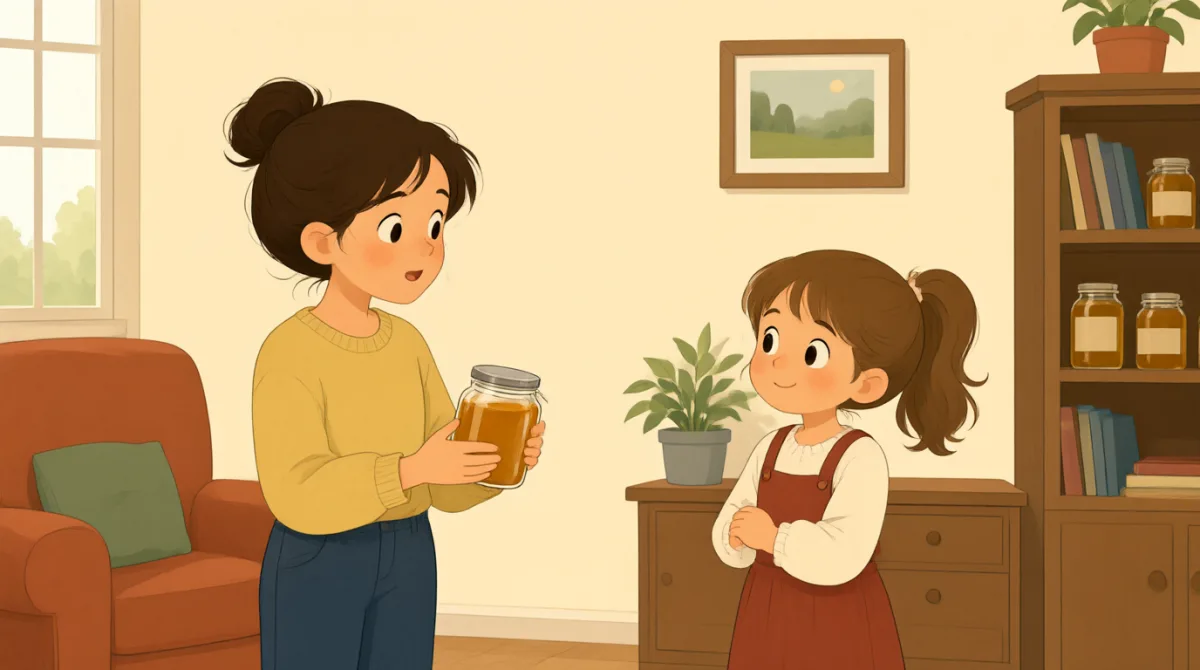

Hi, Grace. Is this honey made here at the market?
Oi, Grace. Este mel é feito aqui na feira?

Yes, it comes from my family’s hives just outside town.
Sim, vem das colmeias da minha família, bem perto da cidade.
That sounds lovely. Is it sweet, or does it taste different?
Que legal. Ele é doce ou tem um sabor diferente?
It’s sweet, with a light flower taste. Would you like to try a little?
É doce, com um leve sabor floral. Quer provar um pouquinho?
Sure, thank you. Oh, it’s smooth and not too sweet.
Claro, obrigada. Nossa, é suave e não muito doce.
I stir it into tea or spread it on toast at home.
Em casa, misturo no chá ou passo na torrada.
I’d like to try it in my tea. How much is one jar?
Queria experimentar no meu chá. Quanto custa um pote?
It’s eight dollars. I’ll wrap it up for you.
Custa oito dólares. Vou embrulhar para você.
Here you go. Thanks, Grace. I’m glad I stopped by.
Aqui está. Obrigada, Grace. Que bom que passei por aqui.
Vocabulário8
- comes fromvem de
This tells where something is made or produced. You can ask, “Where does this honey come from?”
Essa expressão indica a origem ou o local onde algo é produzido. Você pode perguntar: “Where does this honey come from?”
- just outside townbem perto da cidade
This means a place very close to the town, but not inside it. Use it to describe where something is located.
Isso indica um lugar muito próximo da cidade, mas que fica fora dela. Use essa expressão para dizer onde algo fica.
- taste differentter um sabor diferente
This means to have a flavor that is not the same as another food or drink. You can ask, “Does it taste different?”
Isso significa ter um sabor que não é igual ao de outro alimento ou bebida. Você pode perguntar: “Does it taste different?”
- try a littleprovar um pouquinho
This means to taste a small amount of something. You can say this when offering food or drink.
Isso significa experimentar uma pequena quantidade de algo. Você pode dizer isso ao oferecer comida ou bebida.
- spread it on toastpassar na torrada
This means to put something like honey or jam over toast. Replace “it” with another spread you enjoy.
Isso significa colocar algo, como mel ou geleia, sobre uma torrada. Você pode substituir “it” por outra coisa que goste de passar.
- stir it into teamisturar no chá
This means to mix something into tea with a spoon. You can use this phrase for honey, sugar, or milk.
Isso significa misturar algo no chá com uma colher. Você pode usar essa expressão para falar de mel, açúcar ou leite.
- wrap it upembrulhar
This means to put something in paper or another covering, often after someone buys it. A shop worker might say this before handing over an item.
Isso significa colocar algo em papel ou em outra embalagem, muitas vezes depois que alguém compra. Uma pessoa que trabalha numa loja pode dizer isso antes de entregar o produto.
- stopped bypassar por aqui
This means visited a place briefly. You can say, “I’m glad I stopped by,” when you enjoyed a short visit.
Isso significa visitar um lugar por pouco tempo. Você pode dizer: “I’m glad I stopped by” quando gostou de uma visita rápida.
Frases-chave7
- 1
Is this honey made here at the market?
Este mel é feito aqui na feira?
Use this question to ask whether a product is made locally. You can replace “honey” with another product, such as “cheese” or “bread.”
Use essa pergunta para saber se um produto é feito na região. Você pode substituir “honey” por outro produto, como “cheese” ou “bread.”
- 2
Would you like to try a little?
Quer provar um pouquinho?
Use this friendly question when offering someone a small taste. You can replace “try” with another suitable action, such as “taste.”
Use essa pergunta simpática ao oferecer uma pequena degustação. Você pode substituir “try” por outra ação adequada, como “taste.”
- 3
Oh, it’s smooth and not too sweet.
Nossa, é suave e não muito doce.
This sentence describes the texture and flavor of food. Replace “smooth” and “sweet” with other simple words, such as “soft” or “salty.”
Essa frase descreve a textura e o sabor de um alimento. Substitua “smooth” e “sweet” por outras palavras simples, como “soft” ou “salty.”
- 4
I stir it into tea or spread it on toast at home.
Em casa, misturo no chá ou passo na torrada.
Use this sentence to explain how you use a food or ingredient. You can name another food and say what you mix it into or spread it on.
Use essa frase para explicar como você usa um alimento ou ingrediente. Você pode mencionar outro alimento e dizer em que o mistura ou onde o passa.
- 5
How much is one jar?
Quanto custa um pote?
This is a simple way to ask the price of one item. Replace “jar” with the item or container you want to buy.
Essa é uma maneira simples de perguntar o preço de um item. Substitua “jar” pelo produto ou recipiente que quer comprar.
- 6
I’ll wrap it up for you.
Vou embrulhar para você.
A seller can use this sentence to say they will prepare an item for a customer to take away. You can replace “wrap” with another action, such as “bag.”
Uma pessoa que vende algo pode usar essa frase para dizer que vai preparar o produto para o cliente levar. Você pode substituir “wrap” por outra ação, como “bag.”
- 7
I’m glad I stopped by.
Que bom que passei por aqui.
Use this sentence to say you are happy you visited a place. Replace “stopped by” with another short visit, such as “came in.”
Use essa frase para dizer que ficou feliz por ter visitado um lugar. Substitua “stopped by” por outra forma de dizer que fez uma visita rápida, como “came in.”