Asking About Local Honey
Preguntar por la miel local
Mia asks Grace where her honey comes from and how it tastes. She buys a jar after hearing how Grace uses it at home.
Mia le pregunta a Grace de dónde viene su miel y qué sabor tiene. Compra un tarro después de escuchar cómo la usa Grace en casa.
Diálogo9
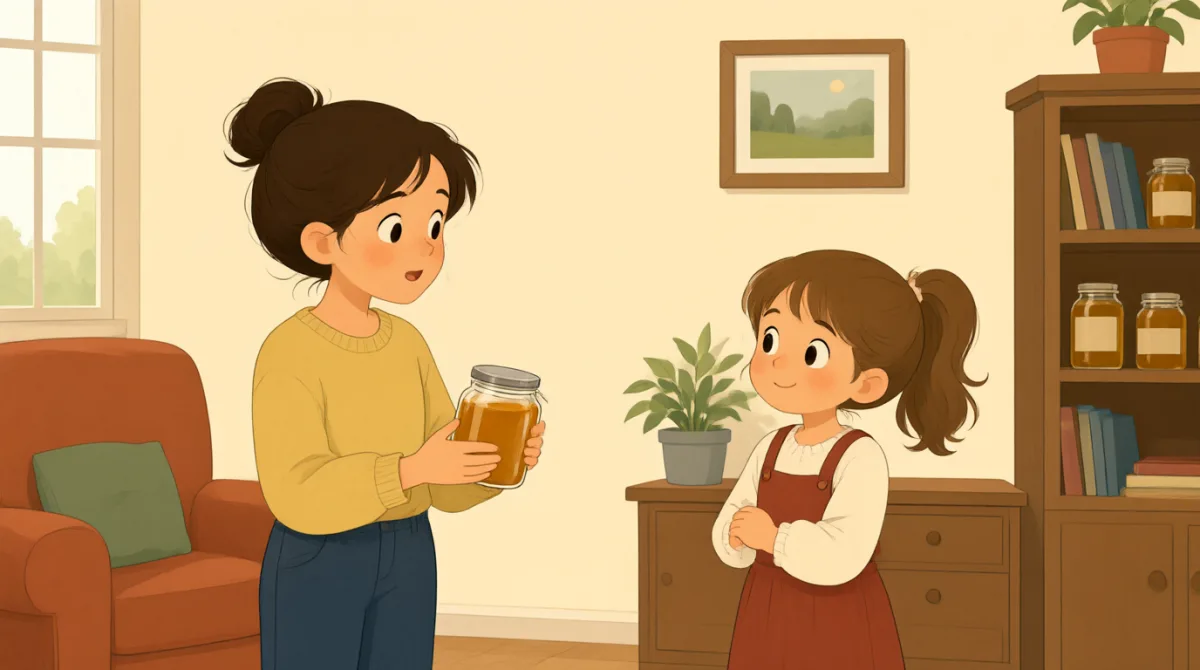

Hi, Grace. Is this honey made here at the market?
Hola, Grace. ¿Esta miel se produce aquí, en el mercado?

Yes, it comes from my family’s hives just outside town.
Sí, viene de las colmenas de mi familia, a las afueras del pueblo.
That sounds lovely. Is it sweet, or does it taste different?
Qué bien. ¿Es dulce o tiene un sabor diferente?
It’s sweet, with a light flower taste. Would you like to try a little?
Es dulce, con un ligero sabor a flores. ¿Quieres probar un poquito?
Sure, thank you. Oh, it’s smooth and not too sweet.
Claro, gracias. ¡Oh, es suave y no demasiado dulce!
I stir it into tea or spread it on toast at home.
En casa la mezclo con el té o la unto en una tostada.
I’d like to try it in my tea. How much is one jar?
Me gustaría probarla en mi té. ¿Cuánto cuesta un tarro?
It’s eight dollars. I’ll wrap it up for you.
Cuesta ocho dólares. Te lo envuelvo.
Here you go. Thanks, Grace. I’m glad I stopped by.
Aquí tienes. Gracias, Grace. Me alegro de haber pasado.
Vocabulario8
- comes fromvenir de
This tells where something is made or produced. You can ask, “Where does this honey come from?”
Sirve para decir de dónde viene o dónde se produce algo. Puedes preguntar: “Where does this honey come from?” (¿De dónde viene esta miel?).
- just outside towna las afueras del pueblo
This means a place very close to the town, but not inside it. Use it to describe where something is located.
Se refiere a un lugar muy cerca del pueblo, pero fuera de él. Úsalo para describir dónde está algo.
- taste differenttener un sabor diferente
This means to have a flavor that is not the same as another food or drink. You can ask, “Does it taste different?”
Significa tener un sabor distinto al de otra comida o bebida. Puedes preguntar: “Does it taste different?” (¿Tiene un sabor diferente?).
- try a littleprobar un poquito
This means to taste a small amount of something. You can say this when offering food or drink.
Significa probar una pequeña cantidad de algo. Puedes decirlo cuando ofreces comida o bebida.
- spread it on toastuntarla en una tostada
This means to put something like honey or jam over toast. Replace “it” with another spread you enjoy.
Significa poner algo, como miel o mermelada, sobre una tostada. Puedes cambiar “it” por otro alimento para untar que te guste.
- stir it into teamezclarla con el té
This means to mix something into tea with a spoon. You can use this phrase for honey, sugar, or milk.
Significa mezclar algo con el té usando una cuchara. Puedes usar esta expresión con miel, azúcar o leche.
- wrap it upenvolverlo
This means to put something in paper or another covering, often after someone buys it. A shop worker might say this before handing over an item.
Significa cubrir algo con papel u otro material, a menudo después de que alguien lo compra. Quien atiende en una tienda puede decirlo antes de entregar un producto.
- stopped bypasar por
This means visited a place briefly. You can say, “I’m glad I stopped by,” when you enjoyed a short visit.
Significa visitar un lugar brevemente. Puedes decir “I’m glad I stopped by” (Me alegro de haber pasado) cuando disfrutaste de una visita corta.
Frases clave7
- 1
Is this honey made here at the market?
¿Esta miel se produce aquí, en el mercado?
Use this question to ask whether a product is made locally. You can replace “honey” with another product, such as “cheese” or “bread.”
Usa esta pregunta para saber si un producto se elabora localmente. Puedes cambiar “honey” por otro producto, como “cheese” o “bread”.
- 2
Would you like to try a little?
¿Quieres probar un poquito?
Use this friendly question when offering someone a small taste. You can replace “try” with another suitable action, such as “taste.”
Usa esta pregunta amable cuando ofrezcas a alguien probar una pequeña cantidad. Puedes cambiar “try” por otra acción adecuada, como “taste”.
- 3
Oh, it’s smooth and not too sweet.
¡Oh, es suave y no demasiado dulce!
This sentence describes the texture and flavor of food. Replace “smooth” and “sweet” with other simple words, such as “soft” or “salty.”
Esta frase describe la textura y el sabor de la comida. Cambia “smooth” y “sweet” por otras palabras sencillas, como “soft” o “salty”.
- 4
I stir it into tea or spread it on toast at home.
En casa la mezclo con el té o la unto en una tostada.
Use this sentence to explain how you use a food or ingredient. You can name another food and say what you mix it into or spread it on.
Usa esta frase para explicar cómo utilizas un alimento o ingrediente. Puedes mencionar otro alimento y decir con qué lo mezclas o sobre qué lo untas.
- 5
How much is one jar?
¿Cuánto cuesta un tarro?
This is a simple way to ask the price of one item. Replace “jar” with the item or container you want to buy.
Esta es una forma sencilla de preguntar el precio de un artículo. Cambia “jar” por el artículo o el envase que quieras comprar.
- 6
I’ll wrap it up for you.
Te lo envuelvo.
A seller can use this sentence to say they will prepare an item for a customer to take away. You can replace “wrap” with another action, such as “bag.”
Quien vende puede usar esta frase para decir que preparará un artículo para que el cliente se lo lleve. Puedes cambiar “wrap” por otra acción, como “bag”.
- 7
I’m glad I stopped by.
Me alegro de haber pasado.
Use this sentence to say you are happy you visited a place. Replace “stopped by” with another short visit, such as “came in.”
Usa esta frase para decir que te alegra haber visitado un lugar. Puedes cambiar “stopped by” por otra forma de expresar una visita breve, como “came in”.