Helping Clean Up After Dinner
Ajudando a arrumar depois do jantar
After dinner, Emma helps Grace clean up the table and wash the dishes. They work together and chat casually.
Depois do jantar, Emma ajuda Grace a tirar as coisas da mesa e lavar a louça. Elas trabalham juntas e conversam descontraidamente.
Diálogo8
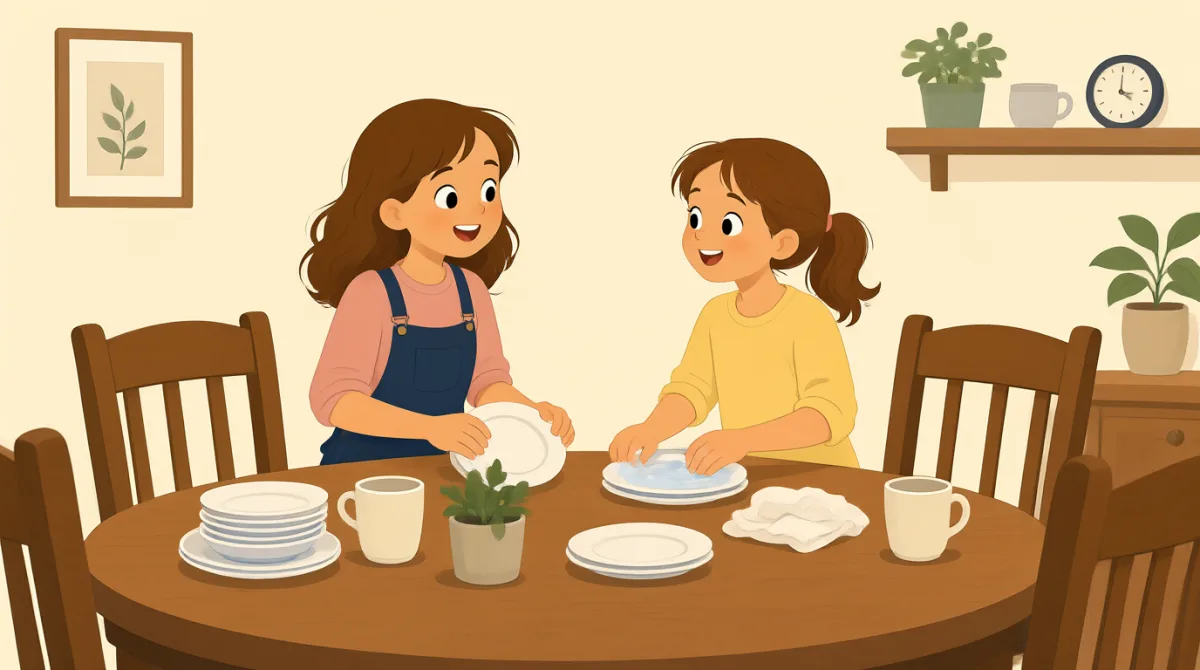

That was a lovely dinner, Grace. Let me help you clear the table.
O jantar estava uma delícia, Grace. Deixa eu te ajudar a tirar as coisas da mesa.

Thanks, Emma. Could you take these plates to the kitchen?
Obrigada, Emma. Você pode levar esses pratos para a cozinha?
Sure. Should I put them by the sink?
Claro. Devo deixá-los perto da pia?
Yes, please. I’ll bring the glasses and the dishes.
Sim, por favor. Vou levar os copos e a louça.
I can wash the plates while you dry them.
Posso lavar os pratos enquanto você seca.
That sounds good. We’ll finish in no time.
Boa. A gente termina rapidinho.
This is easy. I usually help out at home, too.
É fácil. Eu também costumo ajudar em casa.
You’re a wonderful guest. Thanks for helping me clean up.
Você é uma visita maravilhosa. Obrigada por me ajudar a arrumar tudo.
Vocabulário8
- lovely dinnerjantar delicioso
A warm way to say that a meal was very nice. You can use “lovely” to compliment a meal or an event.
Uma maneira carinhosa de dizer que a refeição estava muito boa. Você pode usar “lovely” para elogiar uma refeição ou um evento.
- clear the tabletirar as coisas da mesa
To take plates and other things off the table after a meal. You can offer to help by saying, “Let me help you clear the table.”
Retirar os pratos e outras coisas da mesa depois de uma refeição. Você pode se oferecer para ajudar dizendo: “Let me help you clear the table.”
- take these plates to the kitchenlevar esses pratos para a cozinha
To carry the plates from where you are to the kitchen. Use “take [something] to [place]” to ask someone to move an item.
Levar os pratos de onde você está até a cozinha. Use “take [something] to [place]” para pedir que alguém leve um objeto a algum lugar.
- by the sinkperto da pia
This means next to the sink. You can ask where to put dishes by saying, “Should I put them by the sink?”
Significa ao lado da pia. Você pode perguntar onde deixar a louça dizendo: “Should I put them by the sink?”
- dry themsecá-los
To remove water from dishes with a towel after washing them. One person can wash the dishes while another dries them.
Tirar a água da louça com um pano depois de lavá-la. Uma pessoa pode lavar a louça enquanto outra a seca.
- in no timerapidinho
Very quickly, or after only a short time. Use this phrase to say that a task will be finished soon.
Muito depressa ou depois de pouco tempo. Use essa expressão para dizer que uma tarefa vai terminar logo.
- help outajudar
To help someone with a task. You can say, “I help out at home,” when you regularly help with chores.
Ajudar alguém com uma tarefa. Você pode dizer “I help out at home” quando costuma ajudar nas tarefas de casa.
- clean uparrumar tudo
To make a place tidy by putting things away or washing dishes. After a meal, people often clean up together.
Deixar um lugar arrumado, guardando as coisas ou lavando a louça. Depois de uma refeição, as pessoas costumam arrumar tudo juntas.
Frases-chave8
- 1
That was a lovely dinner, Grace.
O jantar estava uma delícia, Grace.
This is a friendly way to compliment someone’s meal. You can use “That was a lovely…” to praise an event or experience.
Uma maneira simpática de elogiar a refeição de alguém. Você pode usar “That was a lovely…” para elogiar um evento ou uma experiência.
- 2
Let me help you clear the table.
Deixa eu te ajudar a tirar as coisas da mesa.
Use this sentence to offer help with a task. You can replace “clear the table” with another activity, such as “wash the dishes.”
Use essa frase para se oferecer para ajudar em uma tarefa. Você pode substituir “clear the table” por outra atividade, como “wash the dishes.”
- 3
Could you take these plates to the kitchen?
Você pode levar esses pratos para a cozinha?
This is a polite way to ask someone to carry something somewhere. Replace “these plates” and “the kitchen” with other items and places.
Uma maneira educada de pedir que alguém leve alguma coisa a algum lugar. Substitua “these plates” e “the kitchen” por outros objetos e lugares.
- 4
Should I put them by the sink?
Devo deixá-los perto da pia?
Use this question to check where something should go. Replace “them” and “by the sink” with the items and place you mean.
Use essa pergunta para confirmar onde uma coisa deve ficar. Substitua “them” e “by the sink” pelos objetos e pelo lugar que você tem em mente.
- 5
I can wash the plates while you dry them.
Posso lavar os pratos enquanto você seca.
This sentence offers to share a task and shows what each person can do. Use “while” to describe two actions happening at the same time.
Essa frase propõe dividir uma tarefa e mostra o que cada pessoa pode fazer. Use “while” para descrever duas ações que acontecem ao mesmo tempo.
- 6
We’ll finish in no time.
A gente termina rapidinho.
This is a reassuring way to say a task will be done quickly. Use “We’ll finish…” when you want to encourage someone working with you.
Uma maneira tranquilizadora de dizer que uma tarefa vai ser concluída depressa. Use “We’ll finish…” para incentivar alguém que está trabalhando com você.
- 7
I usually help out at home, too.
Eu também costumo ajudar em casa.
Use this sentence to talk about a regular habit of helping with chores. Replace “help out at home” with another activity you often do.
Use essa frase para falar do hábito de ajudar nas tarefas domésticas. Substitua “help out at home” por outra atividade que você costuma fazer.
- 8
You’re a wonderful guest.
Você é uma visita maravilhosa.
This is a kind way to compliment someone who is visiting. You can replace “wonderful” with another positive adjective, such as “helpful.”
Uma maneira gentil de elogiar alguém que está fazendo uma visita. Você pode substituir “wonderful” por outro adjetivo positivo, como “helpful.”