Helping Clean Up After Dinner
After dinner, Emma helps Grace clean up the table and wash the dishes. They work together and chat casually.
Dialogue8
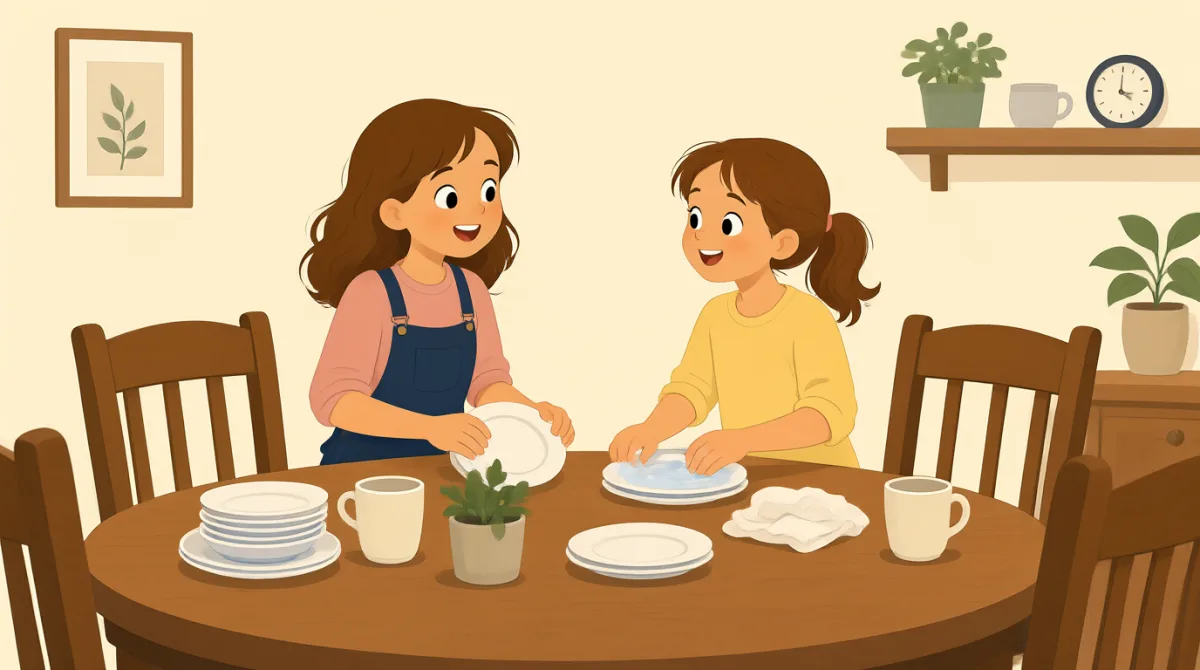

That was a lovely dinner, Grace. Let me help you clear the table.

Thanks, Emma. Could you take these plates to the kitchen?
Sure. Should I put them by the sink?
Yes, please. I’ll bring the glasses and the dishes.
I can wash the plates while you dry them.
That sounds good. We’ll finish in no time.
This is easy. I usually help out at home, too.
You’re a wonderful guest. Thanks for helping me clean up.
Vocabulary8
- lovely dinner
A warm way to say that a meal was very nice. You can use “lovely” to compliment a meal or an event.
- clear the table
To take plates and other things off the table after a meal. You can offer to help by saying, “Let me help you clear the table.”
- take these plates to the kitchen
To carry the plates from where you are to the kitchen. Use “take [something] to [place]” to ask someone to move an item.
- by the sink
This means next to the sink. You can ask where to put dishes by saying, “Should I put them by the sink?”
- dry them
To remove water from dishes with a towel after washing them. One person can wash the dishes while another dries them.
- in no time
Very quickly, or after only a short time. Use this phrase to say that a task will be finished soon.
- help out
To help someone with a task. You can say, “I help out at home,” when you regularly help with chores.
- clean up
To make a place tidy by putting things away or washing dishes. After a meal, people often clean up together.
Key Sentences8
- 1
That was a lovely dinner, Grace.
This is a friendly way to compliment someone’s meal. You can use “That was a lovely…” to praise an event or experience.
- 2
Let me help you clear the table.
Use this sentence to offer help with a task. You can replace “clear the table” with another activity, such as “wash the dishes.”
- 3
Could you take these plates to the kitchen?
This is a polite way to ask someone to carry something somewhere. Replace “these plates” and “the kitchen” with other items and places.
- 4
Should I put them by the sink?
Use this question to check where something should go. Replace “them” and “by the sink” with the items and place you mean.
- 5
I can wash the plates while you dry them.
This sentence offers to share a task and shows what each person can do. Use “while” to describe two actions happening at the same time.
- 6
We’ll finish in no time.
This is a reassuring way to say a task will be done quickly. Use “We’ll finish…” when you want to encourage someone working with you.
- 7
I usually help out at home, too.
Use this sentence to talk about a regular habit of helping with chores. Replace “help out at home” with another activity you often do.
- 8
You’re a wonderful guest.
This is a kind way to compliment someone who is visiting. You can replace “wonderful” with another positive adjective, such as “helpful.”