Offering to Help in the Kitchen
Oferecendo ajuda na cozinha
Grace starts preparing dinner, and Emma offers to help in the kitchen. Grace gives her a simple task.
Grace começa a preparar o jantar, e Emma se oferece para ajudar na cozinha. Grace lhe passa uma tarefa simples.
Diálogo8
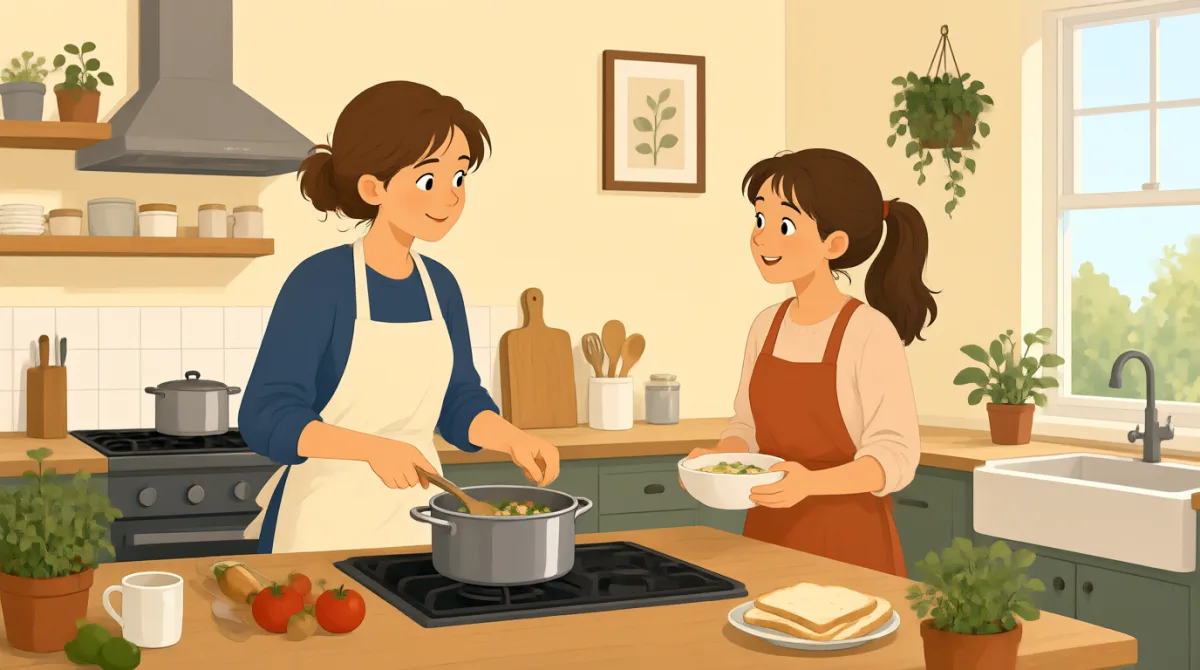

I’m going to get dinner started. Would you like to help me in the kitchen?
Vou começar a preparar o jantar. Quer me ajudar na cozinha?

Of course! What can I do?
Claro! O que posso fazer?
Could you wash these tomatoes and put them on the counter?
Você pode lavar estes tomates e colocá-los na bancada?
Sure. Where should I wash them?
Claro. Onde devo lavá-los?
Use the sink over there. The colander is next to it.
Use a pia ali. O escorredor está ao lado dela.
Got it. Do you need help with anything else?
Entendi. Precisa de ajuda com mais alguma coisa?
That’s all for now, thanks. You can slice the bread, if you like.
Por enquanto, é só. Obrigada. Se quiser, pode fatiar o pão.
I’d be happy to. I’ll get a knife from the drawer.
Vou adorar. Vou pegar uma faca na gaveta.
Vocabulário8
- get dinner startedcomeçar a preparar o jantar
To get dinner started means to begin preparing the meal. You can use this phrase when you start making dinner.
“get dinner started” significa começar a preparar a refeição. Você pode usar essa expressão quando começa a fazer o jantar.
- Would you like to help meQuer me ajudar?
This is a polite way to offer someone a chance to help. You can say, “Would you like to help me with this?”
Essa é uma maneira educada de oferecer a alguém a oportunidade de ajudar. Você pode dizer: “Would you like to help me with this?” (Você gostaria de me ajudar com isto?).
- What can I do?O que posso fazer?
Use this question to ask what task you can do to help. It is useful at home or at work.
Use essa pergunta para saber que tarefa pode fazer para ajudar. Ela é útil em casa ou no trabalho.
- put them on the countercolocá-los na bancada
This means to place the tomatoes on the kitchen counter. You can use “put it on the counter” for one thing.
Isso significa colocar os tomates na bancada da cozinha. Para falar de apenas uma coisa, você pode usar “put it on the counter” (colocá-la na bancada).
- the sink over therea pia ali
This refers to the sink in a place nearby. You can use “over there” to point out where something is.
Essa expressão se refere a uma pia que está ali perto. Você pode usar “over there” (ali) para indicar onde está alguma coisa.
- That’s all for nowPor enquanto, é só
This means there is nothing else to do at the moment. You can use it when someone asks if you need more help.
Isso significa que não há mais nada para fazer no momento. Você pode usar essa expressão quando alguém pergunta se você precisa de mais ajuda.
- I’d be happy toVou adorar
This is a friendly way to say you are willing to do something. You can use it when someone asks you to help.
Essa é uma maneira simpática de dizer que você está disposto a fazer alguma coisa. Você pode usá-la quando alguém pede sua ajuda.
- get a knife from the drawerpegar uma faca na gaveta
This means to take a knife out of the drawer. You can use “get a [thing] from the [place]” to say where you will take something from.
Isso significa tirar uma faca da gaveta. Você pode usar “get a [thing] from the [place]” (pegar [uma coisa] em [um lugar]) para dizer de onde vai pegar alguma coisa.
Frases-chave8
- 1
Would you like to help me in the kitchen?
Quer me ajudar na cozinha?
This is a polite way to invite someone to help. You can change the place or task, as in “Would you like to help me set the table?”
Essa é uma maneira educada de convidar alguém para ajudar. Você pode mudar o lugar ou a tarefa, como em “Would you like to help me set the table?” (Quer me ajudar a pôr a mesa?).
- 2
Of course!
Claro!
Use this friendly phrase to agree readily. It works well when someone asks if you can help.
Use essa expressão simpática para aceitar prontamente. Ela cai bem quando alguém pergunta se você pode ajudar.
- 3
What can I do?
O que posso fazer?
This is a simple way to ask what task is needed. You can use it when you want to be helpful but do not know what to do.
Essa é uma maneira simples de perguntar que tarefa precisa ser feita. Você pode usá-la quando quer ajudar, mas não sabe o que fazer.
- 4
Could you wash these tomatoes and put them on the counter?
Você pode lavar estes tomates e colocá-los na bancada?
This is a polite request that gives two clear instructions. You can use “Could you [action] and [action]?” to ask someone to do two things.
Esse é um pedido educado que dá duas instruções claras. Você pode usar “Could you [action] and [action]?” (Você poderia [ação] e [ação]?) para pedir que alguém faça duas coisas.
- 5
Where should I wash them?
Onde devo lavá-los?
Use this question to ask where you should do a task. You can replace “wash them” with another action, such as “put these plates.”
Use essa pergunta para saber onde deve fazer uma tarefa. Você pode substituir “wash them” por outra ação, como “put these plates” (colocar estes pratos).
- 6
Do you need help with anything else?
Precisa de ajuda com mais alguma coisa?
This is a useful way to offer more help after finishing a task. You can use it at home, at work, or while helping a friend.
Essa é uma maneira útil de oferecer mais ajuda depois de terminar uma tarefa. Você pode usá-la em casa, no trabalho ou ao ajudar um amigo.
- 7
That’s all for now, thanks.
Por enquanto, é só. Obrigada.
This is a polite way to say no more help is needed at the moment. You can use “for now” when that might change later.
Essa é uma maneira educada de dizer que não precisa de mais ajuda no momento. Você pode usar “for now” (por enquanto) quando isso talvez mude mais tarde.
- 8
I’d be happy to.
Vou adorar.
This is a warm way to accept a request or offer. You can use it before doing a helpful task.
Essa é uma maneira calorosa de aceitar um pedido ou uma oferta. Você pode usá-la antes de fazer uma tarefa para ajudar.