Offering to Help in the Kitchen
Ofrecer ayuda en la cocina
Grace starts preparing dinner, and Emma offers to help in the kitchen. Grace gives her a simple task.
Grace empieza a preparar la cena y Emma se ofrece a ayudar en la cocina. Grace le encarga una tarea sencilla.
Diálogo8
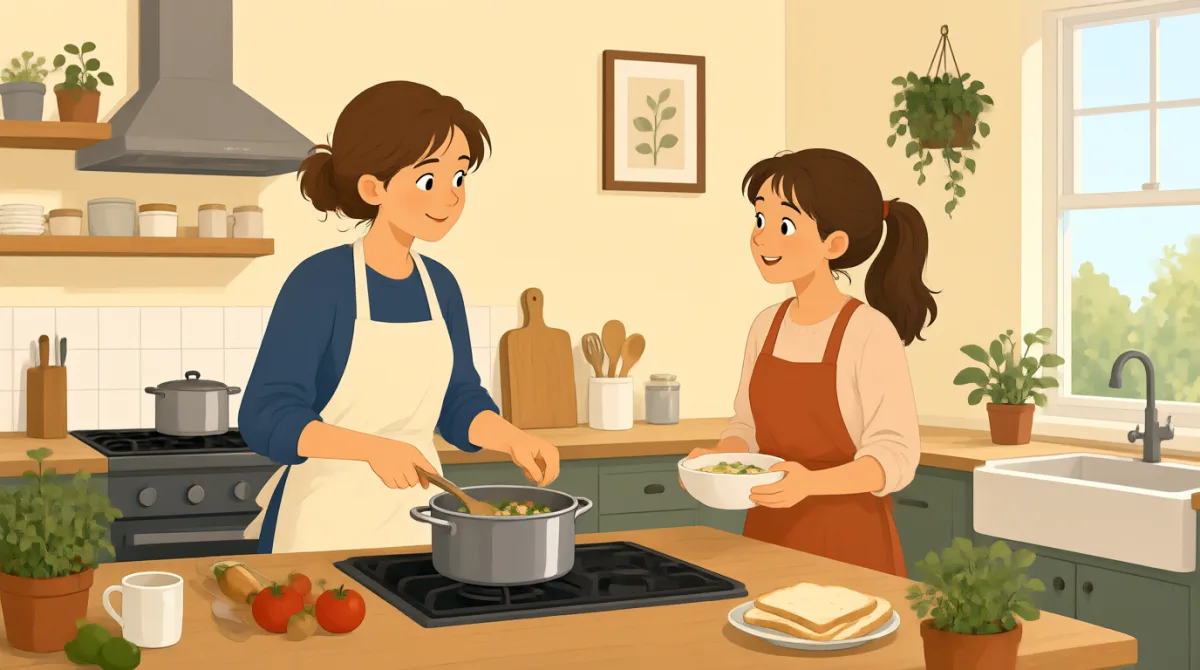

I’m going to get dinner started. Would you like to help me in the kitchen?
Voy a empezar a preparar la cena. ¿Te gustaría ayudarme en la cocina?

Of course! What can I do?
¡Claro! ¿Qué puedo hacer?
Could you wash these tomatoes and put them on the counter?
¿Podrías lavar estos tomates y ponerlos en la encimera?
Sure. Where should I wash them?
Claro. ¿Dónde debería lavarlos?
Use the sink over there. The colander is next to it.
Usa el fregadero de allí. El colador está al lado.
Got it. Do you need help with anything else?
Entendido. ¿Necesitas ayuda con algo más?
That’s all for now, thanks. You can slice the bread, if you like.
Por ahora, eso es todo, gracias. Si quieres, puedes cortar el pan en rebanadas.
I’d be happy to. I’ll get a knife from the drawer.
Encantada. Voy a buscar un cuchillo en el cajón.
Vocabulario8
- get dinner startedempezar a preparar la cena
To get dinner started means to begin preparing the meal. You can use this phrase when you start making dinner.
“get dinner started” significa empezar a preparar la comida. Puedes usar esta expresión cuando comienzas a hacer la cena.
- Would you like to help me¿Te gustaría ayudarme?
This is a polite way to offer someone a chance to help. You can say, “Would you like to help me with this?”
Esta es una forma amable de ofrecerle a alguien la oportunidad de ayudar. Puedes decir: “Would you like to help me with this?” (¿Te gustaría ayudarme con esto?).
- What can I do?¿Qué puedo hacer?
Use this question to ask what task you can do to help. It is useful at home or at work.
Usa esta pregunta para averiguar qué tarea puedes hacer para ayudar. Es útil en casa o en el trabajo.
- put them on the counterponerlos en la encimera
This means to place the tomatoes on the kitchen counter. You can use “put it on the counter” for one thing.
Significa colocar los tomates en la encimera de la cocina. Puedes usar “put it on the counter” (ponlo en la encimera) para hablar de una sola cosa.
- the sink over thereel fregadero de allí
This refers to the sink in a place nearby. You can use “over there” to point out where something is.
Se refiere al fregadero que está cerca. Puedes usar “over there” (allí) para indicar dónde está algo.
- That’s all for nowPor ahora, eso es todo
This means there is nothing else to do at the moment. You can use it when someone asks if you need more help.
Significa que por el momento no hay nada más que hacer. Puedes usar esta expresión cuando alguien te pregunta si necesitas más ayuda.
- I’d be happy toEncantado/a
This is a friendly way to say you are willing to do something. You can use it when someone asks you to help.
Esta es una forma cordial de decir que estás dispuesto/a a hacer algo. Puedes usarla cuando alguien te pide ayuda.
- get a knife from the drawersacar un cuchillo del cajón
This means to take a knife out of the drawer. You can use “get a [thing] from the [place]” to say where you will take something from.
Significa sacar un cuchillo del cajón. Puedes usar “get a [thing] from the [place]” para decir de dónde vas a sacar algo.
Frases clave8
- 1
Would you like to help me in the kitchen?
¿Te gustaría ayudarme en la cocina?
This is a polite way to invite someone to help. You can change the place or task, as in “Would you like to help me set the table?”
Esta es una forma amable de invitar a alguien a ayudar. Puedes cambiar el lugar o la tarea, como en “Would you like to help me set the table?” (¿Te gustaría ayudarme a poner la mesa?).
- 2
Of course!
¡Claro!
Use this friendly phrase to agree readily. It works well when someone asks if you can help.
Usa esta expresión cordial para aceptar algo enseguida. Va muy bien cuando alguien te pregunta si puedes ayudar.
- 3
What can I do?
¿Qué puedo hacer?
This is a simple way to ask what task is needed. You can use it when you want to be helpful but do not know what to do.
Esta es una forma sencilla de preguntar qué tarea hace falta. Puedes usarla cuando quieres ayudar, pero no sabes qué hacer.
- 4
Could you wash these tomatoes and put them on the counter?
¿Podrías lavar estos tomates y ponerlos en la encimera?
This is a polite request that gives two clear instructions. You can use “Could you [action] and [action]?” to ask someone to do two things.
Esta es una petición amable que da dos instrucciones claras. Puedes usar “Could you [action] and [action]?” para pedirle a alguien que haga dos cosas.
- 5
Where should I wash them?
¿Dónde debería lavarlos?
Use this question to ask where you should do a task. You can replace “wash them” with another action, such as “put these plates.”
Usa esta pregunta para averiguar dónde debes hacer una tarea. Puedes sustituir “wash them” por otra acción, como “put these plates”.
- 6
Do you need help with anything else?
¿Necesitas ayuda con algo más?
This is a useful way to offer more help after finishing a task. You can use it at home, at work, or while helping a friend.
Esta es una forma útil de ofrecer más ayuda después de terminar una tarea. Puedes usarla en casa, en el trabajo o cuando ayudas a un amigo.
- 7
That’s all for now, thanks.
Por ahora, eso es todo, gracias.
This is a polite way to say no more help is needed at the moment. You can use “for now” when that might change later.
Esta es una forma amable de decir que por el momento no hace falta más ayuda. Puedes usar “for now” cuando eso podría cambiar más adelante.
- 8
I’d be happy to.
Encantado/a.
This is a warm way to accept a request or offer. You can use it before doing a helpful task.
Esta es una forma cordial de aceptar una petición o un ofrecimiento. Puedes usarla antes de hacer una tarea para ayudar.