Offering to Help in the Kitchen
Grace starts preparing dinner, and Emma offers to help in the kitchen. Grace gives her a simple task.
Dialogue8
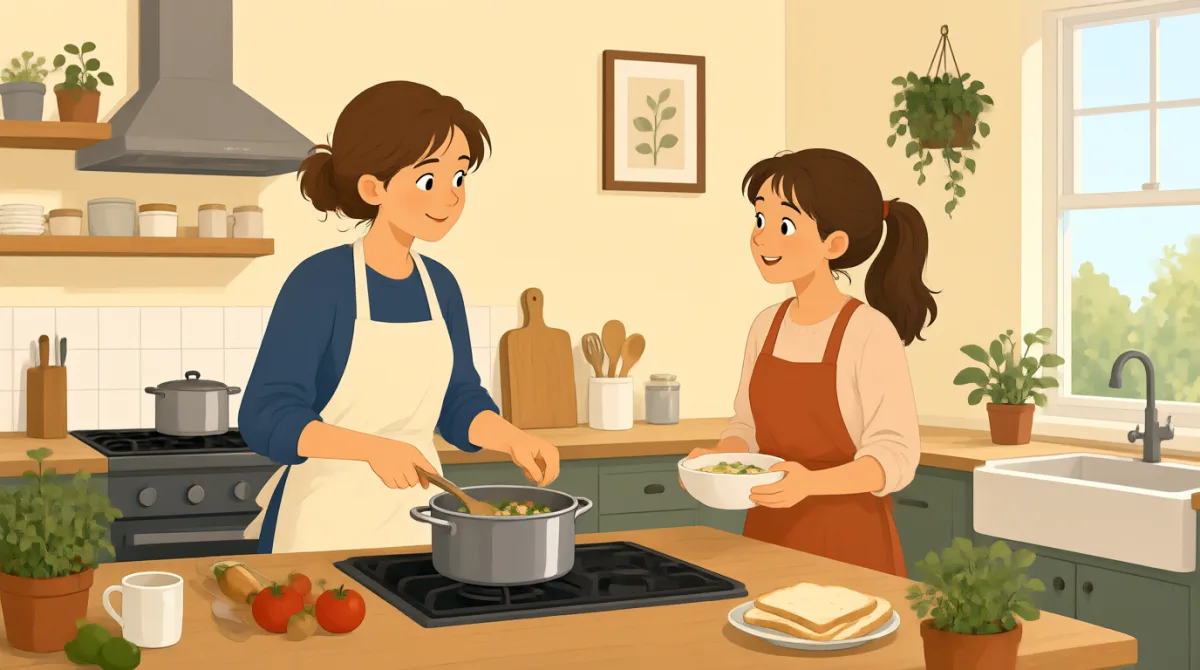

I’m going to get dinner started. Would you like to help me in the kitchen?

Of course! What can I do?
Could you wash these tomatoes and put them on the counter?
Sure. Where should I wash them?
Use the sink over there. The colander is next to it.
Got it. Do you need help with anything else?
That’s all for now, thanks. You can slice the bread, if you like.
I’d be happy to. I’ll get a knife from the drawer.
Vocabulary8
- get dinner started
To get dinner started means to begin preparing the meal. You can use this phrase when you start making dinner.
- Would you like to help me
This is a polite way to offer someone a chance to help. You can say, “Would you like to help me with this?”
- What can I do?
Use this question to ask what task you can do to help. It is useful at home or at work.
- put them on the counter
This means to place the tomatoes on the kitchen counter. You can use “put it on the counter” for one thing.
- the sink over there
This refers to the sink in a place nearby. You can use “over there” to point out where something is.
- That’s all for now
This means there is nothing else to do at the moment. You can use it when someone asks if you need more help.
- I’d be happy to
This is a friendly way to say you are willing to do something. You can use it when someone asks you to help.
- get a knife from the drawer
This means to take a knife out of the drawer. You can use “get a [thing] from the [place]” to say where you will take something from.
Key Sentences8
- 1
Would you like to help me in the kitchen?
This is a polite way to invite someone to help. You can change the place or task, as in “Would you like to help me set the table?”
- 2
Of course!
Use this friendly phrase to agree readily. It works well when someone asks if you can help.
- 3
What can I do?
This is a simple way to ask what task is needed. You can use it when you want to be helpful but do not know what to do.
- 4
Could you wash these tomatoes and put them on the counter?
This is a polite request that gives two clear instructions. You can use “Could you [action] and [action]?” to ask someone to do two things.
- 5
Where should I wash them?
Use this question to ask where you should do a task. You can replace “wash them” with another action, such as “put these plates.”
- 6
Do you need help with anything else?
This is a useful way to offer more help after finishing a task. You can use it at home, at work, or while helping a friend.
- 7
That’s all for now, thanks.
This is a polite way to say no more help is needed at the moment. You can use “for now” when that might change later.
- 8
I’d be happy to.
This is a warm way to accept a request or offer. You can use it before doing a helpful task.