Offering to Help in the Kitchen
Hilfe in der Küche anbieten
Grace starts preparing dinner, and Emma offers to help in the kitchen. Grace gives her a simple task.
Grace fängt mit den Vorbereitungen fürs Abendessen an, und Emma bietet ihr Hilfe in der Küche an. Grace gibt ihr eine einfache Aufgabe.
Dialog8
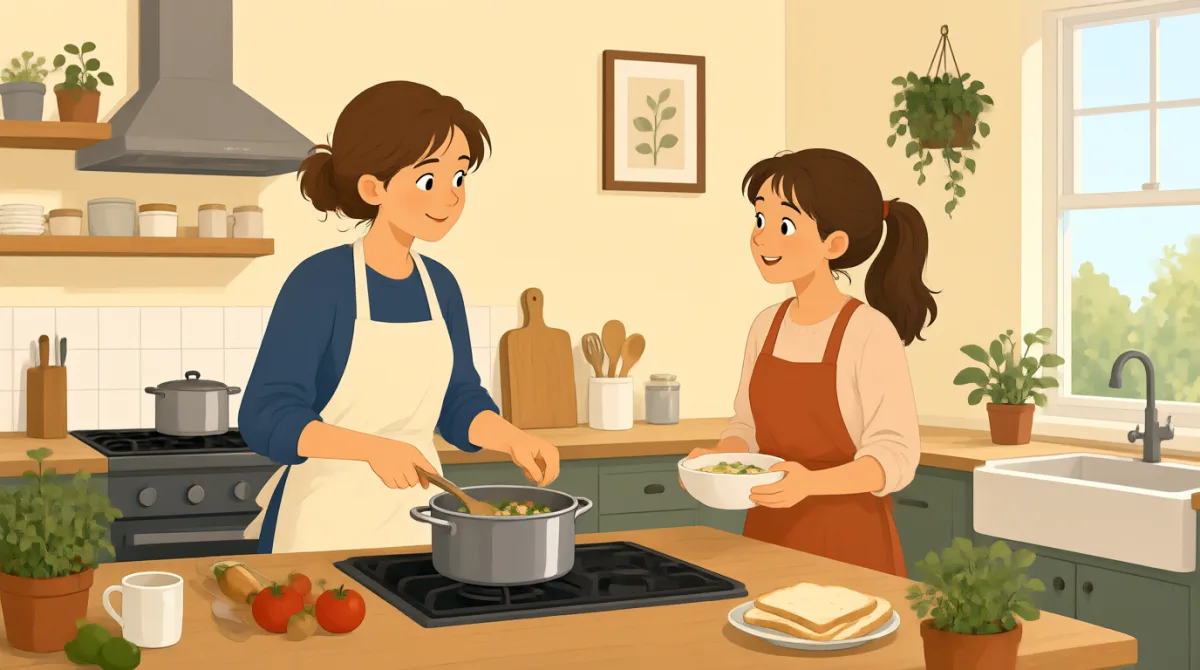

I’m going to get dinner started. Would you like to help me in the kitchen?
Ich fange schon mal mit dem Abendessen an. Möchtest du mir in der Küche helfen?

Of course! What can I do?
Klar! Was kann ich tun?
Could you wash these tomatoes and put them on the counter?
Kannst du diese Tomaten waschen und auf die Arbeitsfläche legen?
Sure. Where should I wash them?
Klar. Wo soll ich sie waschen?
Use the sink over there. The colander is next to it.
Nimm die Spüle da drüben. Das Sieb steht daneben.
Got it. Do you need help with anything else?
Alles klar. Brauchst du sonst noch Hilfe?
That’s all for now, thanks. You can slice the bread, if you like.
Das reicht erst mal, danke. Wenn du magst, kannst du das Brot schneiden.
I’d be happy to. I’ll get a knife from the drawer.
Gerne. Ich hole ein Messer aus der Schublade.
Wortschatz8
- get dinner startedmit dem Abendessen anfangen
To get dinner started means to begin preparing the meal. You can use this phrase when you start making dinner.
“get dinner started” bedeutet, mit der Zubereitung des Essens anzufangen. Du kannst diese Wendung verwenden, wenn du mit dem Kochen beginnst.
- Would you like to help meMöchtest du mir helfen
This is a polite way to offer someone a chance to help. You can say, “Would you like to help me with this?”
“Would you like to help me” ist eine höfliche Art, jemandem anzubieten, mitzuhelfen. Du kannst zum Beispiel sagen: “Would you like to help me with this?” (Möchtest du mir dabei helfen?)
- What can I do?Was kann ich tun?
Use this question to ask what task you can do to help. It is useful at home or at work.
Mit “What can I do?” fragst du, welche Aufgabe du übernehmen kannst. Das ist zu Hause und bei der Arbeit nützlich.
- put them on the countersie auf die Arbeitsfläche legen
This means to place the tomatoes on the kitchen counter. You can use “put it on the counter” for one thing.
“put them on the counter” bedeutet, die Tomaten auf die Küchenarbeitsfläche zu legen. Für eine einzelne Sache kannst du “put it on the counter” sagen.
- the sink over theredie Spüle da drüben
This refers to the sink in a place nearby. You can use “over there” to point out where something is.
“the sink over there” bezeichnet eine Spüle in der Nähe. Mit “over there” kannst du auf den Ort einer Sache hinweisen.
- That’s all for nowDas reicht erst mal
This means there is nothing else to do at the moment. You can use it when someone asks if you need more help.
“That’s all for now” bedeutet, dass es im Moment nichts Weiteres zu tun gibt. Du kannst das sagen, wenn dich jemand fragt, ob du noch mehr Hilfe brauchst.
- I’d be happy toGerne
This is a friendly way to say you are willing to do something. You can use it when someone asks you to help.
“I’d be happy to” ist eine freundliche Art zu sagen, dass du etwas gerne machst. Du kannst es sagen, wenn dich jemand um Hilfe bittet.
- get a knife from the drawerein Messer aus der Schublade holen
This means to take a knife out of the drawer. You can use “get a [thing] from the [place]” to say where you will take something from.
“get a knife from the drawer” bedeutet, ein Messer aus der Schublade zu nehmen. Mit “get a [thing] from the [place]” kannst du sagen, woher du etwas holst.
Wichtige Sätze8
- 1
Would you like to help me in the kitchen?
Möchtest du mir in der Küche helfen?
This is a polite way to invite someone to help. You can change the place or task, as in “Would you like to help me set the table?”
Das ist eine höfliche Art, jemanden um Hilfe zu bitten. Du kannst den Ort oder die Aufgabe ändern, zum Beispiel: “Would you like to help me set the table?” (Möchtest du mir beim Tischdecken helfen?)
- 2
Of course!
Klar!
Use this friendly phrase to agree readily. It works well when someone asks if you can help.
Mit dieser freundlichen Wendung sagst du sofort zu. Sie passt gut, wenn dich jemand fragt, ob du helfen kannst.
- 3
What can I do?
Was kann ich tun?
This is a simple way to ask what task is needed. You can use it when you want to be helpful but do not know what to do.
So kannst du einfach fragen, welche Aufgabe erledigt werden muss. Du kannst das sagen, wenn du gerne helfen möchtest, aber nicht weißt, was zu tun ist.
- 4
Could you wash these tomatoes and put them on the counter?
Kannst du diese Tomaten waschen und auf die Arbeitsfläche legen?
This is a polite request that gives two clear instructions. You can use “Could you [action] and [action]?” to ask someone to do two things.
Das ist eine höfliche Bitte mit zwei klaren Anweisungen. Mit “Could you [action] and [action]?” kannst du jemanden bitten, zwei Dinge zu tun.
- 5
Where should I wash them?
Wo soll ich sie waschen?
Use this question to ask where you should do a task. You can replace “wash them” with another action, such as “put these plates.”
Mit dieser Frage erkundigst du dich, wo du eine Aufgabe erledigen sollst. Du kannst “wash them” durch eine andere Handlung ersetzen, zum Beispiel durch “put these plates”.
- 6
Do you need help with anything else?
Brauchst du sonst noch Hilfe?
This is a useful way to offer more help after finishing a task. You can use it at home, at work, or while helping a friend.
So kannst du anbieten, noch mehr zu helfen, nachdem du eine Aufgabe erledigt hast. Das passt zu Hause, bei der Arbeit oder wenn du einer Freundin oder einem Freund hilfst.
- 7
That’s all for now, thanks.
Das reicht erst mal, danke.
This is a polite way to say no more help is needed at the moment. You can use “for now” when that might change later.
Damit sagst du höflich, dass im Moment keine weitere Hilfe nötig ist. “for now” kannst du verwenden, wenn sich das später ändern könnte.
- 8
I’d be happy to.
Gerne.
This is a warm way to accept a request or offer. You can use it before doing a helpful task.
Das ist eine herzliche Art, eine Bitte oder ein Angebot anzunehmen. Du kannst es sagen, bevor du eine hilfreiche Aufgabe übernimmst.