Delivering the Diagnosis
Dr. Mia Patel meets Jack Miller to explain that his test results indicate a serious illness. She pauses to check what he already understands and gives him space to ask questions.
Dialogue11
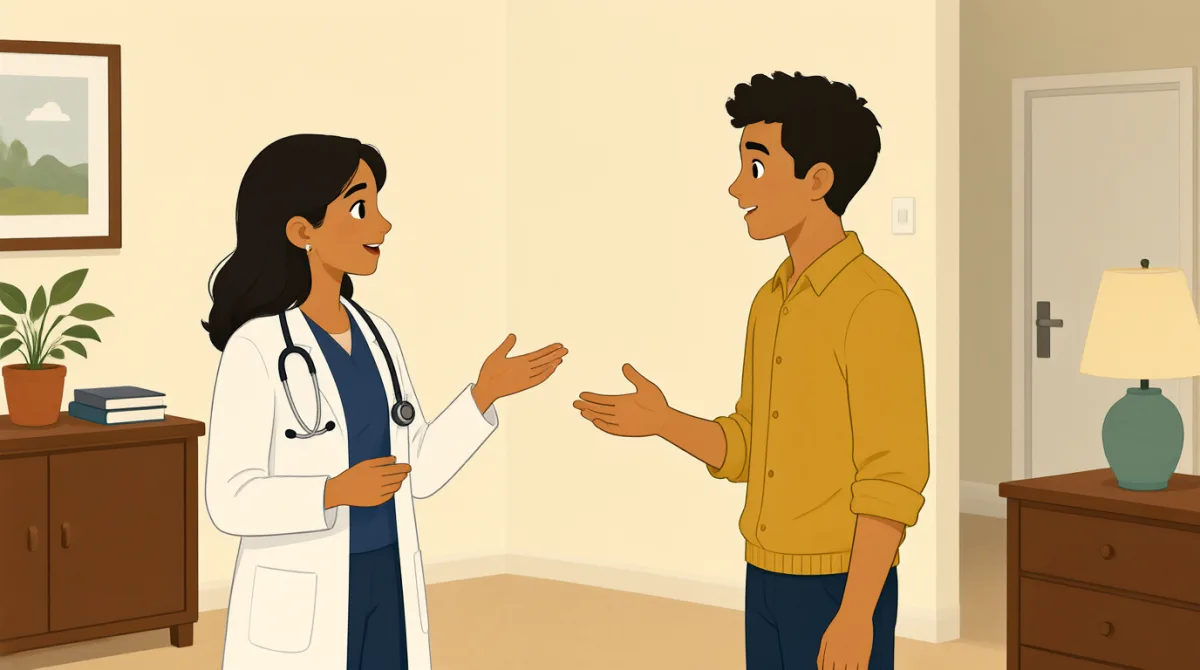

Jack, thank you for coming in. Before we look at the results, could you tell me what you understand so far about the tests and why we ordered them?

I know the scan showed something they wanted to investigate. I’ve been trying not to jump to conclusions, but I’m worried it could be cancer.
That uncertainty can be difficult to sit with. I’m afraid the results do show a serious illness: the biopsy confirms cancer in your lung. I’m very sorry to have to tell you this.
Cancer? I thought the scan might be a false alarm. Are you certain the biopsy is conclusive, or is there still a chance they’ve mistaken what they saw?
I understand why you’d want to check. The biopsy was reviewed by a specialist, and it confirms the diagnosis. I don’t want to minimize what this means, or give you reassurance I can’t support.
I can’t quite take that in. I feel as if I’ve been listening to you, but the words haven’t really landed yet.
That’s a very understandable reaction. We don’t have to cover everything at once. Would it help if I paused, or would you prefer me to explain what we know about the cancer so far?
Please explain what you know. Does this result tell you how advanced it is, or do you need more tests before you can answer that?
The biopsy tells us the type of cancer, but not yet its full extent. We need additional imaging and a few other tests before we can describe the stage or discuss a treatment plan responsibly.
I’m frightened, and I don’t know what I’m supposed to ask first. Is there anything I need to decide today, or can I have some time to process this?
You don’t need to make a treatment decision today. We’ll arrange the next tests promptly, and I’ll make sure you know whom to contact with questions. What feels most important to clarify before we finish?
Vocabulary8
- jump to conclusions
To decide what something means before you have enough information. Jack uses this phrase to describe trying not to assume the worst about his test results.
- sit with
To experience or accept a difficult feeling or uncertainty without immediately resolving it. Here, Mia acknowledges how hard it is to wait without knowing the diagnosis.
- false alarm
A warning or concerning sign that turns out not to indicate a real problem. Jack wonders whether the scan finding might have been one.
- conclusive
Providing a definite answer that leaves little room for doubt. Jack asks whether the biopsy results are conclusive.
- minimize
To make something seem less serious or important than it really is. Mia says she does not want to downplay the significance of the diagnosis.
- take that in
To understand and emotionally absorb new information. Jack uses this phrase to describe his difficulty processing the diagnosis.
- full extent
The complete size, reach, or seriousness of something. Mia explains that more tests are needed to find out how far the cancer has spread.
- process this
To take time to understand and come to terms with difficult information. Jack asks whether he can have time before making decisions.
Key Sentences8
- 1
Before we look at the results, could you tell me what you understand so far about the tests and why we ordered them?
This is a considerate way to check what someone already knows before giving important information. Reuse it by asking what someone understands so far about a situation.
- 2
I’m afraid the results do show a serious illness: the biopsy confirms cancer in your lung.
This sentence delivers difficult news clearly and directly, without hiding the diagnosis. The phrase “I’m afraid” signals that the information will be upsetting.
- 3
I don’t want to minimize what this means, or give you reassurance I can’t support.
This shows honesty and care when you cannot promise a good outcome. You can adapt it when you want to avoid downplaying a problem or making unsupported assurances.
- 4
I feel as if I’ve been listening to you, but the words haven’t really landed yet.
This expresses the shock of hearing something difficult, even when you have heard the words. The phrase “haven’t really landed yet” is a natural way to describe information that has not sunk in.
- 5
We don’t have to cover everything at once.
This reassures someone that they do not need to absorb every detail immediately. Use it to make a difficult conversation feel more manageable.
- 6
The biopsy tells us the type of cancer, but not yet its full extent.
This clearly distinguishes what is known from what still needs investigation. The structure “X tells us…, but not yet…” is useful when explaining the limits of a test or result.
- 7
You don’t need to make a treatment decision today.
This directly reduces pressure by clarifying that an immediate decision is not required. You can adapt it whenever someone needs time before making an important choice.
- 8
What feels most important to clarify before we finish?
This open-ended question gives the other person control over what to discuss next. Use it to invite questions and identify someone’s main concern.