Explaining Treatment Honestly
Dr. Patel explains the available treatment options, their likely benefits, and the uncertainties involved. Jack asks what the next few weeks may look like, and she answers without overstating what medicine can promise.
Dialogue11
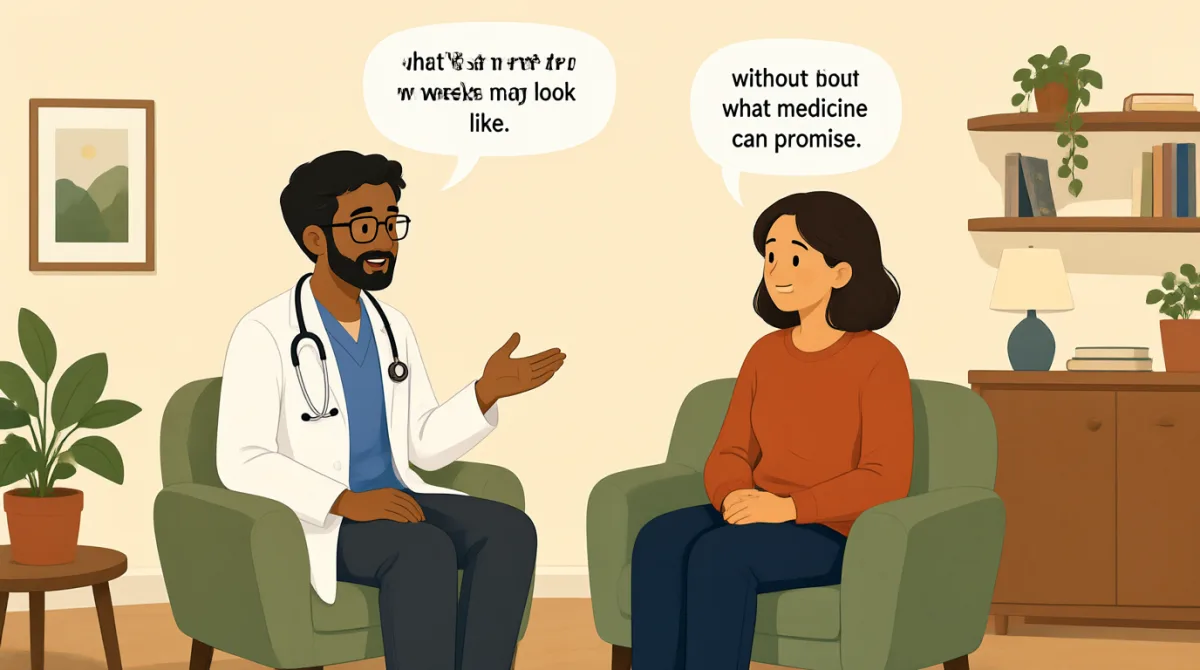

Based on the scans and biopsy, the cancer has spread beyond the original site. I’m sorry; I know that’s a lot to hear. Would it help if I walked you through the options?

Yes. I need to know what can actually be done, not just what sounds hopeful. And what are the chances treatment will work?
That’s a fair question. We can start systemic treatment to slow the cancer and, in some cases, shrink it. The evidence suggests it may help, but it can’t tell us exactly how you’ll respond.
When you say “slow it,” are we talking about buying a little time, or could I realistically get back to something like my normal life?
It could be either, and it’s too early to predict which. Some people have a meaningful response and feel well for a time; others have limited benefit or difficult side effects. I don’t want to promise more than we know.
What would the treatment involve day to day? I’m trying to picture the next few weeks, and whether I’d be able to keep working.
We’d begin with a treatment-planning visit, then give medication in cycles, with blood tests and check-ins between them. The first few weeks are partly about seeing how your body tolerates it; we can adjust the plan if needed.
So there isn’t a reliable way to know whether I’ll be too sick to work until we start? I need to make practical decisions, but I don’t want to overreact.
That’s right; people’s experiences vary. We can discuss flexible hours or time away from work, and I can provide documentation. Let’s also review which symptoms should prompt you to call us promptly.
I’d like to understand the side effects and what happens if the first treatment doesn’t help. I don’t need every answer today, but I need to know there’s a plan.
Absolutely. We’ll go through the common and serious side effects before you decide, and we’ll reassess after the first cycles. If it isn’t helping, we’ll talk through other approaches. You don’t have to make the decision this minute.
Vocabulary8
- systemic treatment
Treatment that works throughout the body rather than only at one specific site. Here, it refers to medication intended to slow or shrink the cancer.
- meaningful response
A noticeable and worthwhile improvement in how a disease responds to treatment. The phrase does not guarantee that the treatment will work for everyone.
- tolerates it
Is able to cope with a treatment and its effects. You can use “tolerate” to discuss how someone manages medication, a procedure, or another difficult experience.
- cycles
Repeated periods of treatment, often followed by time to recover or have check-ins. “Medication in cycles” describes a treatment schedule rather than taking medicine continuously.
- people’s experiences vary
People may have different results or reactions in the same situation. This is a tactful way to explain why you cannot predict exactly what will happen to one person.
- prompt you to call us promptly
Make you call without delay. “Prompt someone to” means to give them a reason to take a particular action.
- reassess
Consider something again, often after gathering new information. Here, the doctor means they will review whether the treatment is helping after the first cycles.
- talk through
Discuss something carefully, often by considering the options one by one. It can be used when helping someone understand a decision or plan.
Key Sentences8
- 1
That’s a fair question.
A concise way to acknowledge that someone’s concern is reasonable before answering. Use it in professional or personal conversations to show you are taking the question seriously.
- 2
The evidence suggests it may help, but it can’t tell us exactly how you’ll respond.
This sentence communicates what is known while clearly stating what remains uncertain. Use “the evidence suggests…” to express a cautious conclusion without presenting it as a guarantee.
- 3
I don’t want to promise more than we know.
A direct, compassionate way to avoid giving false reassurance. You can adapt the structure to other situations where you need to be honest about uncertainty.
- 4
The first few weeks are partly about seeing how your body tolerates it; we can adjust the plan if needed.
This explains both what to expect and how the plan may change based on new information. Use “we can adjust the plan if needed” to offer reassurance without promising a particular outcome.
- 5
We can discuss flexible hours or time away from work, and I can provide documentation.
This offers practical support in a clear, specific way. The structure “We can discuss X, and I can provide Y” is useful when proposing options and assistance.
- 6
I’d like to understand the side effects and what happens if the first treatment doesn’t help.
A useful way to ask about both risks and next steps before making a decision. You can adapt “I’d like to understand…” to raise concerns calmly and directly.
- 7
If it isn’t helping, we’ll talk through other approaches.
This describes a next step without claiming to know the outcome in advance. Use “If [condition], we’ll talk through…” to explain a plan that depends on how things develop.
- 8
You don’t have to make the decision this minute.
A reassuring way to give someone time to consider an important choice. “You don’t have to…” can gently remove pressure without taking away the person’s control.