Discussing Who Pays
Mia and Jack discuss how to split the repair costs, considering that the fence serves both yards. They agree to share the expense fairly and get a few quotes before deciding.
Dialogue9
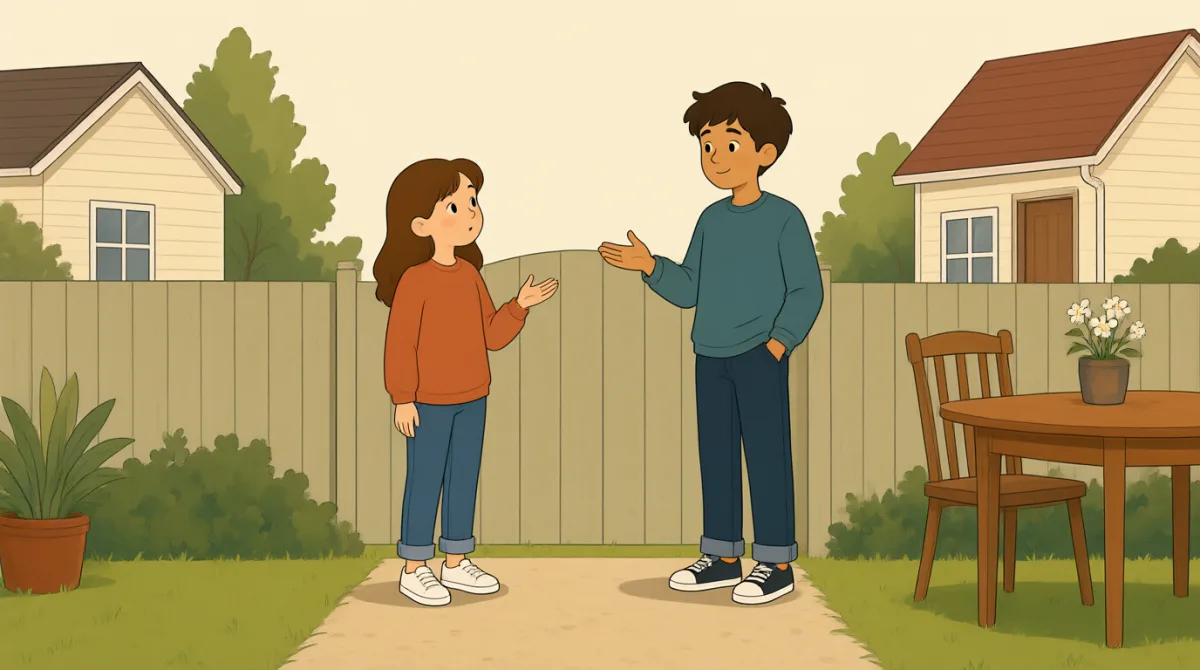

I got an estimate for the fence repair. It’s more than I expected, so we should talk about how to split the cost.

Definitely. Since the fence sits between our yards and we both use it, splitting the bill seems fair to me.
I agree, though one section on my side looks worse. Would it make sense for each of us to pay for that side?
Maybe, but the whole fence needs support. If we only fix one section, the rest could start leaning before long.
That’s a good point. I don’t want us to patch it up now and end up paying more for another repair later.
How about we share the cost of the main repair fifty-fifty? If any extra work is only for one side, we can discuss that separately.
That sounds fair. Before we decide, let’s get a couple more quotes so we know we’re not paying over the odds.
Agreed. I’ll contact two local companies, and you can check whether the estimate includes materials and cleanup.
Great. Once we compare the quotes, we can choose a reasonable option and split the final bill evenly.
Vocabulary8
- estimate
An estimate is an approximate price for a job. Here, it tells Mia how much the fence repair may cost.
- split the cost
To split the cost is to divide the expense between people. You can use this phrase when discussing how to share a bill.
- seems fair to me
This means that something feels reasonable or just in your opinion. Use it to express agreement with a suggestion.
- before long
This means soon or after a short time. Jack uses it to explain that the rest of the fence may start leaning soon.
- patch it up
To patch something up is to make a quick, limited repair. The phrase can also describe fixing a problem temporarily.
- fifty-fifty
This means divided equally, with each person paying half. It is a casual way to talk about sharing costs.
- over the odds
If you pay over the odds, you pay more than something is worth or more than a reasonable price. It is a useful phrase when comparing prices.
- evenly
Evenly means in equal amounts. Here, Mia uses it to describe how they will divide the final bill.
Key Sentences8
- 1
Since the fence sits between our yards and we both use it, splitting the bill seems fair to me.
This sentence gives a reason for sharing a cost and then states an opinion. Reuse the pattern “Since [reason], [suggestion] seems fair to me” in discussions about shared expenses.
- 2
Would it make sense for each of us to pay for that side?
This is a polite way to ask whether a suggestion is reasonable. You can reuse “Would it make sense for [person] to [action]?” when proposing a plan.
- 3
If we only fix one section, the rest could start leaning before long.
This sentence explains a possible result of doing only part of a job. Use “If we only [action], [result] could…” to point out a risk.
- 4
I don’t want us to patch it up now and end up paying more for another repair later.
This sentence explains a concern about a quick fix leading to a bigger expense. “End up + -ing” is useful for describing an unexpected final result.
- 5
How about we share the cost of the main repair fifty-fifty?
This is a friendly way to suggest an equal split. Use “How about we…?” to offer a plan or solution.
- 6
If any extra work is only for one side, we can discuss that separately.
This sentence separates a shared expense from a cost that affects only one person. Reuse “If [condition], we can discuss that separately” when agreeing on how to handle exceptions.
- 7
Before we decide, let’s get a couple more quotes so we know we’re not paying over the odds.
This sentence suggests comparing prices before making a decision. “Let’s get a couple more quotes” is useful when arranging repairs or other services.
- 8
Once we compare the quotes, we can choose a reasonable option and split the final bill evenly.
This sentence lays out the next steps in a clear order. Use “Once we [action], we can [next action]” to explain a plan.