Finding a Good Time
Emma and Leo live in different countries and want to have a video call. They talk about the time difference and choose a good time.
Dialogue8
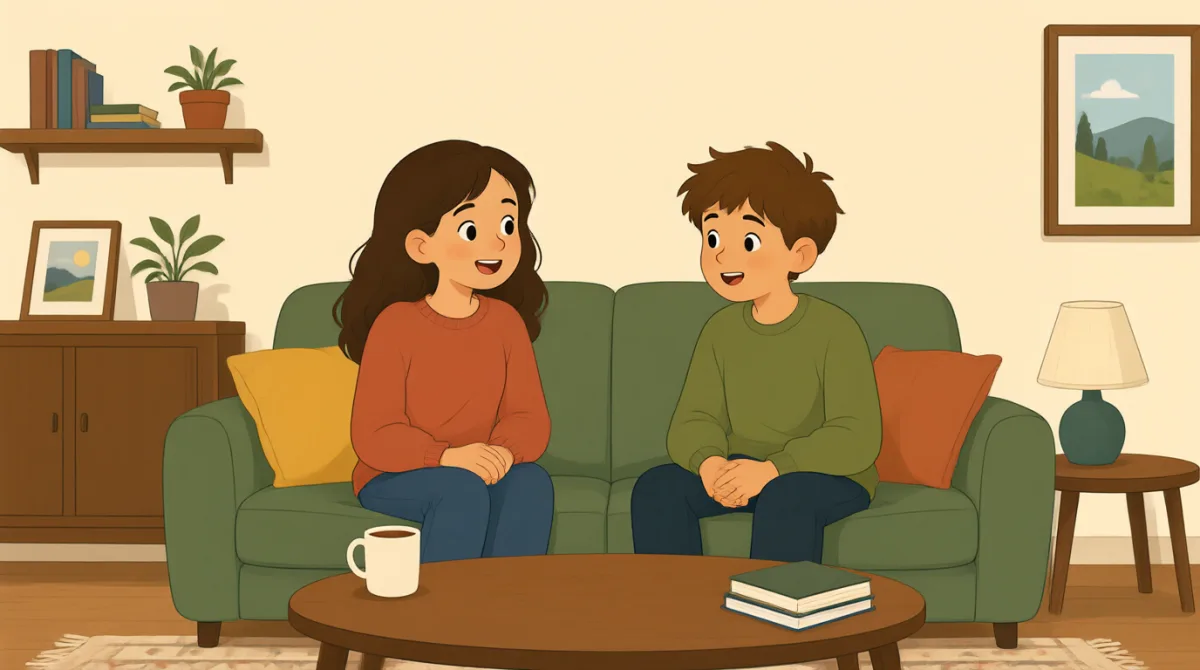

Hi, Leo! I’m glad we can talk. What time is it there?

Hi, Emma! It’s nine in the morning here. What time is it for you?
It’s six in the evening here. We have a nine-hour time difference.
Wow, that’s a big difference! When are you free tomorrow?
I’m free after work, around seven in the evening my time.
That’s ten in the morning for me. I can call then.
Great! Let’s talk tomorrow at seven my time. I’ll send you a message.
Sounds good. I’ll set a reminder so I don’t forget!
Vocabulary7
- time difference
The time difference is how many hours apart the times are in two places. Here, Emma and Leo are nine hours apart.
- free
If you are free, you have time and are not busy. You can use “When are you free?” to ask when someone is available.
- after work
This means after you finish your job for the day. Use it to say when you have time to do something.
- around seven
This means at about seven o’clock, not necessarily exactly then. Use “around” when you are giving an approximate time.
- call then
This means to phone or video-call at that time. You can say “I can call then” to agree to a suggested time.
- send you a message
This means to write and share a message with someone, often by phone. Use it to tell someone you will contact them later.
- set a reminder
This means to make a note or phone alert so you remember something. You can set a reminder for a call or appointment.
Key Sentences7
- 1
What time is it there?
Use this to ask for the current time in another place. You can replace “there” with a city or country.
- 2
We have a nine-hour time difference.
This is a clear way to explain how far apart two local times are. Replace “nine-hour” with the correct number.
- 3
When are you free tomorrow?
Use this to ask when someone is available the next day. You can change “tomorrow” to another day.
- 4
I’m free after work, around seven in the evening my time.
This sentence gives both your availability and an approximate local time. Use “my time” to make clear which time zone you mean.
- 5
I can call then.
Use this to agree to call at a time someone has just mentioned. “Then” refers to that time.
- 6
I’ll send you a message.
Use this to say you will contact someone by message in the future. You can replace “message” with details about what you will send.
- 7
I’ll set a reminder so I don’t forget!
This explains that you will make a reminder to help you remember something. Use “so I don’t forget” to say why you are doing it.