Saying Something Hurts
During a pose, Emma feels pain in her knee and tells Grace. Grace helps her stop and suggests an easier position.
Dialogue8
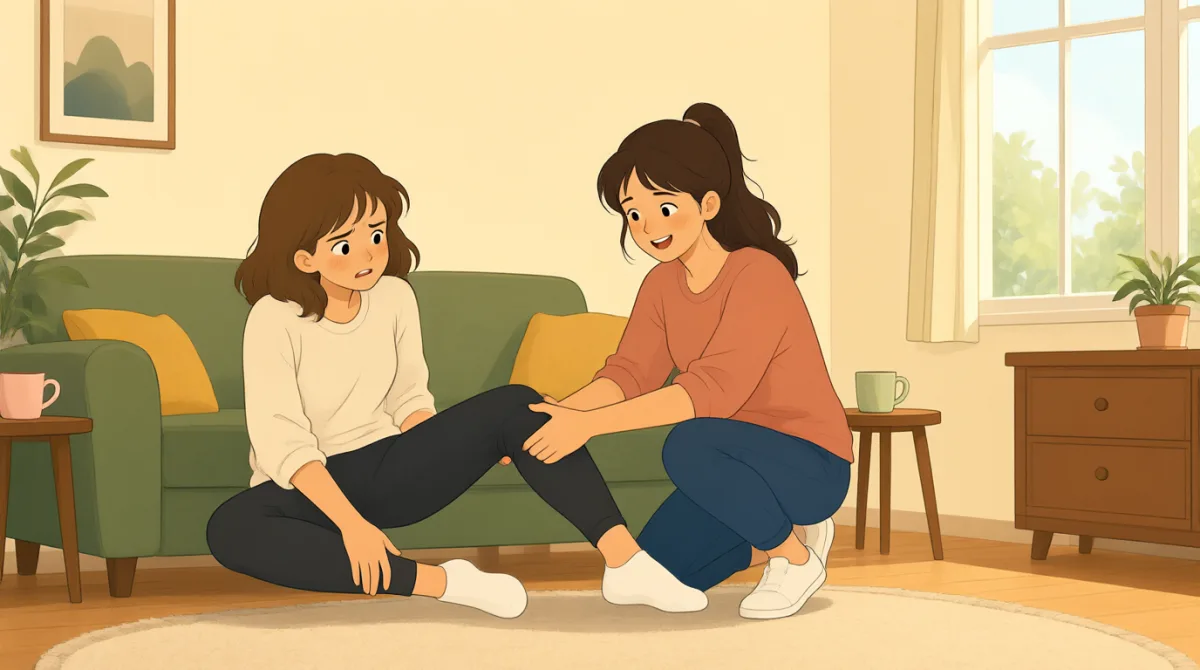

Grace, my knee hurts in this pose. Should I keep going?

No, stop and sit down for a moment. Don’t push through the pain.
Okay. It hurts when I bend my knee like this.
Try keeping your leg straight, or bend it just a little.
Like this? It feels better, but my knee is still sore.
Then rest in a comfortable position. You can skip this pose today.
Thanks. Should I tell you if it still hurts after class?
Yes, please. If the pain continues, check with your doctor before class.
Vocabulary8
- hurts
This means that you feel pain. Use it to tell someone that a part of your body is painful.
- keep going
This means to continue doing something. You can ask, “Should I keep going?” when you are unsure whether to continue.
- sit down
This means to move into a sitting position. It is a simple instruction when someone needs to rest.
- push through the pain
This means to continue an activity even though it hurts. In this conversation, Grace says not to do that.
- bend my knee
This means to move your knee so your leg is not straight. You can name another body part to describe a movement that causes pain.
- sore
This means painful or uncomfortable, often after movement or exercise. You can say, “My [body part] is still sore.”
- skip this pose
This means not to do this pose. You can use “skip” when you decide not to do an activity or part of a class.
- check with your doctor
This means to ask your doctor for advice. Use it when a health problem continues or you are worried about it.
Key Sentences8
- 1
Grace, my knee hurts in this pose.
This is a clear way to tell someone where you feel pain. Replace “my knee” with another body part to describe a different problem.
- 2
Should I keep going?
Use this question when you are unsure whether to continue an activity. You can use it during exercise, work, or another task.
- 3
Don’t push through the pain.
This is useful advice telling someone not to continue when something hurts. You can use it to encourage someone to stop and rest.
- 4
It hurts when I bend my knee like this.
This sentence explains which movement causes pain. Replace “bend my knee” with another movement to describe your situation.
- 5
It feels better, but my knee is still sore.
Use this to say that something has improved but the pain has not completely gone away. Replace “my knee” with another body part.
- 6
You can skip this pose today.
This is a gentle way to tell someone they do not need to do an activity. Replace “this pose” with another activity or task.
- 7
Should I tell you if it still hurts after class?
Use this question to ask whether someone wants an update later. You can change “after class” to another time, such as “after work.”
- 8
If the pain continues, check with your doctor before class.
This gives advice about what to do if pain does not stop. You can use “If [problem] continues” to introduce advice about an ongoing problem.