Following the Teacher
In her first class, Emma follows Grace's simple instructions for a few easy poses. She asks Grace how to position her hands and feet.
Dialogue9
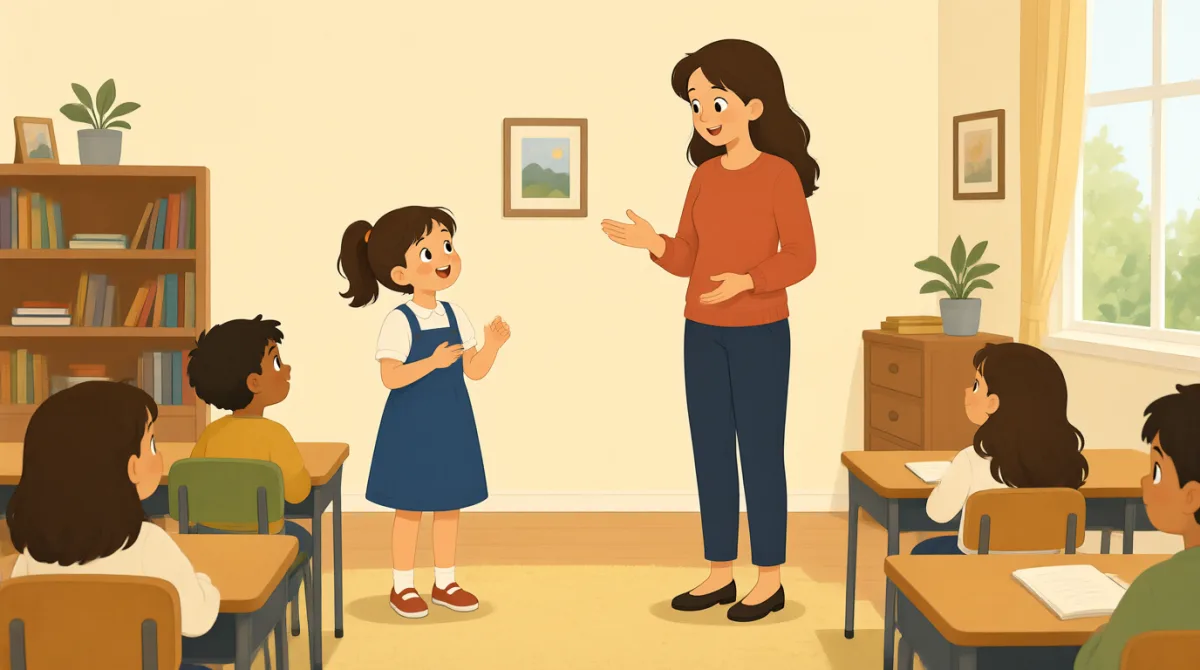

Stand with your feet hip-width apart, and let your arms rest by your sides.

Like this? Should my feet point straight ahead?
Yes, that's right. Now lift your arms slowly over your head.
Should I keep my hands together or leave some space?
Leave a little space, and keep your shoulders relaxed.
Okay. Where should I put my feet for the next pose?
Step your right foot back, and turn your left toes forward.
Is my front knee over my ankle?
Yes. Bend it gently, and keep your back leg straight.
Vocabulary7
- hip-width apart
This means with your feet separated by about the width of your hips. It describes a comfortable standing position.
- rest by your sides
This means to let your arms hang naturally next to your body. You can use “rest by your sides” to describe where to place your arms.
- point straight ahead
This means to face directly forward. It can describe the direction your feet or body should face.
- lift your arms
This means to raise your arms. You can use “lift” for other body parts or objects, too.
- keep your shoulders relaxed
This means not to tense or raise your shoulders. It is a useful instruction for staying comfortable during exercise.
- step your right foot back
This means to move your right foot behind you. You can change “right” to “left” when giving a different instruction.
- bend it gently
This means to bend your knee slowly and without using too much force. “Gently” makes the instruction sound careful and calm.
Key Sentences7
- 1
Should my feet point straight ahead?
Use this question to check the correct direction for your feet or another body part. You can replace “my feet” with another part, such as “my knees.”
- 2
Now lift your arms slowly over your head.
This is a clear instruction for moving your arms. You can reuse “Now” to introduce the next step in an activity.
- 3
Should I keep my hands together or leave some space?
Use this question when you want to choose between two positions. The pattern “Should I … or …?” is useful for checking instructions.
- 4
Leave a little space, and keep your shoulders relaxed.
This gives two simple instructions at once. You can use “keep” to tell someone to maintain a position or condition.
- 5
Where should I put my feet for the next pose?
Use this question to ask where to place your body for the next activity. You can replace “my feet” with another body part or object.
- 6
Is my front knee over my ankle?
This is a useful way to check whether one body part is in the right position. You can use the pattern “Is my … over my …?” for other alignment questions.
- 7
Bend it gently, and keep your back leg straight.
This combines two short instructions for a pose. You can use “keep … straight” to tell someone how to hold a limb or object.