Describing the Fever
At the clinic, Mia tells Dr. David when the fever started and how high it got. He asks a few simple questions about the child’s symptoms.
Dialogue9
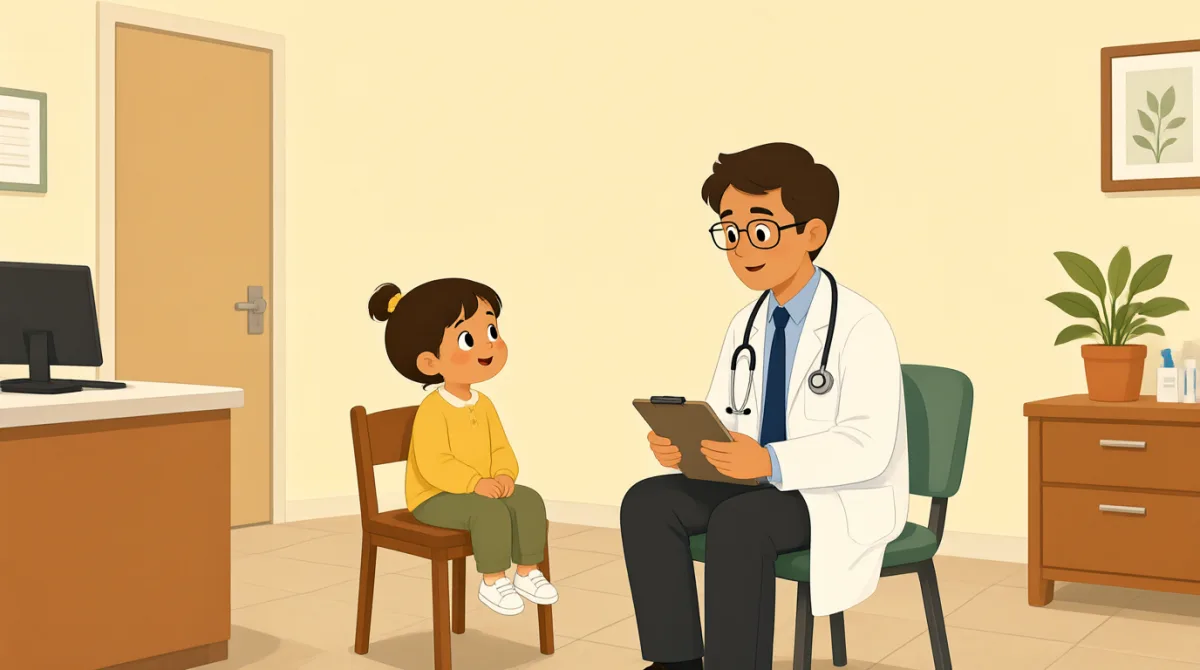

Good morning, Dr. Chen. My child has had a fever since last night.

I’m sorry to hear that. Did you take your child’s temperature?
Yes, it was 102 degrees this morning. It was lower last night.
Has your child been coughing or had a sore throat?
A little cough, but no sore throat. My child feels tired, too.
Has your child been drinking water and eating anything today?
My child drank some water, but didn’t want breakfast.
I see. Any trouble breathing, or a rash on the skin?
No, breathing is fine, and I haven’t seen a rash.
Vocabulary8
- fever
A fever is a body temperature that is higher than normal. Here, Mia says her child has been sick since last night.
- take your child’s temperature
This means to check how hot your child’s body is. You can use this phrase when asking about a child’s fever.
- 102 degrees
This tells the child’s temperature. You can use a number and “degrees” to report a temperature.
- a sore throat
A sore throat is pain or discomfort in the throat. You can ask, “Do you have a sore throat?”
- feels tired
This means someone does not have much energy. You can say, “I feel tired,” or “My child feels tired.”
- drinking water
This means having water to drink. A doctor may ask if someone is drinking water when they are sick.
- trouble breathing
This means difficulty breathing normally. You can use this phrase to describe an important symptom.
- a rash on the skin
A rash is an area of irritated or unusual skin. You can use this phrase to tell a doctor about a skin problem.
Key Sentences8
- 1
My child has had a fever since last night.
This is a useful way to say when a problem began and how long it has lasted. Reuse “has had [symptom] since [time]” to describe an ongoing symptom.
- 2
Did you take your child’s temperature?
This is a simple question a doctor can ask about a fever. Replace “temperature” with another health question to ask what someone has checked.
- 3
It was lower last night.
This compares the child’s temperature at two different times. You can use “It was lower/higher [time]” to describe how a symptom changed.
- 4
Has your child been coughing or had a sore throat?
This question asks about two common symptoms. You can use “Has your child been [verb]-ing or had [symptom]?” to ask about other problems.
- 5
My child feels tired, too.
This is a simple way to add another symptom. Use “feels [adjective], too” to mention an additional feeling.
- 6
My child drank some water, but didn’t want breakfast.
This sentence describes what the child did and did not do today. Use “but” to connect two different details.
- 7
Any trouble breathing, or a rash on the skin?
This is a short way to ask about serious symptoms. You can name two things after “Any” when checking for problems.
- 8
No, breathing is fine, and I haven’t seen a rash.
This gives a clear answer about two symptoms. You can use “I haven’t seen…” to say that you have not noticed a problem.