Washing and Cutting Vegetables
Grace shows Emma and Leo how to wash and cut the vegetables safely. Leo asks how small the pieces should be.
Dialogue9
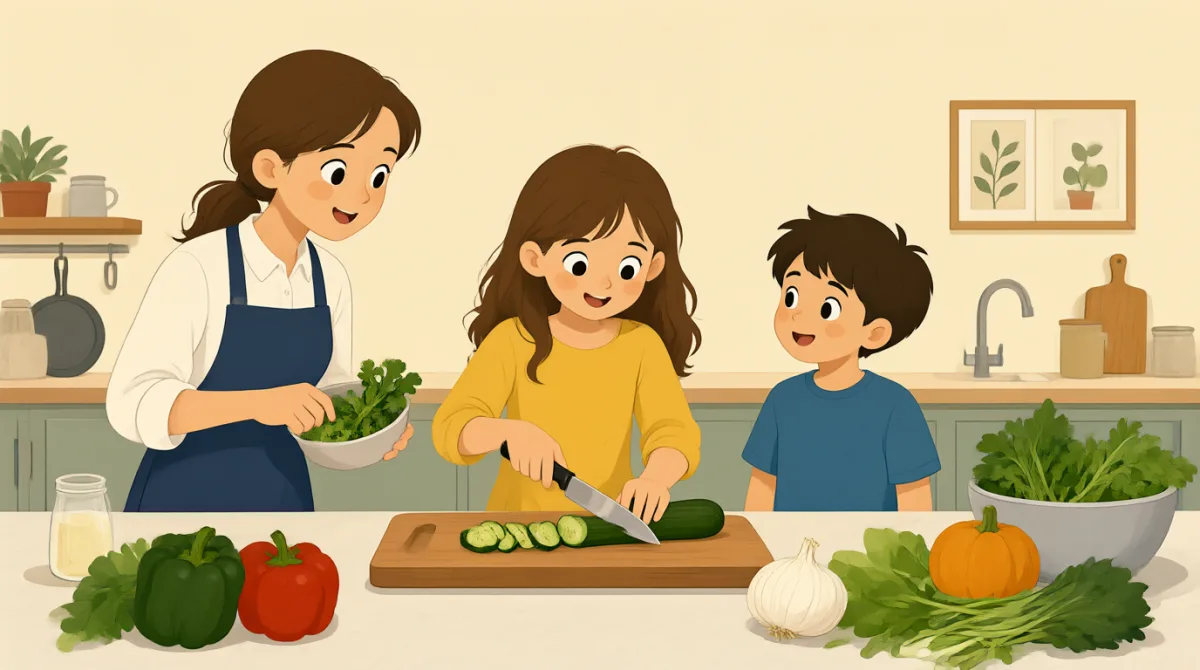

First, rinse the vegetables under cold water. Make sure you wash off all the dirt.

Should I wash the carrots too, even though we’re going to peel them?
Yes, wash them first. Then use the peeler and keep your fingers away from the blade.

Got it. Now, how small should I cut these onions?
Cut them into small pieces, about the size of your fingernail. Use the cutting board.
Okay. I’ll hold the onion still. Is this knife sharp?
Yes, so cut slowly. Curl your fingers in, and keep the knife tip on the board.
Like this? I’m going to cut the carrots into little rounds.
That’s right, Emma. Nice work. Put the cut vegetables in this bowl.
Vocabulary8
- rinse the vegetables
Wash the vegetables quickly with water. You can use this phrase when you clean vegetables before cooking.
- wash off all the dirt
Remove dirt from something by washing it. You can say this when food or another item is dirty.
- peel them
Take the thin outer skin off the vegetables. Use this phrase when preparing carrots or other vegetables.
- keep your fingers away from the blade
Move your fingers away from the sharp part of a knife. This is a useful safety instruction when cutting food.
- cut them into small pieces
Use a knife to make the vegetables into small parts. You can use this phrase to explain how you want food cut.
- hold the onion still
Keep the onion in one place while you cut it. This phrase is useful for giving safe cutting instructions.
- curl your fingers in
Bend your fingers toward your palm while holding food. This helps keep your fingers away from the knife.
- cut the carrots into little rounds
Slice the carrots into small, round pieces. You can use this phrase to describe a way of cutting vegetables.
Key Sentences8
- 1
First, rinse the vegetables under cold water.
This gives a clear first step for washing vegetables. You can reuse the pattern “First, rinse [food] under cold water” for other ingredients.
- 2
Should I wash the carrots too, even though we’re going to peel them?
This is a useful way to check whether an extra step is needed. Use “Should I [action] too, even though…?” when you are unsure.
- 3
Then use the peeler and keep your fingers away from the blade.
This sentence gives two simple instructions for peeling safely. You can use “Then use…” to give the next step in a task.
- 4
Now, how small should I cut these onions?
This is a natural way to ask about the size of food pieces. You can replace “onions” with another ingredient.
- 5
Cut them into small pieces, about the size of your fingernail.
This explains both how to cut something and how small the pieces should be. Use “about the size of…” to describe an approximate size.
- 6
I’ll hold the onion still.
This sentence says what you will do to help with a task. You can use “I’ll hold [something] still” when someone else needs to work on it.
- 7
Curl your fingers in, and keep the knife tip on the board.
This gives clear advice for cutting safely. You can use “keep [something] on…” to tell someone where to place or hold it.
- 8
Put the cut vegetables in this bowl.
This is a simple instruction for where to place prepared food. You can replace “cut vegetables” and “this bowl” with other items and containers.