Washing and Cutting Vegetables
Mycie i krojenie warzyw
Grace shows Emma and Leo how to wash and cut the vegetables safely. Leo asks how small the pieces should be.
Grace pokazuje Emmie i Leo, jak bezpiecznie myć i kroić warzywa. Leo pyta, na jak małe kawałki należy je pokroić.
Dialog9
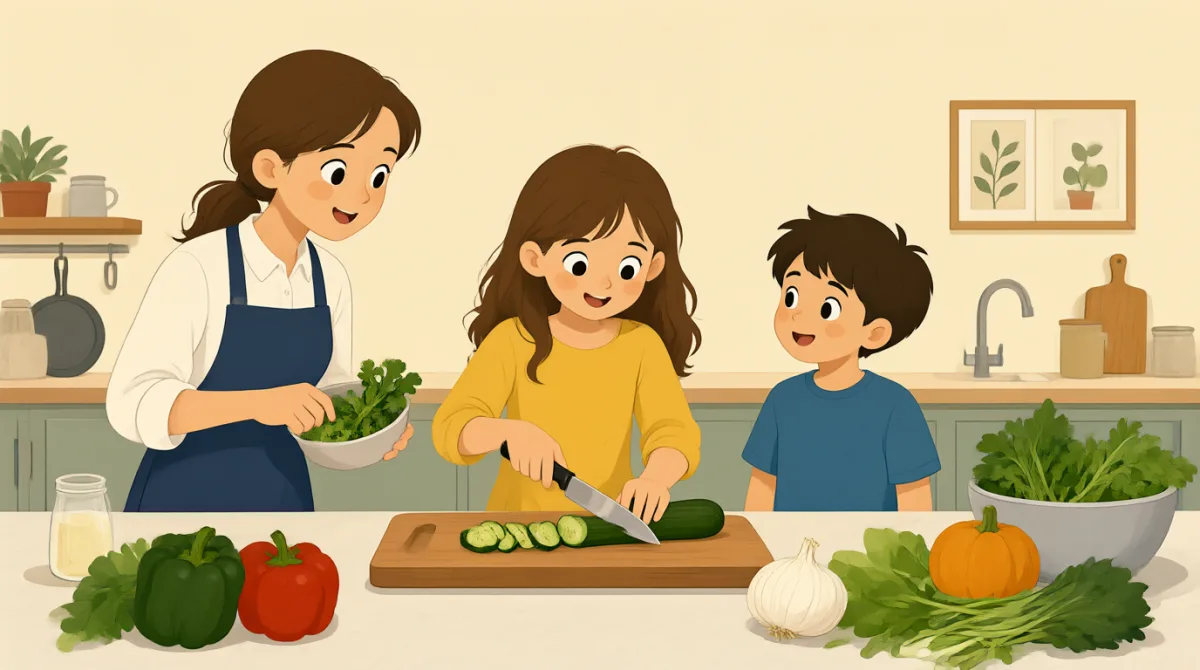

First, rinse the vegetables under cold water. Make sure you wash off all the dirt.
Najpierw opłucz warzywa pod zimną wodą. Pamiętaj, żeby zmyć cały brud.

Should I wash the carrots too, even though we’re going to peel them?
Czy marchewki też mam umyć, chociaż będziemy je obierać?
Yes, wash them first. Then use the peeler and keep your fingers away from the blade.
Tak, najpierw je umyj. Potem użyj obieraczki i trzymaj palce z dala od ostrza.

Got it. Now, how small should I cut these onions?
Jasne. A teraz, na jak małe kawałki pokroić te cebule?
Cut them into small pieces, about the size of your fingernail. Use the cutting board.
Pokrój je na małe kawałki, mniej więcej wielkości paznokcia. Użyj deski do krojenia.
Okay. I’ll hold the onion still. Is this knife sharp?
Dobra. Przytrzymam cebulę. Ten nóż jest ostry?
Yes, so cut slowly. Curl your fingers in, and keep the knife tip on the board.
Tak, więc krój powoli. Podwiń palce i trzymaj czubek noża na desce.
Like this? I’m going to cut the carrots into little rounds.
Tak? Pokroję marchewki w małe plasterki.
That’s right, Emma. Nice work. Put the cut vegetables in this bowl.
Zgadza się, Emma. Dobrze ci idzie. Włóż pokrojone warzywa do tej miski.
Słownictwo8
- rinse the vegetablesopłukać warzywa
Wash the vegetables quickly with water. You can use this phrase when you clean vegetables before cooking.
Szybko umyć warzywa wodą. Tego wyrażenia możesz użyć, gdy myjesz warzywa przed gotowaniem.
- wash off all the dirtzmyć cały brud
Remove dirt from something by washing it. You can say this when food or another item is dirty.
Usunąć brud z czegoś przez umycie. Możesz tak powiedzieć, gdy jedzenie lub inna rzecz jest brudna.
- peel themobrać je
Take the thin outer skin off the vegetables. Use this phrase when preparing carrots or other vegetables.
Zdjąć cienką zewnętrzną skórkę z warzyw. Tego wyrażenia używa się przy przygotowywaniu marchewek i innych warzyw.
- keep your fingers away from the bladetrzymać palce z dala od ostrza
Move your fingers away from the sharp part of a knife. This is a useful safety instruction when cutting food.
Odsunąć palce od ostrej części noża. To przydatna wskazówka dotycząca bezpieczeństwa podczas krojenia jedzenia.
- cut them into small piecespokroić je na małe kawałki
Use a knife to make the vegetables into small parts. You can use this phrase to explain how you want food cut.
Pokroić warzywa nożem na małe części. Tego wyrażenia możesz użyć, żeby określić, jak drobno pokroić jedzenie.
- hold the onion stillprzytrzymać cebulę
Keep the onion in one place while you cut it. This phrase is useful for giving safe cutting instructions.
Trzymać cebulę w jednym miejscu podczas krojenia. To przydatne wyrażenie, gdy instruujesz kogoś, jak bezpiecznie kroić.
- curl your fingers inpodwinąć palce
Bend your fingers toward your palm while holding food. This helps keep your fingers away from the knife.
Zgiąć palce w kierunku dłoni podczas trzymania jedzenia. Dzięki temu palce są dalej od noża.
- cut the carrots into little roundspokroić marchewki w małe plasterki
Slice the carrots into small, round pieces. You can use this phrase to describe a way of cutting vegetables.
Pokroić marchewki na małe, okrągłe kawałki. Tego wyrażenia możesz użyć, by opisać sposób krojenia warzyw.
Kluczowe zdania8
- 1
First, rinse the vegetables under cold water.
Najpierw opłucz warzywa pod zimną wodą.
This gives a clear first step for washing vegetables. You can reuse the pattern “First, rinse [food] under cold water” for other ingredients.
To jasny sposób na wskazanie pierwszego etapu mycia warzyw. Możesz używać wzoru “First, rinse [food] under cold water” (Najpierw opłucz [produkt] pod zimną wodą) w odniesieniu do innych składników.
- 2
Should I wash the carrots too, even though we’re going to peel them?
Czy marchewki też mam umyć, chociaż będziemy je obierać?
This is a useful way to check whether an extra step is needed. Use “Should I [action] too, even though…?” when you are unsure.
To przydatny sposób, by zapytać, czy trzeba wykonać dodatkową czynność. Użyj wzoru “Should I [action] too, even though…?” (Czy mam też [czynność], chociaż…?), gdy nie masz pewności.
- 3
Then use the peeler and keep your fingers away from the blade.
Potem użyj obieraczki i trzymaj palce z dala od ostrza.
This sentence gives two simple instructions for peeling safely. You can use “Then use…” to give the next step in a task.
To zdanie zawiera dwie proste wskazówki, jak bezpiecznie obrać warzywa. Możesz użyć “Then use…” (Potem użyj…), by podać kolejny etap zadania.
- 4
Now, how small should I cut these onions?
A teraz, na jak małe kawałki pokroić te cebule?
This is a natural way to ask about the size of food pieces. You can replace “onions” with another ingredient.
To naturalny sposób, by zapytać o wielkość kawałków jedzenia. Zamiast “onions” możesz wstawić nazwę innego składnika.
- 5
Cut them into small pieces, about the size of your fingernail.
Pokrój je na małe kawałki, mniej więcej wielkości paznokcia.
This explains both how to cut something and how small the pieces should be. Use “about the size of…” to describe an approximate size.
To zdanie wyjaśnia zarówno, jak coś pokroić, jak i jak małe powinny być kawałki. Użyj “about the size of…” (mniej więcej wielkości…), by opisać przybliżony rozmiar.
- 6
I’ll hold the onion still.
Przytrzymam cebulę.
This sentence says what you will do to help with a task. You can use “I’ll hold [something] still” when someone else needs to work on it.
To zdanie mówi, co zrobisz, żeby pomóc w wykonaniu zadania. Możesz użyć “I’ll hold [something] still” (Przytrzymam [coś]), gdy ktoś inny musi nad tym pracować.
- 7
Curl your fingers in, and keep the knife tip on the board.
Podwiń palce i trzymaj czubek noża na desce.
This gives clear advice for cutting safely. You can use “keep [something] on…” to tell someone where to place or hold it.
To jasna wskazówka, jak bezpiecznie kroić. Możesz użyć “keep [something] on…” (trzymaj [coś] na…), by powiedzieć komuś, gdzie coś położyć lub trzymać.
- 8
Put the cut vegetables in this bowl.
Włóż pokrojone warzywa do tej miski.
This is a simple instruction for where to place prepared food. You can replace “cut vegetables” and “this bowl” with other items and containers.
To proste polecenie mówiące, gdzie umieścić przygotowane jedzenie. Zamiast “cut vegetables” i “this bowl” możesz wstawić inne produkty i pojemniki.