Washing and Cutting Vegetables
Lavar y cortar verduras
Grace shows Emma and Leo how to wash and cut the vegetables safely. Leo asks how small the pieces should be.
Grace les enseña a Emma y Leo a lavar y cortar las verduras de forma segura. Leo pregunta qué tan pequeños deben ser los trozos.
Diálogo9
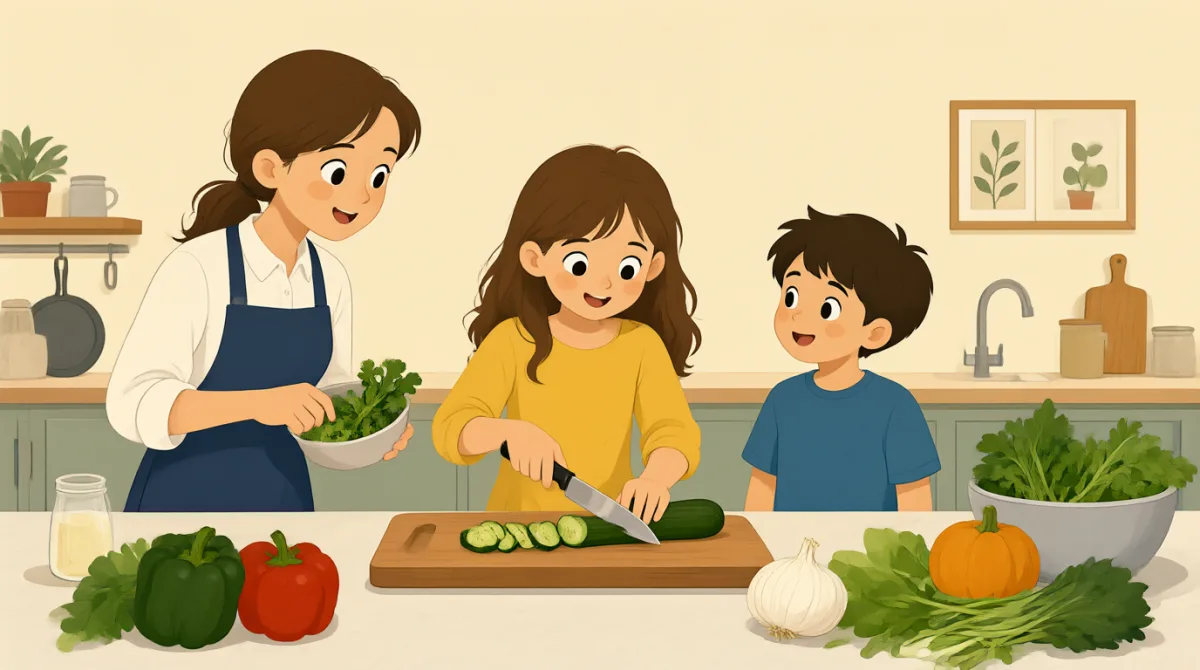

First, rinse the vegetables under cold water. Make sure you wash off all the dirt.
Primero, enjuaguen las verduras con agua fría. Asegúrense de quitarles toda la tierra.

Should I wash the carrots too, even though we’re going to peel them?
¿También lavo las zanahorias, aunque las vayamos a pelar?
Yes, wash them first. Then use the peeler and keep your fingers away from the blade.
Sí, lávalas primero. Luego usa el pelador y mantén los dedos alejados de la cuchilla.

Got it. Now, how small should I cut these onions?
Entendido. Y ahora, ¿qué tan pequeñas corto estas cebollas?
Cut them into small pieces, about the size of your fingernail. Use the cutting board.
Córtalas en trozos pequeños, más o menos del tamaño de una uña. Usa la tabla de cortar.
Okay. I’ll hold the onion still. Is this knife sharp?
Está bien. Voy a sujetar la cebolla para que no se mueva. ¿Este cuchillo está afilado?
Yes, so cut slowly. Curl your fingers in, and keep the knife tip on the board.
Sí, así que corta despacio. Dobla los dedos hacia adentro y mantén la punta del cuchillo sobre la tabla.
Like this? I’m going to cut the carrots into little rounds.
¿Así? Voy a cortar las zanahorias en rodajitas.
That’s right, Emma. Nice work. Put the cut vegetables in this bowl.
Así está bien, Emma. Muy bien. Pon las verduras cortadas en este bol.
Vocabulario8
- rinse the vegetablesenjuagar las verduras
Wash the vegetables quickly with water. You can use this phrase when you clean vegetables before cooking.
Lavar las verduras rápidamente con agua. Puedes usar esta expresión para limpiar las verduras antes de cocinar.
- wash off all the dirtquitar toda la tierra
Remove dirt from something by washing it. You can say this when food or another item is dirty.
Quitar la tierra de algo lavándolo. Puedes decirlo cuando la comida u otro objeto está sucio.
- peel thempelarlas
Take the thin outer skin off the vegetables. Use this phrase when preparing carrots or other vegetables.
Quitarles la fina capa exterior a las verduras. Usa esta expresión cuando prepares zanahorias u otras verduras.
- keep your fingers away from the blademantener los dedos alejados de la cuchilla
Move your fingers away from the sharp part of a knife. This is a useful safety instruction when cutting food.
Apartar los dedos de la parte afilada de un cuchillo. Es una instrucción de seguridad útil al cortar alimentos.
- cut them into small piecescortarlas en trozos pequeños
Use a knife to make the vegetables into small parts. You can use this phrase to explain how you want food cut.
Usar un cuchillo para dividir las verduras en trozos pequeños. Puedes usar esta expresión para explicar cómo quieres que corten la comida.
- hold the onion stillsujetar la cebolla para que no se mueva
Keep the onion in one place while you cut it. This phrase is useful for giving safe cutting instructions.
Mantener la cebolla en su sitio mientras la cortas. Esta expresión es útil para dar instrucciones seguras al cortar.
- curl your fingers indoblar los dedos hacia adentro
Bend your fingers toward your palm while holding food. This helps keep your fingers away from the knife.
Doblar los dedos hacia la palma mientras sujetas la comida. Así mantienes los dedos alejados del cuchillo.
- cut the carrots into little roundscortar las zanahorias en rodajitas
Slice the carrots into small, round pieces. You can use this phrase to describe a way of cutting vegetables.
Cortar las zanahorias en trozos pequeños y redondos. Puedes usar esta expresión para describir una forma de cortar verduras.
Frases clave8
- 1
First, rinse the vegetables under cold water.
Primero, enjuaguen las verduras con agua fría.
This gives a clear first step for washing vegetables. You can reuse the pattern “First, rinse [food] under cold water” for other ingredients.
Esta frase indica claramente el primer paso para lavar las verduras. Puedes usar el patrón “First, rinse [food] under cold water” para hablar de otros ingredientes.
- 2
Should I wash the carrots too, even though we’re going to peel them?
¿También lavo las zanahorias, aunque las vayamos a pelar?
This is a useful way to check whether an extra step is needed. Use “Should I [action] too, even though…?” when you are unsure.
Esta es una forma útil de preguntar si hace falta hacer algo más. Usa “Should I [action] too, even though…?” cuando tengas dudas.
- 3
Then use the peeler and keep your fingers away from the blade.
Luego usa el pelador y mantén los dedos alejados de la cuchilla.
This sentence gives two simple instructions for peeling safely. You can use “Then use…” to give the next step in a task.
Esta frase da dos instrucciones sencillas para pelar algo de forma segura. Puedes usar “Then use…” para indicar el siguiente paso de una tarea.
- 4
Now, how small should I cut these onions?
Y ahora, ¿qué tan pequeñas corto estas cebollas?
This is a natural way to ask about the size of food pieces. You can replace “onions” with another ingredient.
Esta es una forma natural de preguntar por el tamaño de los trozos de comida. Puedes reemplazar “onions” por otro ingrediente.
- 5
Cut them into small pieces, about the size of your fingernail.
Córtalas en trozos pequeños, más o menos del tamaño de una uña.
This explains both how to cut something and how small the pieces should be. Use “about the size of…” to describe an approximate size.
Esta frase explica cómo cortar algo y qué tamaño deben tener los trozos. Usa “about the size of…” para describir un tamaño aproximado.
- 6
I’ll hold the onion still.
Voy a sujetar la cebolla para que no se mueva.
This sentence says what you will do to help with a task. You can use “I’ll hold [something] still” when someone else needs to work on it.
Esta frase expresa lo que harás para ayudar con una tarea. Puedes usar “I’ll hold [something] still” cuando otra persona necesite trabajar con algo.
- 7
Curl your fingers in, and keep the knife tip on the board.
Dobla los dedos hacia adentro y mantén la punta del cuchillo sobre la tabla.
This gives clear advice for cutting safely. You can use “keep [something] on…” to tell someone where to place or hold it.
Esta frase da consejos claros para cortar de forma segura. Puedes usar “keep [something] on…” para decirle a alguien dónde colocar o mantener algo.
- 8
Put the cut vegetables in this bowl.
Pon las verduras cortadas en este bol.
This is a simple instruction for where to place prepared food. You can replace “cut vegetables” and “this bowl” with other items and containers.
Esta es una instrucción sencilla para indicar dónde colocar la comida preparada. Puedes reemplazar “cut vegetables” y “this bowl” por otros alimentos y recipientes.