Washing and Cutting Vegetables
Gemüse waschen und schneiden
Grace shows Emma and Leo how to wash and cut the vegetables safely. Leo asks how small the pieces should be.
Grace zeigt Emma und Leo, wie man Gemüse sicher wäscht und schneidet. Leo fragt, wie klein die Stücke sein sollen.
Dialog9
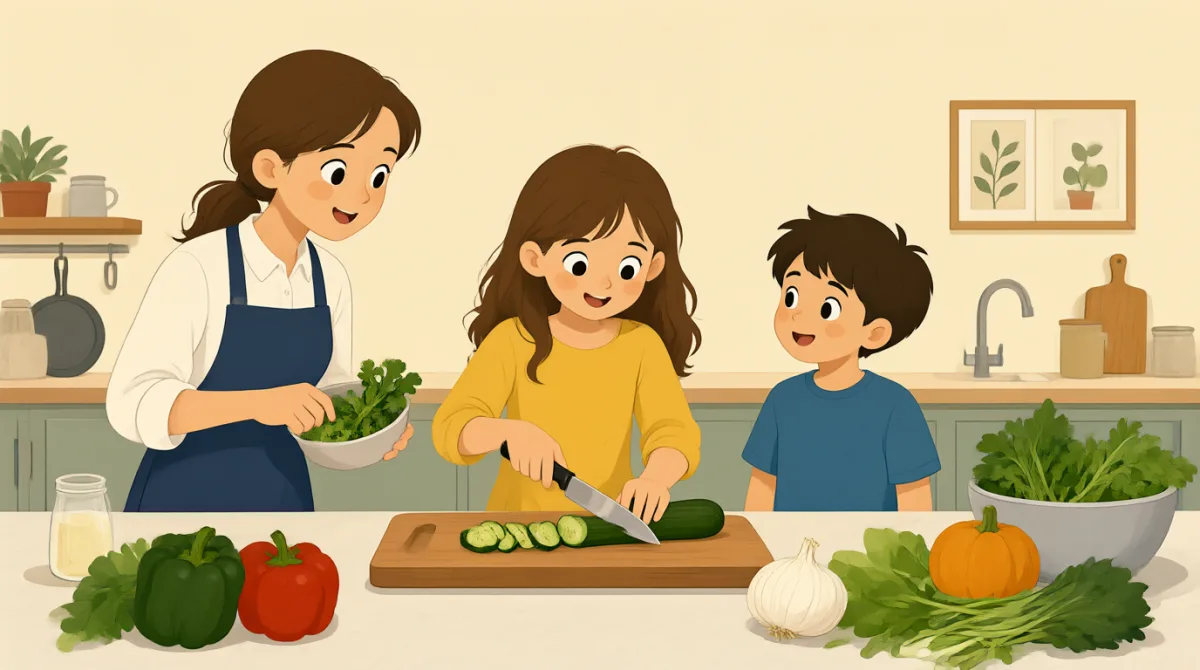

First, rinse the vegetables under cold water. Make sure you wash off all the dirt.
Spült das Gemüse zuerst unter kaltem Wasser ab. Achtet darauf, den ganzen Schmutz abzuwaschen.

Should I wash the carrots too, even though we’re going to peel them?
Soll ich die Karotten auch waschen, obwohl wir sie schälen werden?
Yes, wash them first. Then use the peeler and keep your fingers away from the blade.
Ja, wasch sie zuerst. Nimm dann den Sparschäler und halte deine Finger von der Klinge fern.

Got it. Now, how small should I cut these onions?
Alles klar. Wie klein soll ich diese Zwiebeln schneiden?
Cut them into small pieces, about the size of your fingernail. Use the cutting board.
Schneid sie in kleine Stücke, etwa so groß wie dein Fingernagel. Benutz das Schneidebrett.
Okay. I’ll hold the onion still. Is this knife sharp?
Okay. Ich halte die Zwiebel fest. Ist dieses Messer scharf?
Yes, so cut slowly. Curl your fingers in, and keep the knife tip on the board.
Ja, also schneid langsam. Krümm die Finger nach innen und lass die Messerspitze auf dem Brett.
Like this? I’m going to cut the carrots into little rounds.
So? Ich schneide die Karotten in kleine Scheiben.
That’s right, Emma. Nice work. Put the cut vegetables in this bowl.
Genau, Emma. Gut gemacht. Leg das geschnittene Gemüse in diese Schüssel.
Wortschatz8
- rinse the vegetablesdas Gemüse abspülen
Wash the vegetables quickly with water. You can use this phrase when you clean vegetables before cooking.
Das Gemüse kurz mit Wasser waschen. Diese Wendung kannst du verwenden, wenn du Gemüse vor dem Kochen sauber machst.
- wash off all the dirtden ganzen Schmutz abwaschen
Remove dirt from something by washing it. You can say this when food or another item is dirty.
Schmutz von etwas entfernen, indem man es wäscht. Das kannst du sagen, wenn Lebensmittel oder ein anderer Gegenstand schmutzig sind.
- peel themsie schälen
Take the thin outer skin off the vegetables. Use this phrase when preparing carrots or other vegetables.
Die dünne äußere Schicht des Gemüses entfernen. Diese Wendung passt, wenn du Karotten oder anderes Gemüse zubereitest.
- keep your fingers away from the bladedie Finger von der Klinge fernhalten
Move your fingers away from the sharp part of a knife. This is a useful safety instruction when cutting food.
Die Finger von der scharfen Seite eines Messers wegbewegen. Das ist ein nützlicher Sicherheitshinweis beim Schneiden von Lebensmitteln.
- cut them into small piecessie in kleine Stücke schneiden
Use a knife to make the vegetables into small parts. You can use this phrase to explain how you want food cut.
Das Gemüse mit einem Messer in kleine Teile schneiden. Mit dieser Wendung kannst du erklären, wie etwas geschnitten werden soll.
- hold the onion stilldie Zwiebel festhalten
Keep the onion in one place while you cut it. This phrase is useful for giving safe cutting instructions.
Die Zwiebel beim Schneiden an einer Stelle halten. Diese Wendung eignet sich für sichere Schneideanweisungen.
- curl your fingers indie Finger nach innen krümmen
Bend your fingers toward your palm while holding food. This helps keep your fingers away from the knife.
Die Finger beim Festhalten von Lebensmitteln zur Handfläche beugen. So bleiben sie vom Messer fern.
- cut the carrots into little roundsdie Karotten in kleine Scheiben schneiden
Slice the carrots into small, round pieces. You can use this phrase to describe a way of cutting vegetables.
Die Karotten in kleine, runde Stücke schneiden. Mit dieser Wendung kannst du beschreiben, wie man Gemüse schneidet.
Wichtige Sätze8
- 1
First, rinse the vegetables under cold water.
First, rinse the vegetables under cold water.
This gives a clear first step for washing vegetables. You can reuse the pattern “First, rinse [food] under cold water” for other ingredients.
Damit wird der erste Schritt beim Waschen von Gemüse klar angegeben. Das Muster “First, rinse [food] under cold water” kannst du auch für andere Zutaten verwenden.
- 2
Should I wash the carrots too, even though we’re going to peel them?
Should I wash the carrots too, even though we’re going to peel them?
This is a useful way to check whether an extra step is needed. Use “Should I [action] too, even though…?” when you are unsure.
So kannst du nachfragen, ob ein zusätzlicher Schritt nötig ist. Verwende “Should I [action] too, even though…?”, wenn du unsicher bist.
- 3
Then use the peeler and keep your fingers away from the blade.
Then use the peeler and keep your fingers away from the blade.
This sentence gives two simple instructions for peeling safely. You can use “Then use…” to give the next step in a task.
Dieser Satz enthält zwei einfache Anweisungen zum sicheren Schälen. Mit “Then use…” kannst du den nächsten Arbeitsschritt angeben.
- 4
Now, how small should I cut these onions?
Now, how small should I cut these onions?
This is a natural way to ask about the size of food pieces. You can replace “onions” with another ingredient.
So fragst du ganz natürlich, wie groß die Lebensmittelstücke sein sollen. Du kannst “onions” durch eine andere Zutat ersetzen.
- 5
Cut them into small pieces, about the size of your fingernail.
Cut them into small pieces, about the size of your fingernail.
This explains both how to cut something and how small the pieces should be. Use “about the size of…” to describe an approximate size.
Hier wird erklärt, wie etwas geschnitten werden soll und wie klein die Stücke sein sollen. Mit “about the size of…” beschreibst du eine ungefähre Größe.
- 6
I’ll hold the onion still.
I’ll hold the onion still.
This sentence says what you will do to help with a task. You can use “I’ll hold [something] still” when someone else needs to work on it.
Mit diesem Satz sagst du, was du tun wirst, um bei einer Aufgabe zu helfen. “I’ll hold [something] still” kannst du verwenden, wenn jemand anderes daran arbeiten muss.
- 7
Curl your fingers in, and keep the knife tip on the board.
Curl your fingers in, and keep the knife tip on the board.
This gives clear advice for cutting safely. You can use “keep [something] on…” to tell someone where to place or hold it.
Das ist ein klarer Sicherheitshinweis fürs Schneiden. Mit “keep [something] on…” kannst du jemandem sagen, wo etwas liegen oder gehalten werden soll.
- 8
Put the cut vegetables in this bowl.
Put the cut vegetables in this bowl.
This is a simple instruction for where to place prepared food. You can replace “cut vegetables” and “this bowl” with other items and containers.
Das ist eine einfache Anweisung, wohin die vorbereiteten Lebensmittel gelegt werden sollen. Du kannst “cut vegetables” und “this bowl” durch andere Lebensmittel und Behälter ersetzen.