Washing and Cutting Vegetables
채소 씻고 썰기
Grace shows Emma and Leo how to wash and cut the vegetables safely. Leo asks how small the pieces should be.
그레이스가 에마와 레오에게 채소를 안전하게 씻고 써는 방법을 알려 줘요. 레오는 채소를 얼마나 작게 썰어야 하는지 물어봐요.
대화9
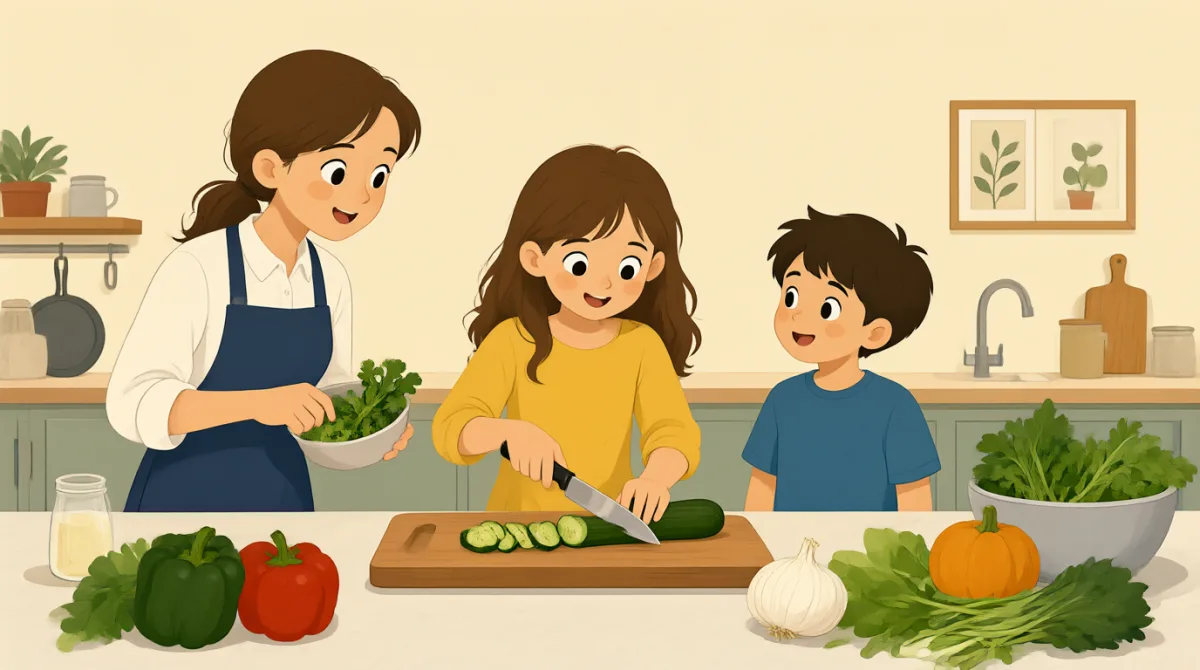

First, rinse the vegetables under cold water. Make sure you wash off all the dirt.
먼저 채소를 찬물에 헹궈. 흙이 다 씻겨 나가도록 잘 씻어.

Should I wash the carrots too, even though we’re going to peel them?
껍질을 벗길 건데도 당근을 씻어야 해?
Yes, wash them first. Then use the peeler and keep your fingers away from the blade.
응, 먼저 씻어. 그다음 필러를 쓰고 칼날에 손가락이 닿지 않게 해.

Got it. Now, how small should I cut these onions?
알았어. 이제 양파를 얼마나 작게 썰면 돼?
Cut them into small pieces, about the size of your fingernail. Use the cutting board.
손톱만 한 크기로 작게 썰어. 도마를 써.
Okay. I’ll hold the onion still. Is this knife sharp?
좋아. 양파를 움직이지 않게 잡을게. 이 칼 날카로워?
Yes, so cut slowly. Curl your fingers in, and keep the knife tip on the board.
응, 그러니까 천천히 썰어. 손가락을 안쪽으로 말고 칼끝은 도마에 대고 있어.
Like this? I’m going to cut the carrots into little rounds.
이렇게? 당근은 작고 동그랗게 썰게.
That’s right, Emma. Nice work. Put the cut vegetables in this bowl.
맞아, 에마. 잘했어. 썬 채소는 이 그릇에 담아.
어휘8
- rinse the vegetables채소를 헹구다
Wash the vegetables quickly with water. You can use this phrase when you clean vegetables before cooking.
채소를 물로 빠르게 씻는다는 뜻이에요. 요리하기 전에 채소를 씻을 때 쓸 수 있는 표현이에요.
- wash off all the dirt흙을 다 씻어 내다
Remove dirt from something by washing it. You can say this when food or another item is dirty.
무언가를 씻어서 흙을 없앤다는 뜻이에요. 음식이나 다른 물건에 흙이 묻었을 때 쓸 수 있어요.
- peel them껍질을 벗기다
Take the thin outer skin off the vegetables. Use this phrase when preparing carrots or other vegetables.
채소의 얇은 겉껍질을 벗긴다는 뜻이에요. 당근 같은 채소를 손질할 때 쓸 수 있는 표현이에요.
- keep your fingers away from the blade칼날에 손가락이 닿지 않게 하다
Move your fingers away from the sharp part of a knife. This is a useful safety instruction when cutting food.
손가락을 칼의 날카로운 부분에서 멀리 두라는 뜻이에요. 음식을 썰 때 안전을 위해 유용한 지시예요.
- cut them into small pieces작게 썰다
Use a knife to make the vegetables into small parts. You can use this phrase to explain how you want food cut.
칼을 사용해 채소를 작은 조각으로 만든다는 뜻이에요. 음식을 어떻게 썰면 좋을지 설명할 때 쓸 수 있어요.
- hold the onion still양파를 움직이지 않게 잡다
Keep the onion in one place while you cut it. This phrase is useful for giving safe cutting instructions.
양파를 써는 동안 한자리에 고정해 둔다는 뜻이에요. 안전하게 써는 방법을 알려 줄 때 유용한 표현이에요.
- curl your fingers in손가락을 안쪽으로 말다
Bend your fingers toward your palm while holding food. This helps keep your fingers away from the knife.
음식을 잡은 채 손가락을 손바닥 쪽으로 굽힌다는 뜻이에요. 이렇게 하면 손가락이 칼에 닿지 않게 할 수 있어요.
- cut the carrots into little rounds당근을 작고 동그랗게 썰다
Slice the carrots into small, round pieces. You can use this phrase to describe a way of cutting vegetables.
당근을 작고 둥근 조각으로 썬다는 뜻이에요. 채소를 써는 방법을 설명할 때 쓸 수 있는 표현이에요.
핵심 문장8
- 1
First, rinse the vegetables under cold water.
먼저 채소를 찬물에 헹궈.
This gives a clear first step for washing vegetables. You can reuse the pattern “First, rinse [food] under cold water” for other ingredients.
채소를 씻는 첫 단계를 명확하게 알려 주는 문장이에요. 다른 재료에도 “First, rinse [food] under cold water”라는 표현을 활용할 수 있어요.
- 2
Should I wash the carrots too, even though we’re going to peel them?
껍질을 벗길 건데도 당근을 씻어야 해?
This is a useful way to check whether an extra step is needed. Use “Should I [action] too, even though…?” when you are unsure.
추가로 어떤 단계가 필요한지 확인할 때 유용한 표현이에요. 확실하지 않을 때 “Should I [action] too, even though…?”라고 물어보세요.
- 3
Then use the peeler and keep your fingers away from the blade.
그다음 필러를 쓰고 칼날에 손가락이 닿지 않게 해.
This sentence gives two simple instructions for peeling safely. You can use “Then use…” to give the next step in a task.
이 문장은 안전하게 껍질을 벗기는 방법을 두 가지 간단한 지시로 알려 줘요. 어떤 작업의 다음 단계를 말할 때 “Then use…”라고 할 수 있어요.
- 4
Now, how small should I cut these onions?
이제 양파를 얼마나 작게 썰면 돼?
This is a natural way to ask about the size of food pieces. You can replace “onions” with another ingredient.
음식 조각의 크기를 물어볼 때 자연스럽게 쓸 수 있는 표현이에요. “onions” 대신 다른 재료를 넣어도 돼요.
- 5
Cut them into small pieces, about the size of your fingernail.
손톱만 한 크기로 작게 썰어.
This explains both how to cut something and how small the pieces should be. Use “about the size of…” to describe an approximate size.
무언가를 어떻게 썰지, 조각을 얼마나 작게 만들지 모두 설명하는 문장이에요. 대략적인 크기를 말할 때 “about the size of…”를 사용하세요.
- 6
I’ll hold the onion still.
양파를 움직이지 않게 잡을게.
This sentence says what you will do to help with a task. You can use “I’ll hold [something] still” when someone else needs to work on it.
어떤 일을 도우려고 자신이 할 일을 말하는 문장이에요. 다른 사람이 무언가를 작업해야 할 때 “I’ll hold [something] still”이라고 할 수 있어요.
- 7
Curl your fingers in, and keep the knife tip on the board.
손가락을 안쪽으로 말고 칼끝은 도마에 대고 있어.
This gives clear advice for cutting safely. You can use “keep [something] on…” to tell someone where to place or hold it.
안전하게 써는 방법을 명확하게 알려 주는 표현이에요. 어떤 것을 어디에 두거나 대고 있어야 하는지 말할 때 “keep [something] on…”을 쓸 수 있어요.
- 8
Put the cut vegetables in this bowl.
썬 채소는 이 그릇에 담아.
This is a simple instruction for where to place prepared food. You can replace “cut vegetables” and “this bowl” with other items and containers.
손질한 음식을 어디에 둘지 간단히 알려 주는 지시예요. “cut vegetables”와 “this bowl”을 다른 음식이나 용기로 바꿔 쓸 수 있어요.