Following the Recipe
The class follows the recipe and adds the ingredients to a pot. Grace explains when to stir and how long to cook the food.
Dialogue9
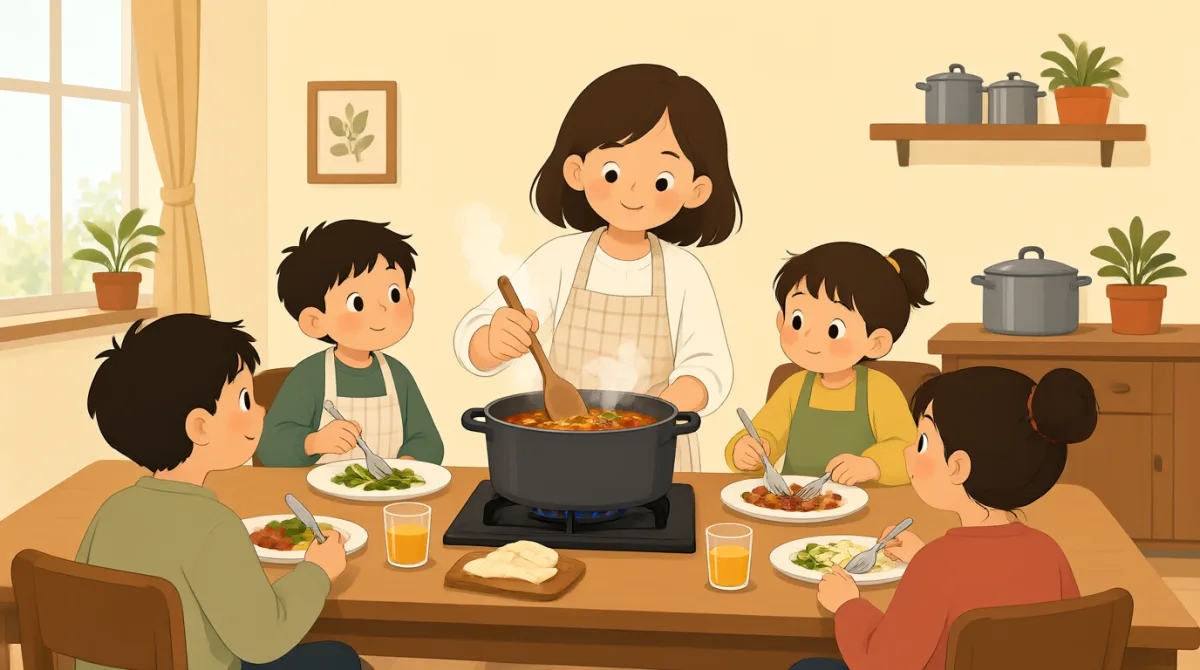

Now, read the recipe. First, pour two cups of water into the pot.

Should I add the tomatoes now, or wait until the water gets hot?
Wait until it boils. Then add the tomatoes, beans, and a little salt.

How long should we cook everything? I don't want to burn lunch.
Cook it for ten minutes. Stir it gently every few minutes.
The soup is bubbling now. Should I turn the heat down?
Yes, turn it down to low. Keep stirring so nothing sticks.
I stirred it, and the beans feel soft. Can we taste it now?
Sure. Take a small spoonful, and tell me if it needs more salt.
Vocabulary8
- pour two cups of water
This means to put two cups of water into the pot. You can use “pour” when adding a liquid to a container.
- until it boils
This means to wait until the water gets very hot and starts bubbling. You can say “until it boils” when explaining when to do something.
- add the tomatoes
This means to put the tomatoes into the pot. Use “add” when putting an ingredient into food.
- stir it gently
This means to mix the food slowly and carefully with a spoon. You can use “stir gently” when giving cooking instructions.
- turn it down to low
This means to lower the heat to a low setting. You can use this phrase when a dish needs to cook more slowly.
- sticks
Here, “sticks” means food gets attached to the bottom of the pot. You can say “so nothing sticks” when explaining why you should stir.
- a small spoonful
This means a small amount of food that fits on a spoon. Use it when tasting food or serving a little.
- needs more salt
This means the food may need extra salt to taste better. You can use this phrase when asking someone to check the flavor.
Key Sentences8
- 1
First, pour two cups of water into the pot.
This gives a clear first step in a recipe. You can reuse the pattern “First, pour [amount] of [liquid] into the [container].”
- 2
Should I add the tomatoes now, or wait until the water gets hot?
This is a useful way to ask whether to do something now or later. Replace “add the tomatoes” with another task to ask about the right time.
- 3
Cook it for ten minutes.
This tells someone how long to cook something. You can use “Cook it for [time]” to give a simple cooking instruction.
- 4
Stir it gently every few minutes.
This gives both the action and how often to do it. You can change “gently” or “every few minutes” to give different instructions.
- 5
Yes, turn it down to low.
This is a short, practical instruction for lowering the heat. You can replace “low” with another heat setting, such as “medium.”
- 6
Keep stirring so nothing sticks.
This explains what to keep doing and why. Use “Keep [verb]-ing so [result]” to give a helpful reminder.
- 7
Can we taste it now?
This is a simple way to ask if it is okay to try some food. You can replace “taste it” with another action to ask permission.
- 8
Take a small spoonful, and tell me if it needs more salt.
This gives someone two clear steps: taste a little and say what the food needs. You can replace “more salt” with another ingredient or seasoning.