Washing and Cutting Vegetables
Lavando e cortando legumes
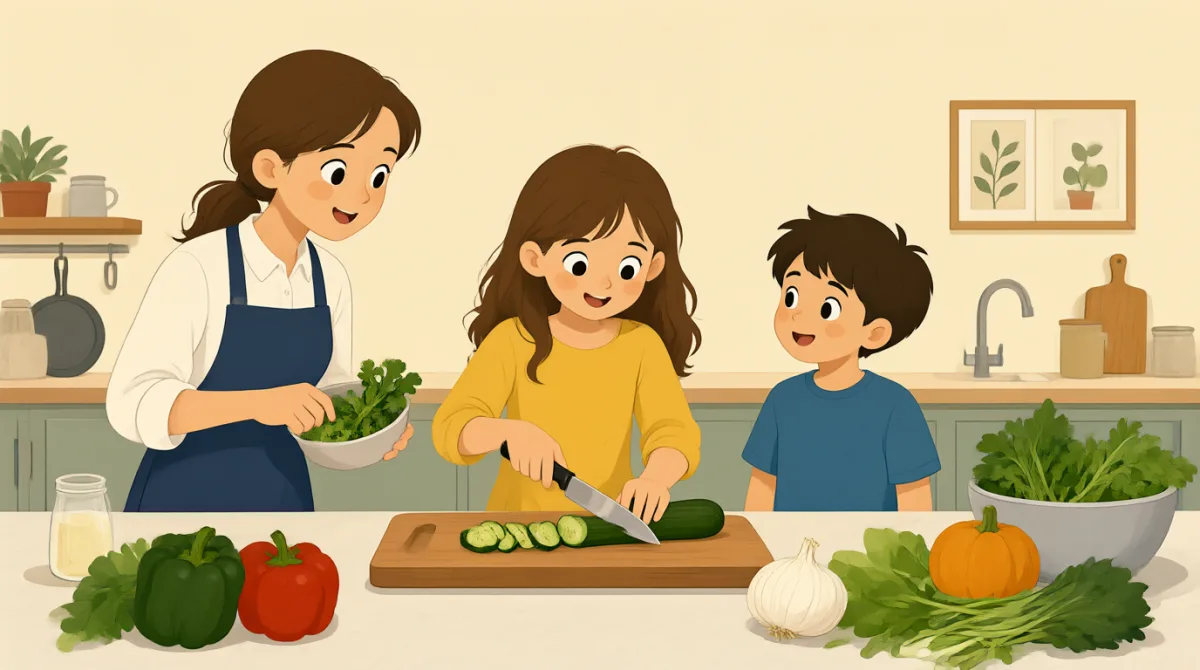
Grace shows Emma and Leo how to wash and cut the vegetables safely. Leo asks how small the pieces should be.
Grace ensina Emma e Leo a lavar e cortar os legumes com segurança. Leo pergunta qual deve ser o tamanho dos pedaços.
Diálogo9

First, rinse the vegetables under cold water. Make sure you wash off all the dirt.
Primeiro, enxágue os legumes em água fria. Não deixe nenhuma sujeira.

Should I wash the carrots too, even though we’re going to peel them?
Também devo lavar as cenouras, mesmo que a gente vá descascá-las?
Yes, wash them first. Then use the peeler and keep your fingers away from the blade.
Sim, lave-as primeiro. Depois, use o descascador e mantenha os dedos longe da lâmina.

Got it. Now, how small should I cut these onions?
Entendi. Agora, que tamanho devo cortar essas cebolas?
Cut them into small pieces, about the size of your fingernail. Use the cutting board.
Corte-as em pedaços pequenos, mais ou menos do tamanho da sua unha. Use a tábua de corte.
Okay. I’ll hold the onion still. Is this knife sharp?
Certo. Vou segurar a cebola firme. Esta faca está afiada?
Yes, so cut slowly. Curl your fingers in, and keep the knife tip on the board.
Sim, então corte devagar. Dobre os dedos para dentro e mantenha a ponta da faca apoiada na tábua.
Like this? I’m going to cut the carrots into little rounds.
Assim? Vou cortar as cenouras em rodelinhas.
That’s right, Emma. Nice work. Put the cut vegetables in this bowl.
Isso mesmo, Emma. Muito bem. Coloque os legumes cortados nesta tigela.
Vocabulário8
- rinse the vegetablesenxaguar os legumes
Wash the vegetables quickly with water. You can use this phrase when you clean vegetables before cooking.
Lavar os legumes rapidamente com água. Você pode usar essa expressão para falar de limpar os legumes antes de cozinhar.
- wash off all the dirttirar toda a sujeira
Remove dirt from something by washing it. You can say this when food or another item is dirty.
Remover a sujeira de algo lavando. Você pode dizer isso quando um alimento ou outro objeto está sujo.
- peel themdescascá-las
Take the thin outer skin off the vegetables. Use this phrase when preparing carrots or other vegetables.
Retirar a casca fina dos legumes. Use essa expressão ao preparar cenouras ou outros legumes.
- keep your fingers away from the blademanter os dedos longe da lâmina
Move your fingers away from the sharp part of a knife. This is a useful safety instruction when cutting food.
Afastar os dedos da parte afiada de uma faca. Essa é uma instrução útil de segurança ao cortar alimentos.
- cut them into small piecescortá-los em pedaços pequenos
Use a knife to make the vegetables into small parts. You can use this phrase to explain how you want food cut.
Usar uma faca para dividir os legumes em pedaços pequenos. Você pode usar essa expressão para explicar como quer que cortem um alimento.
- hold the onion stillsegurar a cebola firme
Keep the onion in one place while you cut it. This phrase is useful for giving safe cutting instructions.
Manter a cebola no mesmo lugar enquanto você a corta. Essa expressão é útil para dar instruções seguras de corte.
- curl your fingers indobrar os dedos para dentro
Bend your fingers toward your palm while holding food. This helps keep your fingers away from the knife.
Dobrar os dedos em direção à palma da mão enquanto segura o alimento. Isso ajuda a manter os dedos longe da faca.
- cut the carrots into little roundscortar as cenouras em rodelinhas
Slice the carrots into small, round pieces. You can use this phrase to describe a way of cutting vegetables.
Fatiar as cenouras em pedaços pequenos e redondos. Você pode usar essa expressão para descrever uma maneira de cortar legumes.
Frases-chave8
- 1
First, rinse the vegetables under cold water.
Primeiro, enxágue os legumes em água fria.
This gives a clear first step for washing vegetables. You can reuse the pattern “First, rinse [food] under cold water” for other ingredients.
Essa frase dá um primeiro passo claro para lavar legumes. Você pode reutilizar o padrão “First, rinse [food] under cold water” para falar de outros ingredientes.
- 2
Should I wash the carrots too, even though we’re going to peel them?
Também devo lavar as cenouras, mesmo que a gente vá descascá-las?
This is a useful way to check whether an extra step is needed. Use “Should I [action] too, even though…?” when you are unsure.
Essa é uma forma útil de perguntar se uma etapa extra é necessária. Use “Should I [action] too, even though…?” quando não tiver certeza.
- 3
Then use the peeler and keep your fingers away from the blade.
Depois, use o descascador e mantenha os dedos longe da lâmina.
This sentence gives two simple instructions for peeling safely. You can use “Then use…” to give the next step in a task.
Essa frase dá duas instruções simples para descascar com segurança. Você pode usar “Then use…” para indicar a próxima etapa de uma tarefa.
- 4
Now, how small should I cut these onions?
Agora, que tamanho devo cortar essas cebolas?
This is a natural way to ask about the size of food pieces. You can replace “onions” with another ingredient.
Essa é uma forma natural de perguntar sobre o tamanho dos pedaços de um alimento. Você pode substituir “onions” por outro ingrediente.
- 5
Cut them into small pieces, about the size of your fingernail.
Corte-as em pedaços pequenos, mais ou menos do tamanho da sua unha.
This explains both how to cut something and how small the pieces should be. Use “about the size of…” to describe an approximate size.
Essa frase explica como cortar algo e qual deve ser o tamanho dos pedaços. Use “about the size of…” para descrever um tamanho aproximado.
- 6
I’ll hold the onion still.
Vou segurar a cebola firme.
This sentence says what you will do to help with a task. You can use “I’ll hold [something] still” when someone else needs to work on it.
Essa frase diz o que você vai fazer para ajudar numa tarefa. Você pode usar “I’ll hold [something] still” quando outra pessoa precisar trabalhar nesse objeto.
- 7
Curl your fingers in, and keep the knife tip on the board.
Dobre os dedos para dentro e mantenha a ponta da faca apoiada na tábua.
This gives clear advice for cutting safely. You can use “keep [something] on…” to tell someone where to place or hold it.
Essa frase dá instruções claras para cortar com segurança. Você pode usar “keep [something] on…” para dizer a alguém onde colocar ou manter algo.
- 8
Put the cut vegetables in this bowl.
Coloque os legumes cortados nesta tigela.
This is a simple instruction for where to place prepared food. You can replace “cut vegetables” and “this bowl” with other items and containers.
Essa é uma instrução simples sobre onde colocar os alimentos preparados. Você pode substituir “cut vegetables” e “this bowl” por outros itens e recipientes.