Choosing a Trail
Emma and Jack look at the trail map and choose a route that fits their time and experience. They pack water and a few snacks before setting off.
Dialogue8
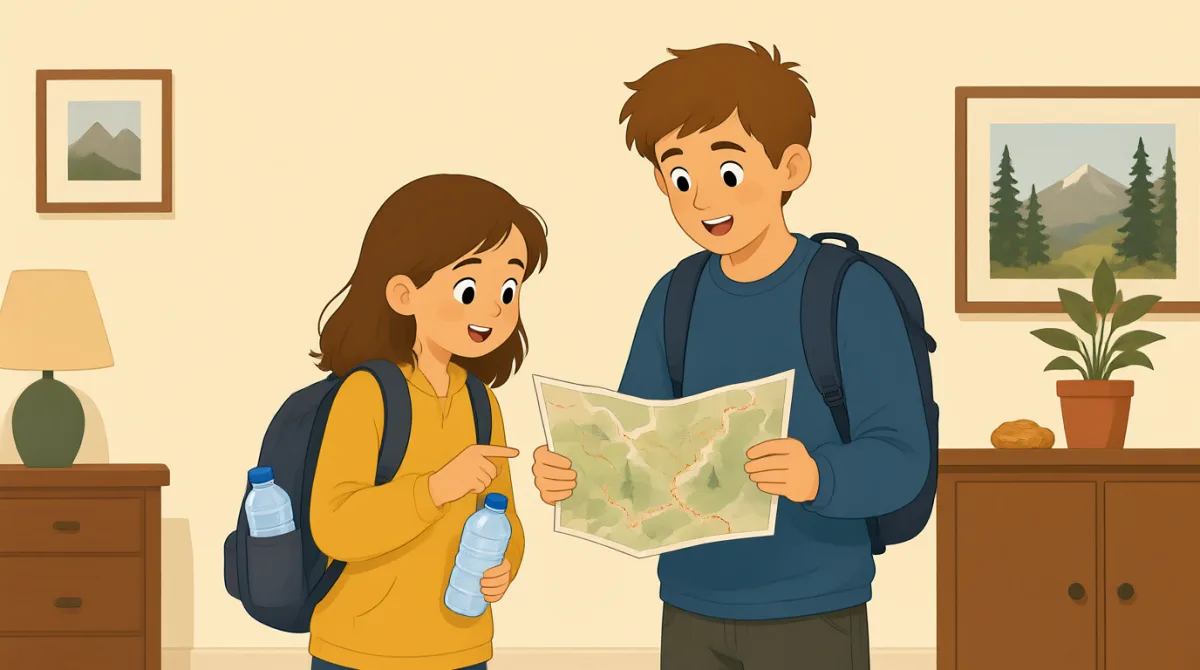

Jack, how much time do we have for the hike?

About two hours. Let's check the trail map before we choose.
This loop is four miles. Is that too far for us?
It looks a little hard, and it may take three hours.
What about the shorter trail? It says one and a half miles.
That sounds good. It should take about an hour, and the view looks nice.
Great! I'll pack water and some snacks. Do you have the map?
Yes. I've got the map. Let's pack up and set off.
Vocabulary6
- trail map
A map that shows paths in a natural area. You can check it to choose a route.
- loop
A route that goes around and returns to where it started. You can use “loop” when talking about a walking or hiking path.
- a little hard
Somewhat difficult. Use “a little” before an adjective to describe something as slightly difficult or different.
- shorter trail
A trail that is not as long as another one. Use “shorter” to compare the lengths of two routes.
- pack water
To put water in your bag to take with you. You can use “pack” with other things you need for a trip, like snacks or clothes.
- set off
To begin a journey or trip. You can say “set off” when you start walking, driving, or traveling.
Key Sentences7
- 1
How much time do we have for the hike?
This is a useful way to ask how much time is available for an activity. You can replace “the hike” with another event or task.
- 2
Let's check the trail map before we choose.
Use “Let’s” to suggest doing something together. You can replace “check the trail map” with another action and “choose” with a decision.
- 3
Is that too far for us?
This is a simple way to ask whether something is beyond your group’s ability or comfort. You can replace “far” with an adjective like “hard” or “expensive.”
- 4
It may take three hours.
Use “may” to say that something is possible but not certain. You can change the activity or the amount of time.
- 5
That sounds good.
This is a friendly way to agree with an idea or plan. You can use it in everyday conversations when someone makes a suggestion.
- 6
I'll pack water and some snacks.
Use “I’ll” to talk about a decision or plan you are making now. You can replace “water and some snacks” with other things you will bring.
- 7
Let's pack up and set off.
This suggests getting your things ready and then starting a journey. You can use “Let’s” to invite someone to do both actions with you.