Getting Instructions
Recibir instrucciones
Mia tells Emma about her child's meals, bedtime, and house rules before leaving. Emma asks a few questions to make sure she understands.
Antes de irse, Mia le cuenta a Emma qué come su hija, a qué hora se acuesta y cuáles son las reglas de la casa. Emma hace algunas preguntas para asegurarse de haber entendido.
Diálogo8
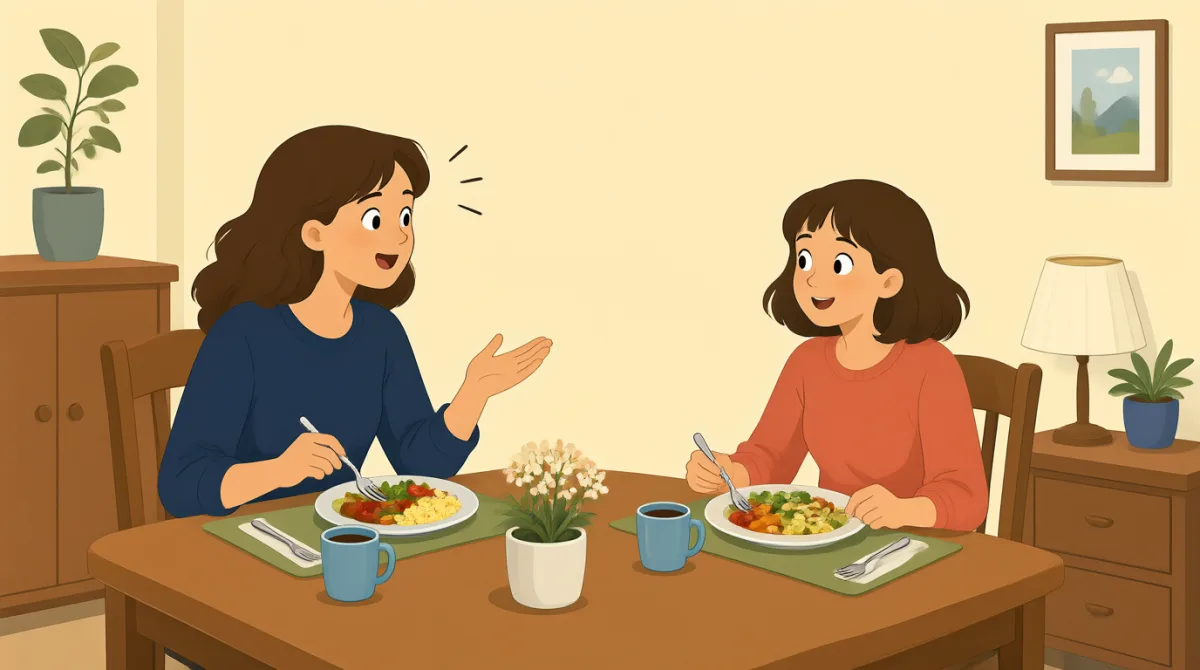

Thanks for watching my child tonight. Dinner is at six, and she likes pasta.
Gracias por cuidar de mi hija esta noche. La cena es a las seis y le gusta la pasta.

Sure. Should I heat up the pasta in the fridge?
Claro. ¿Caliento la pasta que está en la nevera?
Yes, please. She can have some fruit after dinner, but no sweets.
Sí, por favor. Puede comer fruta después de cenar, pero nada de dulces.
Got it. What time should she go to bed?
Entendido. ¿A qué hora debería acostarse?
At eight. Please help her brush her teeth and read one short story.
A las ocho. Por favor, ayúdala a cepillarse los dientes y léele un cuento corto.
Okay. Can she watch TV before bed?
Vale. ¿Puede ver la tele antes de acostarse?
No TV tonight. And please keep the front door locked.
Esta noche, nada de tele. Y, por favor, asegúrate de que la puerta de entrada quede cerrada con llave.
Understood. I’ll lock the door and call you if I need anything.
Entendido. Cerraré la puerta con llave y te llamaré si necesito algo.
Vocabulario8
- watching my childcuidar de mi hija
Here, it means taking care of Mia’s child for a short time. You can use “watching” to talk about caring for someone’s child.
Aquí significa cuidar de la hija de Mia durante un rato. Puedes usar “watching” para hablar de cuidar al hijo de alguien.
- heat upcalentar
To heat up food is to make it warm before eating. You can ask, “Should I heat up the dinner?”
“Heat up” significa calentar la comida antes de comerla. Puedes preguntar: “Should I heat up the dinner?” (¿Caliento la cena?).
- in the fridgeen la nevera
This means inside the refrigerator, where food is kept cold. You can say, “The milk is in the fridge.”
Significa dentro del refrigerador, donde se guarda la comida para mantenerla fría. Puedes decir: “The milk is in the fridge.” (La leche está en la nevera).
- after dinnerdespués de cenar
This means once the evening meal is finished. You can use it to say when something will happen, such as “We’ll have dessert after dinner.”
Significa cuando ya terminó la cena. Puedes usar esta expresión para decir cuándo ocurrirá algo, como en “We’ll have dessert after dinner.” (Tomaremos el postre después de cenar).
- go to bedacostarse
This means to get into bed and prepare to sleep. You can ask, “What time do you usually go to bed?”
Significa meterse en la cama y prepararse para dormir. Puedes preguntar: “What time do you usually go to bed?” (¿A qué hora sueles acostarte?).
- brush her teethcepillarse los dientes
This means clean her teeth with a toothbrush. You can use “brush your teeth” when reminding someone about this daily routine.
Significa limpiarse los dientes con un cepillo de dientes. Puedes decir “brush your teeth” para recordarle a alguien esta rutina diaria.
- keep the front door lockedasegurarse de que la puerta de entrada quede cerrada con llave
This means make sure the main entrance stays locked. You can use “keep the door locked” as a safety instruction.
Significa asegurarse de que la entrada principal permanezca cerrada con llave. Puedes usar “keep the door locked” para dar una instrucción de seguridad.
- if I need anythingsi necesito algo
This means if I need help or something else. You can use this phrase when telling someone you will contact them if a problem comes up.
Significa que llamarás si necesitas ayuda o cualquier otra cosa. Puedes usar esta expresión para decirle a alguien que te pondrás en contacto si surge algún problema.
Frases clave7
- 1
Should I heat up the pasta in the fridge?
¿Caliento la pasta que está en la nevera?
Use “Should I…?” to check what someone wants you to do. You can change the action and food, as in “Should I warm up the soup?”
Usa “Should I…?” para preguntarle a alguien qué quiere que hagas. Puedes cambiar la acción y la comida, como en “Should I warm up the soup?” (¿Caliento la sopa?).
- 2
She can have some fruit after dinner, but no sweets.
Puede comer fruta después de cenar, pero nada de dulces.
This sentence gives permission and then adds a limit. You can use “can have…, but no…” to explain what someone may and may not eat.
Esta frase da permiso y luego añade un límite. Puedes usar “can have…, but no…” para explicar qué puede comer alguien y qué no.
- 3
What time should she go to bed?
¿A qué hora debería acostarse?
This is a polite way to ask about someone’s bedtime. You can replace “she” with another person, such as “What time should the children go to bed?”
Esta es una forma educada de preguntar a qué hora debe acostarse alguien. Puedes cambiar “she” por otra persona, como en “What time should the children go to bed?” (¿A qué hora deberían acostarse los niños?).
- 4
Please help her brush her teeth and read one short story.
Por favor, ayúdala a cepillarse los dientes y léele un cuento corto.
Use “Please” to give a polite instruction. You can list two simple tasks with “and.”
Usa “Please” para dar una instrucción de forma educada. Puedes mencionar dos tareas sencillas y unirlas con “and”.
- 5
Can she watch TV before bed?
¿Puede ver la tele antes de acostarse?
Use “Can she…?” to ask whether something is allowed. You can replace the activity, for example, “Can she play outside before dinner?”
Usa “Can she…?” para preguntar si algo está permitido. Puedes cambiar la actividad, por ejemplo: “Can she play outside before dinner?” (¿Puede jugar afuera antes de cenar?).
- 6
Please keep the front door locked.
Por favor, asegúrate de que la puerta de entrada quede cerrada con llave.
This is a polite way to give an important safety instruction. You can use “Please keep…” for other rules, such as “Please keep the gate closed.”
Esta es una forma educada de dar una instrucción importante de seguridad. Puedes usar “Please keep…” para otras reglas, como “Please keep the gate closed.” (Por favor, mantén la verja cerrada).
- 7
I’ll lock the door and call you if I need anything.
Cerraré la puerta con llave y te llamaré si necesito algo.
Use “I’ll” to say what you plan to do. The phrase “if I need anything” explains when you will call.
Usa “I’ll” para decir lo que piensas hacer. La expresión “if I need anything” explica cuándo llamarás.