Getting Medicine
약 받기
Mia asks the pharmacist, Grace, how much medicine to give and when to give it. Grace explains the label and reminds her not to give more than the recommended amount.
미아는 약사 그레이스에게 약을 얼마나, 언제 먹여야 하는지 물어봐요. 그레이스는 약품 설명서를 확인해 주고, 권장량보다 많이 먹이지 말라고 알려 줘요.
대화9
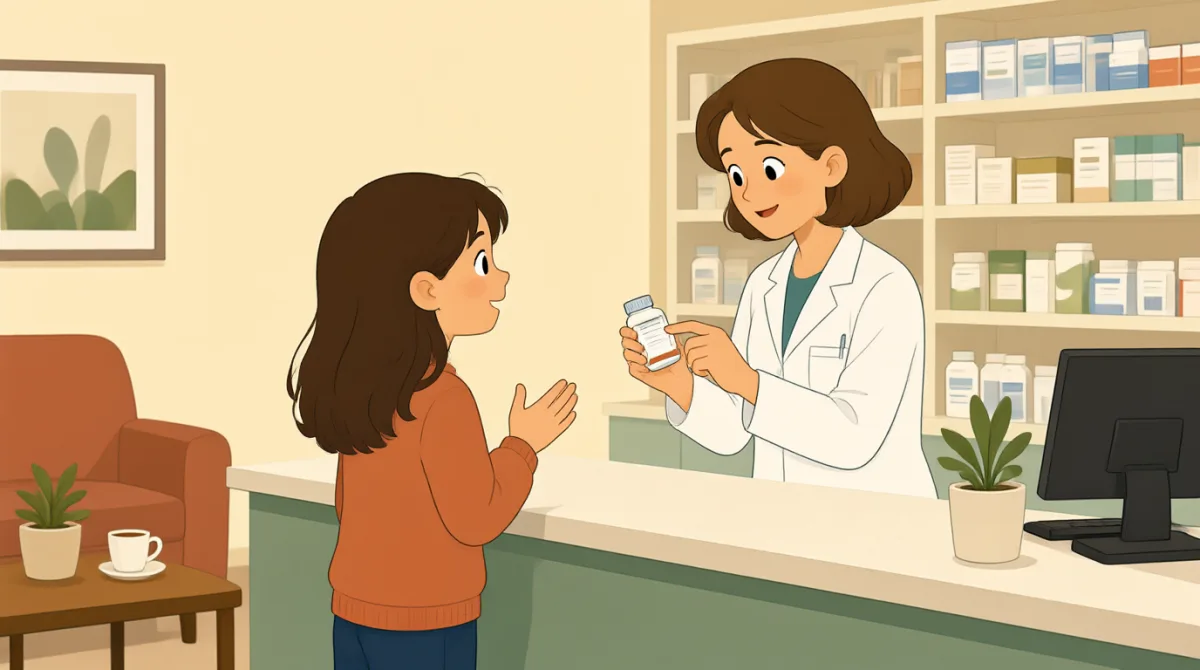

Hi, Grace. I need medicine for my child’s fever. The doctor said to use this.
안녕하세요, 그레이스. 아이가 열이 나서 약이 필요해요. 의사 선생님이 이 약을 쓰라고 하셨어요.

Sure. How old is your child, and what does the label say?
네. 아이가 몇 살인가요? 약품 설명서에는 뭐라고 적혀 있나요?
My child is six. I’m not sure how much to give.
아이는 여섯 살이에요. 얼마나 먹여야 할지 잘 모르겠어요.
Let’s check the label. It says to give five milliliters every six hours.
약품 설명서를 확인해 볼게요. 6시간마다 5밀리리터씩 먹이라고 적혀 있네요.
Should I give it with food, or can I give it now?
음식과 함께 먹여야 하나요, 아니면 지금 먹여도 되나요?
You can give it now. Use the measuring cup, not a kitchen spoon.
지금 먹여도 돼요. 계량컵을 사용하시고, 주방 숟가락은 사용하지 마세요.
Okay. Can I give another dose if the fever comes back sooner?
알겠어요. 열이 더 빨리 다시 나면 한 번 더 먹여도 되나요?
No. Wait six hours, and don’t give more than the label says.
안 돼요. 6시간 기다리시고, 설명서에 적힌 양보다 많이 먹이지 마세요.
Got it. I’ll write down each time I give the medicine. Thank you.
알겠어요. 약을 먹일 때마다 시간을 적어 둘게요. 감사합니다.
어휘8
- how much to give얼마나 먹여야 하는지
This asks about the amount of medicine to use. You can use it to ask how much of something is needed.
약을 얼마나 사용해야 하는지 묻는 표현이에요. 필요한 양을 물을 때 쓸 수 있어요.
- check the label약품 설명서를 확인하다
This means to read the instructions on the medicine package. You can check a label to find important information.
약 포장에 적힌 안내를 읽어 본다는 뜻이에요. 중요한 정보를 찾을 때 설명서를 확인할 수 있어요.
- five milliliters5밀리리터
This is the amount of medicine the label says to give. Milliliters are used to measure liquids.
약품 설명서에 먹이라고 적힌 약의 양이에요. 밀리리터는 액체의 양을 재는 단위예요.
- every six hours6시간마다
This tells you how often to give the medicine. You can use “every” with a time period to describe how often something happens.
약을 얼마나 자주 먹여야 하는지 알려 주는 표현이에요. “every” 뒤에 시간 단위를 붙이면 어떤 일이 얼마나 자주 일어나는지 말할 수 있어요.
- measuring cup계량컵
This is a small cup used to measure the right amount of liquid medicine. Use it when you need an accurate amount.
액체 약을 알맞은 양만큼 덜어 내는 작은 컵이에요. 정확한 양을 재야 할 때 사용하세요.
- comes back sooner더 빨리 다시 나타나다
Here, this means the fever returns before it is time for the next dose. “Come back” can describe a problem that returns.
여기서는 다음 복용 시간이 되기 전에 열이 다시 난다는 뜻이에요. “Come back”은 다시 생기는 문제를 표현할 때 쓸 수 있어요.
- give another dose한 번 더 먹이다
This means to give one more amount of medicine. You can use “another dose” when talking about taking medicine again.
약을 한 번 더 먹인다는 뜻이에요. 약을 다시 먹는 일을 말할 때 “another dose”라고 할 수 있어요.
- write down적어 두다
This means to record something on paper. You can write down the time you give medicine so you can keep track.
종이에 기록한다는 뜻이에요. 약을 먹인 시간을 적어 두면 복용 상황을 기억하기 쉬워요.
핵심 문장7
- 1
How old is your child, and what does the label say?
아이가 몇 살인가요? 약품 설명서에는 뭐라고 적혀 있나요?
This is a useful way to ask for a child’s age and check instructions. You can reuse the question to ask about someone’s age and what a label or notice says.
아이의 나이를 묻고 약품 안내를 확인할 때 유용한 표현이에요. 누군가의 나이와 설명서나 안내문에 적힌 내용을 물을 때도 활용할 수 있어요.
- 2
I’m not sure how much to give.
얼마나 먹여야 할지 잘 모르겠어요.
Use this when you do not know the right amount of something. Replace “give” with another verb to ask about a task you are unsure how to do.
적절한 양을 모를 때 쓰는 표현이에요. “give”를 다른 동사로 바꾸면 어떻게 해야 할지 잘 모르는 일을 물어볼 수 있어요.
- 3
It says to give five milliliters every six hours.
6시간마다 5밀리리터씩 먹이라고 적혀 있네요.
This sentence explains an instruction and how often to follow it. You can use “It says to…” to report directions from a label or other source.
안내된 내용과 그 안내를 얼마나 자주 따라야 하는지 설명하는 문장이에요. 약품 설명서나 다른 자료의 지시를 전달할 때 “It says to…”를 쓸 수 있어요.
- 4
Should I give it with food, or can I give it now?
음식과 함께 먹여야 하나요, 아니면 지금 먹여도 되나요?
This asks whether something should be done with food or can be done right away. You can reuse this pattern to ask about the right time or conditions for an action.
음식과 함께 해야 하는지, 아니면 바로 해도 되는지 묻는 표현이에요. 어떤 행동을 해야 하는 적절한 시간이나 조건을 물을 때 이 문형을 활용할 수 있어요.
- 5
Use the measuring cup, not a kitchen spoon.
계량컵을 사용하시고, 주방 숟가락은 사용하지 마세요.
This gives a clear instruction and says what not to use. You can use “Use X, not Y” to recommend one option over another.
분명한 지시를 하면서 사용하면 안 되는 것도 알려 주는 문장이에요. 한 가지 방법을 다른 방법보다 권할 때 “Use X, not Y”를 쓸 수 있어요.
- 6
No. Wait six hours, and don’t give more than the label says.
안 돼요. 6시간 기다리시고, 설명서에 적힌 양보다 많이 먹이지 마세요.
This gives a warning and a clear limit. You can use “don’t give more than…” to remind someone not to exceed an amount or recommendation.
주의를 주고 명확한 한도를 알려 주는 표현이에요. 양이나 권장량을 넘지 말라고 당부할 때 “don’t give more than…”을 쓸 수 있어요.
- 7
I’ll write down each time I give the medicine.
약을 먹일 때마다 시간을 적어 둘게요.
This says what someone plans to do to keep track of medicine. You can use “I’ll write down…” to describe a plan to record important information.
약 복용을 기록하기 위해 무엇을 할지 말하는 문장이에요. 중요한 정보를 기록할 계획을 설명할 때 “I’ll write down…”을 쓸 수 있어요.