Asking to Borrow the Ladder
はしごを借りる
Emma explains that she wants to hang a birdhouse and asks to borrow Jack’s ladder. Jack agrees and gives her a few safety tips.
エマは鳥の巣箱を取り付けたいと話し、ジャックにはしごを借りられるか尋ねます。ジャックは貸すことにして、安全に使うための注意点をいくつか伝えます。
会話8
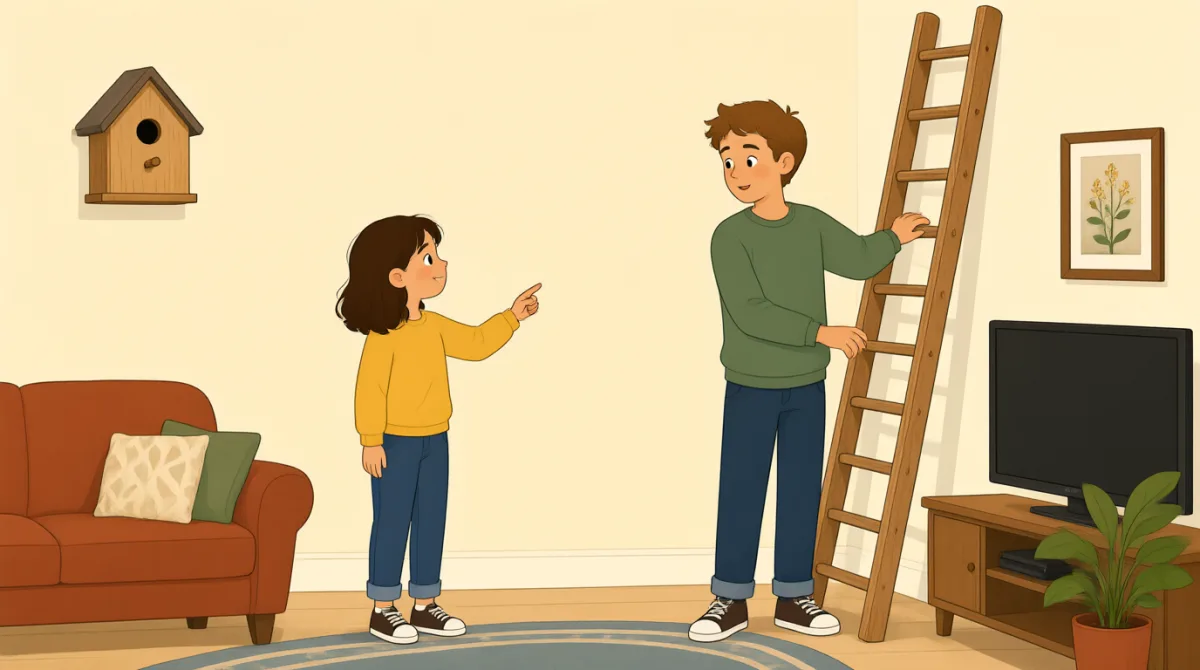

Hi, Jack. I want to hang a birdhouse in my yard. Can I borrow your ladder?
やあ、ジャック。庭に鳥の巣箱を取り付けたいんだ。はしごを借りてもいい?

Sure. How tall is the tree? I have a short ladder and a tall one.
もちろん。木はどれくらい高いの?低いはしごと高いはしごがあるよ。
It’s not very tall. The birdhouse will go near a low branch.
そんなに高くないよ。低い枝の近くに巣箱を取り付けるんだ。
Then the short ladder should be fine. Please put it on flat ground.
じゃあ、低いほうで大丈夫そうだね。平らな地面に置いてね。
Thanks. I’ll be careful. Should I ask someone to hold it for me?
ありがとう。気をつけるね。誰かにはしごを押さえてもらったほうがいいかな?
Yes, that’s safer. Don’t stand on the top step, and take your time.
うん、そのほうが安全だよ。一番上の段には立たないで、焦らずにね。
Got it. I’ll bring it back tomorrow after I finish hanging the birdhouse.
わかった。巣箱を取り付け終わったら、明日返しに来るね。
No problem. Take it now, and just leave it by my door tomorrow.
いいよ。今持っていって、明日はうちのドアのそばに置いておいて。
語彙8
- borrow your ladderあなたのはしごを借りる
To borrow something is to use it for a short time and return it. Use this phrase when asking someone to lend you a ladder.
“borrow”は、物をしばらく使ってから返すことです。誰かにはしごを貸してほしいと頼むときに、この表現を使えます。
- short ladder低いはしご
A short ladder is not very tall. You can use this phrase to describe which ladder you need.
“short ladder”は、高さがあまりないはしごのことです。必要なはしごの種類を伝えるときに使えます。
- flat ground平らな地面
Flat ground is level ground without a slope. It is safer to put a ladder on flat ground.
“flat ground”は、傾斜のない平らな地面のことです。はしごは平らな地面に置くほうが安全です。
- hold it for me私のために押さえておく
This means asking someone to keep the ladder steady while you climb. Use “hold it for me” when you need help with an object.
これは、登っている間にはしごがぐらつかないよう、誰かに押さえてもらうという意味です。物を使うときに手伝ってほしい場合は、“hold it for me”と言えます。
- top step一番上の段
The top step is the highest step on a ladder. The dialogue uses this phrase in a safety warning.
“top step”は、はしごの一番高い位置にある段のことです。この会話では、安全のための注意として使われています。
- take your time焦らずにやる
This means to do something slowly and carefully, without rushing. You can say it to encourage someone to be careful.
“take your time”は、急がずにゆっくり慎重に何かをするという意味です。相手に落ち着いて行動してほしいときに使えます。
- bring it back返す
This means to return something to the person who lent it to you. Use it when talking about returning a borrowed item.
“bring it back”は、借りた物を貸してくれた人に返すという意味です。借りた物を返す話をするときに使えます。
- leave it by my door私のドアのそばに置いておく
This means to put something next to the speaker’s door. It is a simple way to explain where to return an item.
“leave it by my door”は、話し手のドアのそばに物を置いておくという意味です。物を返す場所を簡潔に伝える表現です。
重要な文8
- 1
Can I borrow your ladder?
はしごを借りてもいい?
This is a polite way to ask to use something that belongs to another person. You can reuse the pattern “Can I borrow your...?” with other items.
人の物を使わせてもらいたいときの、丁寧な頼み方です。“Can I borrow your...?”(あなたの……を借りてもいい?)の形は、ほかの物を借りたいときにも使えます。
- 2
How tall is the tree?
木はどれくらい高いの?
This question asks about the height of something. You can use “How tall is...?” to ask about a person, building, or object.
物の高さを尋ねる質問です。“How tall is...?”を使うと、人や建物、物の高さを尋ねられます。
- 3
The birdhouse will go near a low branch.
鳥の巣箱は低い枝の近くに取り付けるんだ。
This sentence explains where something will be placed. Use “will go near...” to talk about where you plan to put something.
何かをどこに置く予定かを説明する文です。“will go near...”は、何かを置く予定の場所を伝えるときに使えます。
- 4
Please put it on flat ground.
平らな地面に置いてね。
This is a polite instruction about where to place something. You can use “Please put it on...” to give simple directions.
何かをどこに置くかを伝える丁寧な指示です。“Please put it on...”を使うと、簡単な置き場所の指示ができます。
- 5
Should I ask someone to hold it for me?
誰かに押さえてもらったほうがいいかな?
This is a useful way to ask whether you should get help. Use “Should I ask someone to...?” when checking what action is best.
手助けを頼んだほうがよいか尋ねるのに便利な表現です。“Should I ask someone to...?”を使うと、どうするのがよいか確認できます。
- 6
Don’t stand on the top step, and take your time.
一番上の段には立たないで、焦らずにね。
This sentence gives two safety tips. You can use “Don’t...” for a warning and “take your time” to remind someone not to rush.
この文では、安全のための注意を二つ伝えています。“Don’t...”は警告に、“take your time”は急がないよう念を押すときに使えます。
- 7
I’ll bring it back tomorrow after I finish hanging the birdhouse.
巣箱を取り付け終わったら、明日返しに来るね。
This sentence tells someone when you will return a borrowed item. Use “I’ll bring it back...” followed by a time or event.
借りた物をいつ返すか伝える文です。“I’ll bring it back...”のあとに、返す時刻や出来事を続けられます。
- 8
Take it now, and just leave it by my door tomorrow.
今持っていって、明日はうちのドアのそばに置いておいて。
This gives permission to take something and explains where to return it. You can reuse “leave it by...” to give a simple drop-off location.
物を持っていってよいと伝え、返す場所も説明する文です。“leave it by...”を使うと、物を置いていく場所を簡潔に伝えられます。