Arriving at the Stadium
Am Stadion ankommen
Emma, Leo, and Grace arrive at the baseball stadium. They check their tickets and look for the right entrance.
Emma, Leo und Grace kommen im Baseballstadion an. Sie überprüfen ihre Tickets und suchen den richtigen Eingang.
Dialog9
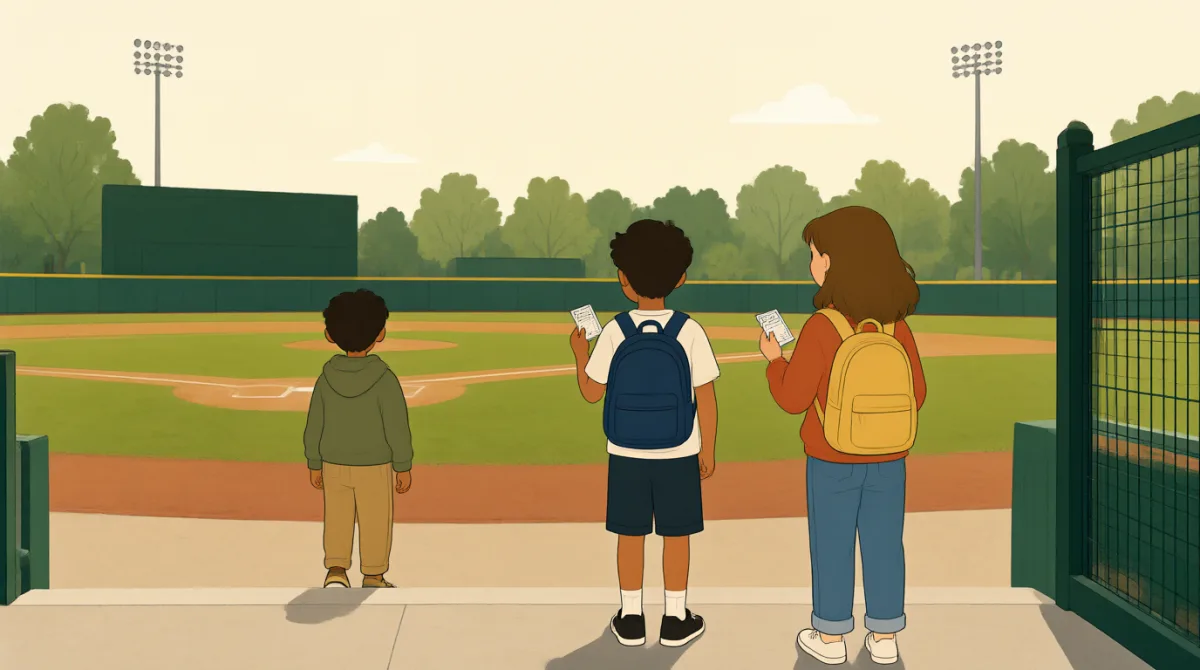

Wow, the stadium is huge! Do you know which entrance we need?
Wow, das Stadion ist riesig! Weißt du, welchen Eingang wir nehmen müssen?

Let me check our tickets. They say Gate B, near the main entrance.
Ich schau mal auf unsere Tickets. Da steht Tor B, in der Nähe des Haupteingangs.

Good. We should find Gate B before the game starts.
Gut. Wir sollten Tor B finden, bevor das Spiel anfängt.
I see a sign over there. Is that the right way?
Da drüben sehe ich ein Schild. Ist das der richtige Weg?
Yes, it says Gate B. Come on, let's go this way.
Ja, da steht Tor B. Komm, wir gehen hier entlang.
Keep your tickets ready. They may check them at the entrance.
Haltet eure Tickets bereit. Vielleicht werden sie am Eingang kontrolliert.
Here they are. Do we need to show them on our phones?
Hier sind sie. Müssen wir sie auf unseren Handys vorzeigen?
Mine is on my phone, and yours are paper tickets.
Meins ist auf meinem Handy, und deine sind Papiertickets.
Either is fine. Let's go in and find our seats.
Beides ist in Ordnung. Gehen wir rein und suchen unsere Plätze.
Wortschatz8
- entranceEingang
An entrance is a place where you go into a building or area. At the stadium, it is a way inside.
Ein Eingang ist eine Stelle, durch die du in ein Gebäude oder auf ein Gelände hineingehst. Im Stadion ist es ein Zugang ins Innere.
- ticketsTickets
Tickets are passes that let you enter an event. You need them to get into the game.
Tickets sind Eintrittskarten für eine Veranstaltung. Du brauchst sie, um ins Stadion und zum Spiel zu kommen.
- nearin der Nähe
Near means close to something. Gate B is close to the main entrance.
„Near“ bedeutet, dass etwas nicht weit entfernt ist. Tor B ist in der Nähe des Haupteingangs.
- signSchild
A sign shows information or directions. You can follow a sign to find the right gate.
Ein Schild zeigt Informationen oder den Weg. Du kannst den Schildern folgen, um das richtige Tor zu finden.
- this wayhier entlang
This way means in this direction. Use it to show someone where to go.
„This way“ bedeutet „in diese Richtung“. Du kannst damit jemandem zeigen, wohin er gehen soll.
- Keep your tickets ready.Haltet eure Tickets bereit.
This means have your tickets out and easy to show. You can say this before entering a place where tickets may be checked.
Das bedeutet: Habt eure Tickets griffbereit, damit ihr sie leicht vorzeigen könnt. Das kannst du sagen, bevor ihr einen Ort betretet, an dem die Tickets möglicherweise kontrolliert werden.
- show them on our phonessie auf unseren Handys vorzeigen
This means display the tickets on your phones. You can use this phrase to ask if digital tickets are accepted.
Das bedeutet, die Tickets auf euren Handys anzuzeigen. Mit diesem Ausdruck kannst du fragen, ob digitale Tickets akzeptiert werden.
- find our seatsunsere Plätze suchen
This means look for the seats listed on your tickets. You can use it when you arrive at a theater, stadium, or other event.
Das bedeutet, nach den Plätzen zu suchen, die auf euren Tickets stehen. Du kannst das sagen, wenn ihr in einem Theater, Stadion oder bei einer anderen Veranstaltung ankommt.
Wichtige Sätze8
- 1
Do you know which entrance we need?
Weißt du, welchen Eingang wir nehmen müssen?
Use this to ask which entrance to use. You can replace “entrance” with another place, such as “which platform we need.”
Mit „Do you know which entrance we need?“ fragst du, welchen Eingang ihr benutzen sollt. Du kannst „entrance“ durch einen anderen Ort ersetzen, zum Beispiel durch „which platform we need“.
- 2
Let me check our tickets.
Ich schau mal auf unsere Tickets.
Use this when you want to look at tickets or another piece of information. “Let me check” is a common way to offer to find something out.
Das kannst du sagen, wenn du Tickets oder andere Informationen nachsehen möchtest. „Let me check“ ist eine übliche Art anzubieten, etwas herauszufinden.
- 3
We should find Gate B before the game starts.
Wir sollten Tor B finden, bevor das Spiel anfängt.
This sentence suggests what to do and when to do it. You can replace “find Gate B” with another task and “the game” with another event.
Dieser Satz schlägt vor, was ihr tun solltet und wann. Du kannst „find Gate B“ durch eine andere Aufgabe und „the game“ durch eine andere Veranstaltung ersetzen.
- 4
Is that the right way?
Ist das der richtige Weg?
Use this to check if you are going in the correct direction. It is useful when following signs or asking someone for directions.
Mit „Is that the right way?“ fragst du, ob ihr in die richtige Richtung geht. Das ist nützlich, wenn du Schildern folgst oder jemanden nach dem Weg fragst.
- 5
Keep your tickets ready.
Haltet eure Tickets bereit.
Use this to remind someone to have their tickets easy to reach. You can also say “Keep your ID ready” when someone may need to show identification.
Mit „Keep your tickets ready.“ erinnerst du jemanden daran, die Tickets griffbereit zu haben. Du kannst auch „Keep your ID ready“ sagen, wenn jemand einen Ausweis vorzeigen muss.
- 6
Do we need to show them on our phones?
Müssen wir sie auf unseren Handys vorzeigen?
Use this to ask whether you need to display something on your phones. Replace “them” with another item, such as “the passes.”
Mit „Do we need to show them on our phones?“ fragst du, ob ihr etwas auf euren Handys vorzeigen müsst. Ersetze „them“ durch etwas anderes, zum Beispiel „the passes“.
- 7
Either is fine.
Beides ist in Ordnung.
Use this to say that two choices are both acceptable. For example, you can say it when someone asks whether you prefer paper or digital tickets.
Mit „Either is fine.“ sagst du, dass beide Möglichkeiten passen. Zum Beispiel kannst du das sagen, wenn dich jemand fragt, ob du lieber Papiertickets oder digitale Tickets möchtest.
- 8
Let's go in and find our seats.
Gehen wir rein und suchen unsere Plätze.
Use this to suggest entering a place and looking for your assigned seats. You can replace “find our seats” with another next step, such as “get some food.”
Mit „Let's go in and find our seats.“ schlägst du vor, hineinzugehen und nach euren zugewiesenen Plätzen zu suchen. Du kannst „find our seats“ durch einen anderen nächsten Schritt ersetzen, zum Beispiel durch „get some food“.