Understanding the Doctor's Advice
Comprendre les conseils du médecin
The doctor explains that Leo has a common cold and gives simple advice. Leo learns to rest, drink water, and stay home if he feels worse.
Le médecin explique à Leo qu’il a un simple rhume et lui donne quelques conseils. Leo apprend qu’il doit se reposer, boire de l’eau et rester chez lui s’il se sent plus mal.
Dialogue9
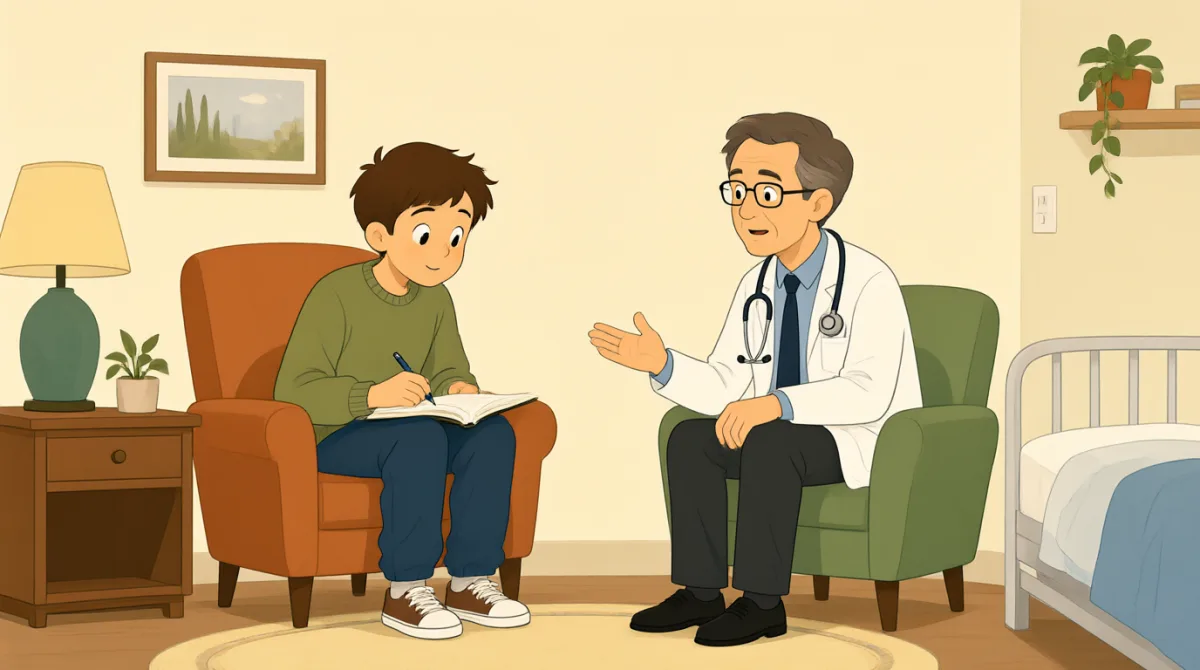

Leo, you have a common cold. It should get better in about a week.
Leo, vous avez un simple rhume. Vous devriez aller mieux d’ici une semaine environ.

That’s good to hear. What should I do at home?
C’est bon à savoir. Que dois-je faire à la maison ?
Get plenty of rest, and drink lots of water or warm tea.
Reposez-vous bien et buvez beaucoup d’eau ou de tisane chaude.
Can I go to work tomorrow, or should I stay home?
Est-ce que je peux aller travailler demain, ou est-ce que je devrais rester chez moi ?
Stay home if you feel worse or have a fever. Try not to spread the cold.
Restez chez vous si vous vous sentez plus mal ou si vous avez de la fièvre. Essayez de ne pas transmettre votre rhume.
Okay. Should I take any medicine for my cough?
D’accord. Est-ce que je devrais prendre un médicament contre la toux ?
You can ask the pharmacist about cough medicine. Follow the directions on the package.
Vous pouvez demander conseil au pharmacien pour un médicament contre la toux. Suivez les instructions sur la boîte.
All right. I’ll rest and drink more water. When should I call you?
Très bien. Je vais me reposer et boire plus d’eau. Quand dois-je vous appeler ?
Call the clinic if you have trouble breathing or your fever gets worse.
Appelez le cabinet si vous avez du mal à respirer ou si votre fièvre s’aggrave.
Vocabulaire7
- common coldun simple rhume
A common cold is a mild illness that can cause a cough or runny nose. Use this phrase to name the illness.
Un « common cold » est une maladie bénigne qui peut provoquer de la toux ou un nez qui coule. Cette expression désigne cette maladie.
- get betteraller mieux
To get better means to become healthier. You can use it to talk about recovering from an illness.
« Get better » signifie retrouver la santé. Cette expression sert à parler du rétablissement après une maladie.
- plenty of restbien se reposer
This means getting a lot of rest or sleep. It is common advice when someone is sick.
« Plenty of rest » signifie se reposer ou dormir beaucoup. C’est un conseil courant quand quelqu’un est malade.
- stay homerester chez soi
To stay home means not to go out, such as to work or school. You can use it when you need to rest or avoid spreading an illness.
« Stay home » signifie ne pas sortir, par exemple pour aller au travail ou à l’école. On peut employer cette expression quand on a besoin de se reposer ou d’éviter de transmettre une maladie.
- feel worsese sentir plus mal
To feel worse means to feel less healthy than before. Use it to describe a change in how you feel.
« Feel worse » signifie se sentir moins bien qu’avant. Cette expression décrit un changement dans son état de santé.
- follow the directionssuivre les instructions
This means to do what the instructions say. You can use it when talking about medicine or other instructions.
« Follow the directions » signifie faire ce qui est indiqué dans les instructions. On peut employer cette expression pour parler d’un médicament ou d’autres consignes.
- trouble breathingavoir du mal à respirer
This means difficulty breathing normally. It is important to tell a doctor if you have trouble breathing.
« Trouble breathing » signifie avoir des difficultés à respirer normalement. Il est important de prévenir un médecin si vous avez du mal à respirer.
Phrases clés6
- 1
It should get better in about a week.
Vous devriez aller mieux d’ici une semaine environ.
This sentence gives an estimate of how long recovery may take. Use “should get better” to talk about an expected improvement.
Cette phrase donne une estimation du temps nécessaire pour se rétablir. Utilisez “should get better” pour parler d’une amélioration attendue.
- 2
What should I do at home?
Que dois-je faire à la maison ?
This is a useful way to ask for advice. You can replace “at home” with another situation, such as “at work.”
C’est une façon pratique de demander conseil. Vous pouvez remplacer “at home” par une autre situation, comme “at work”.
- 3
Get plenty of rest, and drink lots of water or warm tea.
Reposez-vous bien et buvez beaucoup d’eau ou de tisane chaude.
This gives two simple health recommendations. You can use “Get plenty of…” to suggest something someone needs.
Cette phrase donne deux recommandations simples pour la santé. Vous pouvez utiliser “Get plenty of…” pour suggérer ce dont une personne a besoin.
- 4
Stay home if you feel worse or have a fever.
Restez chez vous si vous vous sentez plus mal ou si vous avez de la fièvre.
This gives advice with a condition using “if.” Use the same pattern to explain what someone should do in a particular situation.
Cette phrase donne un conseil soumis à une condition introduite par “if”. Utilisez la même structure pour expliquer ce qu’une personne devrait faire dans une situation précise.
- 5
Follow the directions on the package.
Suivez les instructions sur la boîte.
This is a clear reminder to read and obey instructions. You can use it when giving advice about medicine or a product.
C’est un rappel clair qui invite à lire et à respecter les instructions. Vous pouvez l’utiliser pour donner un conseil à propos d’un médicament ou d’un produit.
- 6
Call the clinic if you have trouble breathing or your fever gets worse.
Appelez le cabinet si vous avez du mal à respirer ou si votre fièvre s’aggrave.
This explains when to contact a medical service. Use “Call… if…” to give someone a clear next step.
Cette phrase explique quand contacter un service médical. Utilisez “Call… if…” pour indiquer clairement à quelqu’un quelle est la prochaine étape.