Finishing Your Tasks
Terminer vos tâches
Emma and Jack check what still needs to be done. Emma finishes her report and hands Jack the notes he needs.
Emma et Jack vérifient ce qu’il leur reste à faire. Emma termine son rapport et remet à Jack les notes dont il a besoin.
Dialogue8
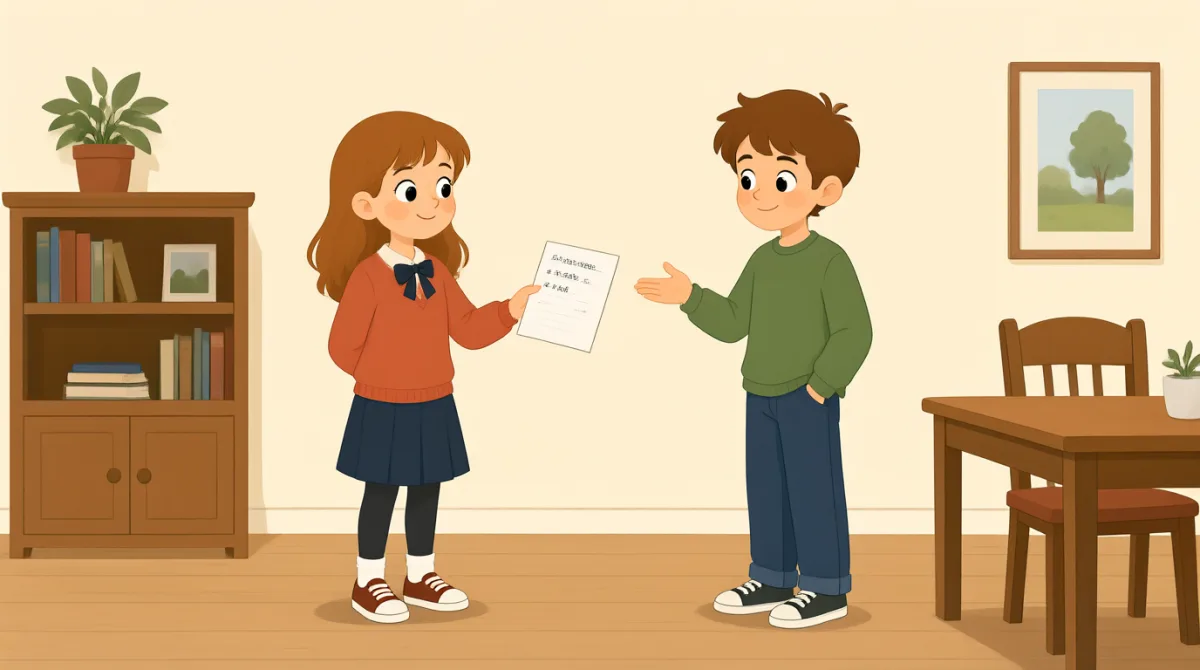

Jack, can you check what we still need to finish today?
Jack, tu peux vérifier ce qu’il nous reste à terminer aujourd’hui ?

Sure. The report is the main thing, and I still need your notes.
Bien sûr. Le rapport, c’est le plus important, et j’ai encore besoin de tes notes.
I’m finishing the report now. I’ll give you the notes in a minute.
Je termine le rapport maintenant. Je te donne les notes dans une minute.
Thanks. Do you need help with any part of the report?
Merci. Tu as besoin d’aide pour une partie du rapport ?
No, I’m almost done. I just need to check these numbers.
Non, j’ai presque fini. Je dois juste vérifier ces chiffres.
Okay. I’ll look over the notes when you hand them to me.
D’accord. Je regarderai les notes quand tu me les donneras.
Here you go. These notes explain the last changes to the schedule.
Tiens, voilà. Ces notes expliquent les derniers changements apportés au planning.
Got it. And the report looks finished. You’re all set to go.
Compris. Et le rapport a l’air terminé. Tu peux y aller.
Vocabulaire7
- check what we still need to finishvérifier ce qu’il nous reste à terminer
This means to review which tasks are not done yet. Use it when you want to find out what work remains.
Cela signifie passer en revue les tâches qui ne sont pas encore terminées. Utilisez cette expression pour savoir quel travail il reste à faire.
- the main thingle plus important
This means the most important task or issue. Use it to say what should get attention first.
Cela désigne la tâche ou le problème le plus important. Utilisez cette expression pour indiquer ce qui doit être traité en priorité.
- in a minutedans une minute
This means very soon, usually after a short wait. You can use it to say when you will do something.
Cela signifie très bientôt, généralement après une courte attente. Vous pouvez l’utiliser pour préciser quand vous ferez quelque chose.
- almost donepresque terminé
This means nearly finished, but not completely finished yet. Use it to describe work that needs only a little more time.
Cela signifie que quelque chose est quasiment terminé, mais pas tout à fait. Utilisez cette expression pour parler d’un travail qui demande encore un peu de temps.
- look overregarder
This means to read or check something quickly and carefully. You can look over notes, a report, or a form.
Cela signifie lire ou vérifier quelque chose rapidement et attentivement. Vous pouvez regarder des notes, un rapport ou un formulaire.
- Here you go.Tiens, voilà.
This is a friendly way to give something to someone. Use it when handing over an item, such as notes or a document.
C’est une façon amicale de donner quelque chose à quelqu’un. Utilisez cette expression en tendant un objet, comme des notes ou un document.
- all set to goprêt à partir
This means ready to leave or do something. Use it to tell someone that everything is ready.
Cela signifie être prêt à partir ou à faire quelque chose. Utilisez cette expression pour dire à quelqu’un que tout est prêt.
Phrases clés8
- 1
Jack, can you check what we still need to finish today?
Jack, tu peux vérifier ce qu’il nous reste à terminer aujourd’hui ?
Use this question to ask someone to review the tasks that remain. You can replace “today” with another time, such as “before the meeting.”
Utilisez cette question pour demander à quelqu’un de passer en revue les tâches qu’il reste à faire. Vous pouvez remplacer “today” par un autre moment, comme “before the meeting.”
- 2
The report is the main thing, and I still need your notes.
Le rapport, c’est le plus important, et j’ai encore besoin de tes notes.
This sentence identifies the most important task and says what is still needed. Use “I still need your…” to ask for something that has not arrived yet.
Cette phrase indique quelle est la tâche la plus importante et précise ce dont on a encore besoin. Utilisez “I still need your…” pour demander quelque chose qui n’est pas encore arrivé.
- 3
I’ll give you the notes in a minute.
Je te donne les notes dans une minute.
Use this to promise to give someone something very soon. Replace “the notes” with another item, such as “the file.”
Utilisez cette phrase pour promettre de donner quelque chose à quelqu’un très bientôt. Remplacez “the notes” par un autre élément, comme “the file.”
- 4
Do you need help with any part of the report?
Tu as besoin d’aide pour une partie du rapport ?
This is a useful way to offer help with a specific task. You can replace “the report” with another piece of work.
C’est une façon utile de proposer son aide pour une tâche précise. Vous pouvez remplacer “the report” par un autre travail.
- 5
I just need to check these numbers.
Je dois juste vérifier ces chiffres.
Use this sentence to explain the one small task you have left. Replace “check these numbers” with another action, such as “send this email.”
Utilisez cette phrase pour expliquer la petite tâche qu’il vous reste à faire. Remplacez “check these numbers” par une autre action, comme “send this email.”
- 6
I’ll look over the notes when you hand them to me.
Je regarderai les notes quand tu me les donneras.
This explains what you will do after someone gives you something. Use “I’ll look over…” to say you will review a document or information.
Cette phrase explique ce que vous ferez après que quelqu’un vous aura donné quelque chose. Utilisez “I’ll look over…” pour dire que vous allez examiner un document ou des informations.
- 7
Here you go.
Tiens, voilà.
Use this short, friendly phrase when handing something to another person. It works with objects such as notes, keys, or a cup of coffee.
Utilisez cette courte expression amicale quand vous tendez quelque chose à quelqu’un. Elle convient pour des objets comme des notes, des clés ou une tasse de café.
- 8
You’re all set to go.
Tu peux y aller.
Use this to tell someone they are ready to leave or begin. It is especially useful after checking that everything is finished.
Utilisez cette expression pour dire à quelqu’un qu’il est prêt à partir ou à commencer. Elle est particulièrement utile après avoir vérifié que tout est terminé.