A Package Arrives
Un colis arrive
While Emma is away, a package arrives with the mail. Mia brings it inside and sends Emma a quick message.
Pendant qu’Emma est absente, un colis arrive avec le courrier. Mia le rentre et envoie un petit message à Emma.
Dialogue8
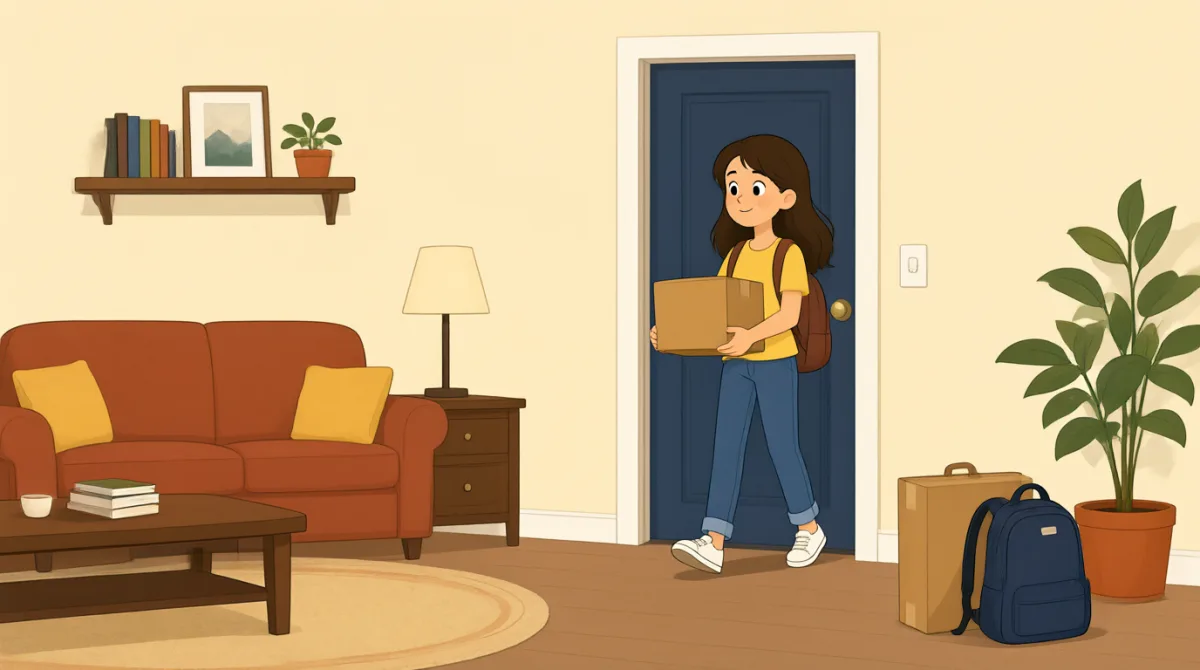

Hi, Emma. A package just arrived with your mail.
Salut, Emma. Un colis vient d’arriver avec ton courrier.

Thanks for letting me know! Is it a small package?
Merci de m’avoir prévenue ! C’est un petit colis ?
Yes, it’s not very big. I brought it inside with your mail.
Oui, il n’est pas très gros. Je l’ai rentré avec ton courrier.
That’s great. Could you leave it by the front door?
Super. Tu pourrais le laisser près de la porte d’entrée ?
Sure. I put it on the table inside your door.
Bien sûr. Je l’ai posé sur la table, juste derrière ta porte.
Perfect. I’ll pick it up when I get home tomorrow.
Parfait. Je le récupérerai en rentrant demain.
No problem. Your mail is there with it, too.
Pas de souci. Ton courrier est là aussi, avec le colis.
Thanks so much, Mia. I really appreciate your help.
Merci beaucoup, Mia. Ton aide me rend vraiment service.
Vocabulaire6
- just arrivedvient d’arriver
This means something came a very short time ago. Use it to tell someone that a package or person has arrived recently.
Cela signifie que quelque chose est arrivé il y a très peu de temps. Utilise cette expression pour dire à quelqu’un qu’un colis ou une personne vient d’arriver.
- leave it by the front doorle laisser près de la porte d’entrée
This means to put something near the main entrance and keep it there. Use this phrase to tell someone where to put an item.
Cela signifie mettre quelque chose près de l’entrée principale et l’y laisser. Utilise cette expression pour indiquer à quelqu’un où poser un objet.
- pick it uple récupérer
Here, this means to go and get something. You can use it when you plan to collect an item later.
Ici, cela signifie aller chercher quelque chose. Tu peux employer cette expression quand tu prévois de récupérer un objet plus tard.
- when I get homeen rentrant chez moi
This means at the time I arrive at my home. Use it to say when you will do something.
Cela signifie au moment où j’arrive chez moi. Utilise cette expression pour dire quand tu feras quelque chose.
- No problem.Pas de souci.
This is a friendly way to say that helping is okay. You can also use it to reply to someone who thanks you.
C’est une façon amicale de dire que ça ne te dérange pas d’aider. Tu peux aussi répondre ainsi quand quelqu’un te remercie.
- appreciate your helpêtre reconnaissant pour ton aide
This means to feel grateful for someone's help. Use it to thank someone warmly.
Cela signifie être reconnaissant envers quelqu’un pour son aide. Utilise cette expression pour remercier chaleureusement quelqu’un.
Phrases clés7
- 1
A package just arrived with your mail.
Un colis vient d’arriver avec ton courrier.
Use this sentence to tell someone that a package came with their letters or other mail. You can change “a package” to name another item that arrived.
Utilise cette phrase pour dire à quelqu’un qu’un colis est arrivé avec ses lettres ou son courrier. Tu peux remplacer “a package” par le nom d’un autre objet qui est arrivé.
- 2
Thanks for letting me know!
Merci de m’avoir prévenue !
This is a friendly way to thank someone for giving you information. You can use it after someone tells you about a delivery or a change of plans.
C’est une façon amicale de remercier quelqu’un de t’avoir donné une information. Tu peux l’utiliser après qu’on t’a parlé d’une livraison ou d’un changement de programme.
- 3
I brought it inside with your mail.
Je l’ai rentré avec ton courrier.
Use this sentence to explain that you took an item indoors along with someone's mail. You can change “it” to name the item.
Utilise cette phrase pour expliquer que tu as rentré un objet en même temps que le courrier de quelqu’un. Tu peux remplacer “it” par le nom de l’objet.
- 4
Could you leave it by the front door?
Tu pourrais le laisser près de la porte d’entrée ?
This is a polite way to ask someone to put something in a particular place. You can replace “by the front door” with another location.
C’est une façon polie de demander à quelqu’un de poser quelque chose à un endroit précis. Tu peux remplacer “by the front door” par un autre lieu.
- 5
I’ll pick it up when I get home tomorrow.
Je le récupérerai en rentrant demain.
Use this sentence to say when you plan to collect something. “I’ll” is a common short form of “I will,” used for future plans or decisions.
Utilise cette phrase pour dire quand tu prévois d’aller chercher quelque chose. “I’ll” est la forme contractée courante de “I will”, utilisée pour parler de projets ou de décisions à venir.
- 6
Your mail is there with it, too.
Ton courrier est là aussi, avec le colis.
This sentence tells someone that their mail is in the same place as another item. You can use “there” to refer to a place already mentioned.
Cette phrase indique à quelqu’un que son courrier se trouve au même endroit qu’un autre objet. Tu peux utiliser “there” pour parler d’un lieu déjà mentionné.
- 7
I really appreciate your help.
Ton aide me rend vraiment service.
This is a warm way to thank someone for helping you. You can use it after a neighbor or friend does you a favor.
C’est une façon chaleureuse de remercier quelqu’un pour son aide. Tu peux l’utiliser après qu’un voisin ou un ami t’a rendu service.