Waiting in a Long Line
Faire la queue longtemps
The friends join a long line for a popular ride. They talk about how long the wait may be and what to do while they wait.
Les amis font la queue pour une attraction très populaire. Ils parlent du temps d’attente et de ce qu’ils peuvent faire en attendant.
Dialogue8
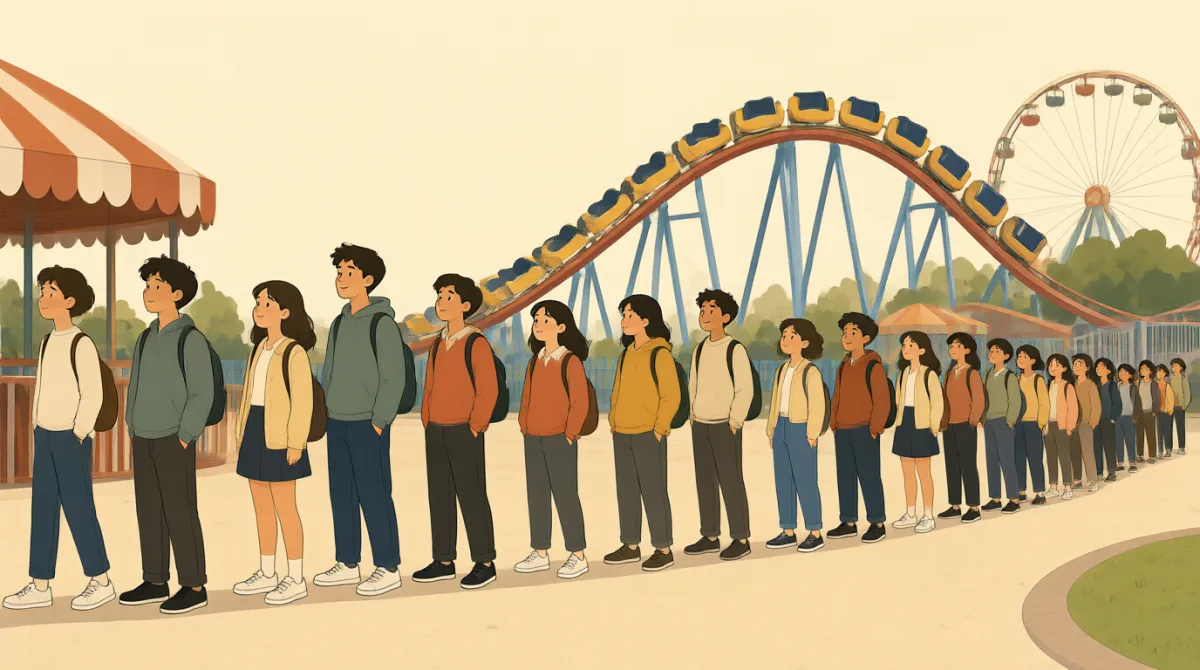

This line is really long. How long do you think we’ll wait?
La queue est vraiment longue. À ton avis, on va attendre combien de temps ?

The sign says forty-five minutes. That’s not too bad, right?
Le panneau indique quarante-cinq minutes. Ce n’est pas si terrible, non ?

Maybe. Let’s stay together and check the map while we wait.
Peut-être. Restons ensemble et regardons le plan en attendant.
Good idea. We can decide which ride to try after this one.
Bonne idée. On pourra décider quelle attraction essayer après celle-ci.
I hope the line moves faster. I’m ready for that big drop!
J’espère que la queue va avancer plus vite. J’ai hâte de vivre cette grande chute !
It’s moving a little. We can talk or take some photos.
Ça avance un peu. On peut discuter ou prendre quelques photos.
Let’s take a photo. The ride looks even taller from here!
Prenons une photo. D’ici, l’attraction a l’air encore plus haute !
Don’t worry, Emma. We’ll be on it soon, and you’ll have fun.
Ne t’inquiète pas, Emma. On va bientôt monter dessus, et tu vas t’amuser.
Vocabulaire8
- linefile d’attente
A line is a row of people waiting for something. Here, the friends are waiting to ride an attraction.
Une « file d’attente », c’est une rangée de personnes qui attendent quelque chose. Ici, les amis attendent pour faire une attraction.
- How long do you think we’ll wait?À ton avis, on va attendre combien de temps ?
Use this to ask someone to guess how much time you will spend waiting. You can change “we’ll” to “I’ll” or “they’ll.”
Utilise cette question pour demander à quelqu’un d’estimer combien de temps vous allez attendre. Tu peux remplacer “we’ll” par “I’ll” ou “they’ll.”
- stay togetherrester ensemble
This means to remain with the people you came with. It is useful when a group is in a busy place.
Cela signifie rester avec les personnes qui vous accompagnent. C’est utile quand on est en groupe dans un endroit très fréquenté.
- while we waiten attendant
This means during the time we are waiting. You can use it to suggest something to do before an event.
Cela signifie pendant que nous attendons. Tu peux utiliser cette expression pour proposer une activité avant qu’un événement commence.
- moves fasteravance plus vite
If a line moves faster, people get closer to the front more quickly. You can also say that a car or person moves faster.
Si une file avance plus vite, les gens arrivent plus rapidement près du début de la file. Tu peux aussi dire qu’une voiture ou une personne « moves faster ».
- take some photosprendre quelques photos
This means to use a camera or phone to make pictures. You can say “take a photo” for one picture.
Cela signifie utiliser un appareil photo ou un téléphone pour faire des images. Pour une seule image, tu peux dire “take a photo.”
- big dropgrande chute
A big drop is a sudden downward movement, like the steep part of a ride. It can describe a roller coaster or another attraction.
Une « grande chute », c’est une descente soudaine, comme la partie très raide d’une attraction. L’expression peut décrire des montagnes russes ou une autre attraction.
- from hered’ici
This means from the place where you are now. For example, you can say, “The view looks nice from here.”
Cela signifie depuis l’endroit où tu te trouves en ce moment. Par exemple, tu peux dire : “The view looks nice from here.”
Phrases clés8
- 1
This line is really long.
La queue est vraiment longue.
Use this sentence to comment on a line that has many people waiting. You can replace “line” with another thing, such as “The movie is really long.”
Utilise cette phrase pour faire remarquer qu’il y a beaucoup de personnes qui attendent. Tu peux remplacer “line” par une autre chose, par exemple dans “The movie is really long.”
- 2
The sign says forty-five minutes.
Le panneau indique quarante-cinq minutes.
Use this to report information written on a sign. You can replace “forty-five minutes” with a time or other detail you see.
Utilise cette phrase pour rapporter une information écrite sur un panneau. Tu peux remplacer “forty-five minutes” par une durée ou un autre détail indiqué.
- 3
Let’s stay together and check the map while we wait.
Restons ensemble et regardons le plan en attendant.
This sentence suggests two things to do as a group. Use “Let’s” to make a friendly suggestion, and add another activity after “and.”
Cette phrase propose deux activités à faire en groupe. Utilise “Let’s” pour faire une suggestion amicale, puis ajoute une autre activité après “and.”
- 4
We can decide which ride to try after this one.
On pourra décider quelle attraction essayer après celle-ci.
Use this to talk about choosing something to do later. Replace “ride” with another activity, such as “which restaurant to visit.”
Utilise cette phrase pour parler du choix d’une activité à faire plus tard. Remplace “ride” par une autre activité, comme dans “which restaurant to visit.”
- 5
I hope the line moves faster.
J’espère que la queue va avancer plus vite.
Use “I hope” to say what you want to happen. You can change the ending, as in “I hope the bus comes soon.”
Utilise “I hope” pour dire ce que tu souhaites voir se produire. Tu peux changer la fin, comme dans “I hope the bus comes soon.”
- 6
We can talk or take some photos.
On peut discuter ou prendre quelques photos.
Use “We can” to suggest possible activities. “Or” connects two choices.
Utilise “We can” pour proposer différentes activités. “Or” relie deux possibilités.
- 7
The ride looks even taller from here!
D’ici, l’attraction a l’air encore plus haute !
Use “looks” to describe how something appears to you. “Even taller” emphasizes that it seems taller than you expected.
Utilise “looks” pour décrire l’apparence de quelque chose à tes yeux. “Even taller” souligne que l’attraction semble plus haute que prévu.
- 8
We’ll be on it soon, and you’ll have fun.
On va bientôt monter dessus, et tu vas t’amuser.
Use “We’ll” and “you’ll” to talk about what you expect in the future. You can replace “have fun” with another positive result.
Utilise “We’ll” et “you’ll” pour parler de ce que tu prévois pour l’avenir. Tu peux remplacer “have fun” par un autre résultat positif.