Eating Together
Comer juntos
After cooking, Emma, Leo, and Grace sit down to eat. They taste the food and talk about what they enjoyed making.
Después de cocinar, Emma, Leo y Grace se sientan a comer. Prueban la comida y hablan de lo que disfrutaron preparando.
Diálogo8
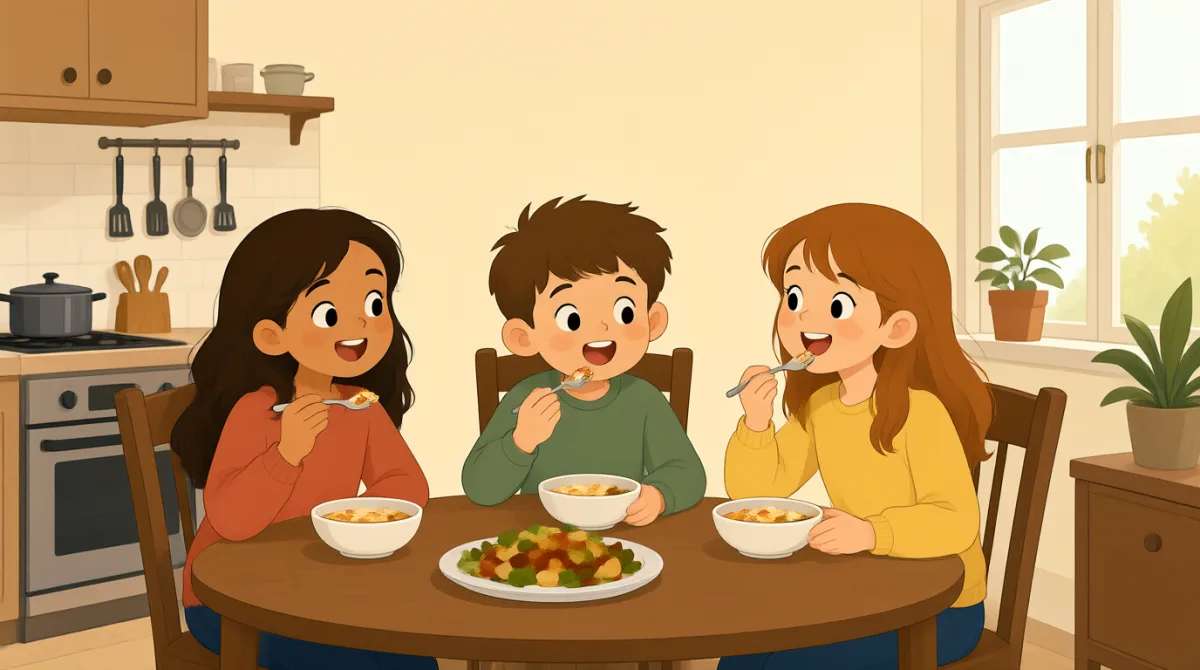

The soup is ready. Let’s sit down and enjoy it together.
La sopa está lista. Sentémonos y disfrutémosla juntos.

It smells wonderful! I’m excited to taste what we made.
¡Huele de maravilla! Tengo muchas ganas de probar lo que preparamos.

Me too. The vegetables are soft, and the soup tastes great.
Yo también. Las verduras están blanditas y la sopa está riquísima.
I liked cutting the vegetables, even though I was a little nervous.
Me gustó cortar las verduras, aunque estaba un poco nerviosa.
You both did a great job. What was your favorite part?
A las dos les quedó genial. ¿Qué fue lo que más les gustó?
I liked adding everything to the pot. It was easy and fun.
Me gustó echar todo en la olla. Fue fácil y divertido.
I enjoyed stirring the soup and tasting it at the end.
Disfruté removiendo la sopa y probándola al final.
I’m glad you enjoyed the class. You can make this soup at home.
Me alegra que hayan disfrutado de la clase. Pueden preparar esta sopa en casa.
Vocabulario8
- sit downsentarse
To move into a sitting position, often at a table. Here, Grace invites everyone to sit and eat.
Pasar a estar sentado, a menudo a la mesa. Aquí, Grace invita a todos a sentarse a comer.
- smells wonderfulhuele de maravilla
This means something has a very pleasant smell. You can use it to compliment food.
Significa que algo tiene un olor muy agradable. Puedes usar esta expresión para elogiar una comida.
- tasteprobar
To try food or drink by eating or drinking a little. Here, Emma is excited to try the soup.
Comer o beber un poco de algo para ver qué sabor tiene. Aquí, Emma tiene muchas ganas de probar la sopa.
- even thoughaunque
This phrase introduces something that is surprising or different from what you might expect. You can use it to connect two contrasting ideas.
Esta expresión introduce algo sorprendente o distinto de lo que cabría esperar. Puedes usarla para conectar dos ideas que contrastan.
- did a great jobhacer un gran trabajo
This means someone did something very well. Use it to praise a person or group.
Significa que alguien hizo algo muy bien. Úsalo para felicitar a una persona o a un grupo.
- favorite partparte favorita
The part you liked best. You can ask, “What was your favorite part?” about an activity or experience.
La parte que más te gustó. Puedes preguntar “What was your favorite part?” para saber qué fue lo que más le gustó a alguien de una actividad o experiencia.
- at the endal final
This means when something is finished. Here, Emma tasted the soup after stirring it.
Significa cuando algo termina. Aquí, Emma probó la sopa después de removerla.
- at homeen casa
This means in your own home. You can use it when talking about doing an activity in your home.
Significa en tu propio hogar. Puedes usarlo cuando hablas de hacer una actividad en tu casa.
Frases clave8
- 1
Let’s sit down and enjoy it together.
Sentémonos y disfrutémoslo juntos.
This is a friendly way to invite people to sit and share something. Replace “it” with a meal or activity you want to enjoy together.
Es una forma amistosa de invitar a otras personas a sentarse y compartir algo. Sustituye “it” por una comida o actividad que quieran disfrutar juntos.
- 2
It smells wonderful!
¡Huele de maravilla!
Use this sentence to say that something has a very nice smell. You can say it about food, flowers, or other pleasant smells.
Usa esta frase para decir que algo tiene un olor muy agradable. Puedes decirla al hablar de comida, flores u otros olores agradables.
- 3
I’m excited to taste what we made.
Tengo muchas ganas de probar lo que preparamos.
This is a useful way to say you are looking forward to trying food you prepared. Replace “what we made” with a specific dish.
Esta es una forma útil de decir que tienes ganas de probar la comida que preparaste. Sustituye “what we made” por un plato específico.
- 4
The vegetables are soft, and the soup tastes great.
Las verduras están blanditas y la sopa está riquísima.
This sentence describes the texture and flavor of food. You can change the food words and adjectives to describe another dish.
Esta frase describe la textura y el sabor de la comida. Puedes cambiar las palabras de la comida y los adjetivos para describir otro plato.
- 5
I liked cutting the vegetables, even though I was a little nervous.
Me gustó cortar las verduras, aunque estaba un poco nerviosa.
Use this pattern to talk about an activity you enjoyed despite feeling unsure. Replace the activity and feeling to describe your own experience.
Usa este patrón para hablar de una actividad que disfrutaste a pesar de sentirte inseguro. Cambia la actividad y lo que sentías para describir tu propia experiencia.
- 6
You both did a great job.
A las dos les quedó genial.
This is a kind way to praise two people. Use “you all” or “you did” when speaking to a different number of people.
Es una forma amable de elogiar a dos personas. Usa “you all” o “you did” cuando hables con un número distinto de personas.
- 7
What was your favorite part?
¿Qué fue lo que más les gustó?
This is a simple question to ask someone what they liked best about an experience. You can ask it after a class, meal, or trip.
Esta es una pregunta sencilla para saber qué fue lo que más le gustó a alguien de una experiencia. Puedes hacerla después de una clase, una comida o un viaje.
- 8
You can make this soup at home.
Pueden preparar esta sopa en casa.
Use this sentence to tell someone they can do or prepare something in their own home. Replace “make this soup” with another activity.
Usa esta frase para decirle a alguien que puede hacer o preparar algo en su propio hogar. Sustituye “make this soup” por otra actividad.