Asking the Chef a Question
Hacerle una pregunta al chef
Emma asks Grace how to make the sauce less salty. Grace suggests adding a little water and tasting it again.
Emma le pregunta a Grace cómo hacer que la salsa quede menos salada. Grace le sugiere agregar un poco de agua y volver a probarla.
Diálogo8
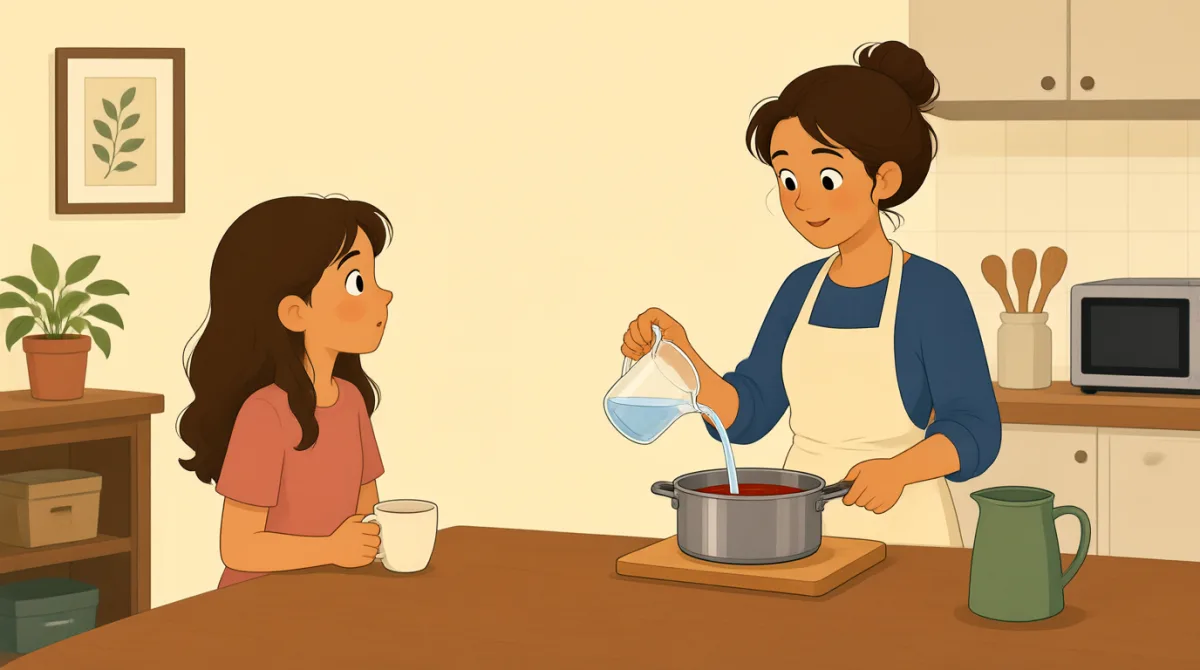

Grace, I think the sauce is too salty. Can I fix it?
Grace, creo que la salsa está demasiado salada. ¿Puedo arreglarla?

Yes. Add a little water, and then stir it well.
Sí. Agrega un poco de agua y luego revuélvela bien.
Should I add the water now, while it’s still hot?
¿Le agrego el agua ahora, mientras todavía está caliente?
Yes, that’s fine. Add just a little at first.
Sí, está bien. Agrega solo un poco al principio.
Okay, I added some. Should I taste it again?
Bueno, ya le agregué un poco. ¿La pruebo otra vez?
Yes, use a clean spoon and taste it carefully.
Sí, usa una cuchara limpia y pruébala con cuidado.
It tastes much better now. Should I add more water?
Ahora sabe mucho mejor. ¿Le agrego más agua?
No, it’s good now. A little water made a big difference.
No, ahora está bien. Un poco de agua hizo una gran diferencia.
Vocabulario7
- too saltydemasiado salado
This means the sauce has more salt than you want. You can use “too” before an adjective to say something is more than you like.
Significa que la salsa tiene más sal de la que quieres. Puedes usar “too” antes de un adjetivo para decir que algo es más de lo que te gusta.
- fix itarreglarla
Here, this means to make the sauce taste better. You can use “fix it” when you want to correct a problem.
Aquí significa hacer que la salsa sepa mejor. Puedes usar “fix it” cuando quieres corregir un problema.
- stir it wellrevolverla bien
This means to mix the sauce thoroughly with a spoon. You can say “stir it well” when giving someone a cooking instruction.
Significa mezclar bien la salsa con una cuchara. Puedes decir “stir it well” para dar instrucciones de cocina.
- at firstal principio
This means at the beginning. Here, Grace says to add only a small amount of water at the beginning.
Significa al comienzo. Aquí, Grace dice que agregue solo un poco de agua al principio.
- taste it againprobarla otra vez
This means to try the sauce once more to check its flavor. You can use this phrase after changing or adding something to food.
Significa probar la salsa una vez más para comprobar su sabor. Puedes usar esta expresión después de cambiar o agregar algo a la comida.
- a clean spoonuna cuchara limpia
This means a spoon that has been washed and is ready to use. It is useful advice when tasting food while cooking.
Significa una cuchara que se lavó y está lista para usar. Es un buen consejo para probar la comida mientras cocinas.
- made a big differencehizo una gran diferencia
This means caused a noticeable change. You can use it to describe how a small action improved a situation.
Significa que causó un cambio notable. Puedes usar esta expresión para describir cómo una pequeña acción mejoró una situación.
Frases clave7
- 1
I think the sauce is too salty.
Creo que la salsa está demasiado salada.
Use this sentence to describe a problem with food. You can replace “the sauce” and “too salty” to talk about other dishes or problems.
Usa esta oración para describir un problema con la comida. Puedes cambiar “the sauce” y “too salty” para hablar de otros platos o problemas.
- 2
Can I fix it?
¿Puedo arreglarla?
This is a simple way to ask if you can correct a problem. You can use “Can I fix it?” in many everyday situations.
Esta es una forma sencilla de preguntar si puedes corregir un problema. Puedes usar “Can I fix it?” en muchas situaciones cotidianas.
- 3
Add a little water, and then stir it well.
Agrega un poco de agua y luego revuélvela bien.
This gives two clear cooking instructions in order. You can use “Add a little [ingredient], and then stir it well” for other recipes.
Esta oración da dos instrucciones claras de cocina, en orden. Puedes usar “Add a little [ingredient], and then stir it well” para otras recetas.
- 4
Should I add the water now, while it’s still hot?
¿Le agrego el agua ahora, mientras todavía está caliente?
Use this question to ask if it is the right time to do something. You can replace “add the water” with another action.
Usa esta pregunta para saber si es el momento adecuado para hacer algo. Puedes reemplazar “add the water” por otra acción.
- 5
Should I taste it again?
¿La pruebo otra vez?
This is a useful way to check what to do next while cooking. You can use “Should I [action] again?” to ask for advice.
Esta es una forma útil de preguntar qué hacer después mientras cocinas. Puedes usar “Should I [action] again?” para pedir consejo.
- 6
Yes, use a clean spoon and taste it carefully.
Sí, usa una cuchara limpia y pruébala con cuidado.
This sentence gives practical advice for tasting food safely. You can use “Use a clean [item] and [action] carefully” to give similar instructions.
Esta oración da consejos prácticos para probar la comida de forma segura. Puedes usar “Use a clean [item] and [action] carefully” para dar instrucciones parecidas.
- 7
A little water made a big difference.
Un poco de agua hizo una gran diferencia.
Use this sentence to say that a small change had a noticeable effect. You can replace “water” with another thing that helped.
Usa esta oración para decir que un pequeño cambio tuvo un efecto notable. Puedes reemplazar “water” por otra cosa que haya ayudado.