Following the Recipe
Siguiendo la receta
The class follows the recipe and adds the ingredients to a pot. Grace explains when to stir and how long to cook the food.
La clase sigue la receta y agrega los ingredientes a una olla. Grace explica cuándo revolver y cuánto tiempo cocinar la comida.
Diálogo9
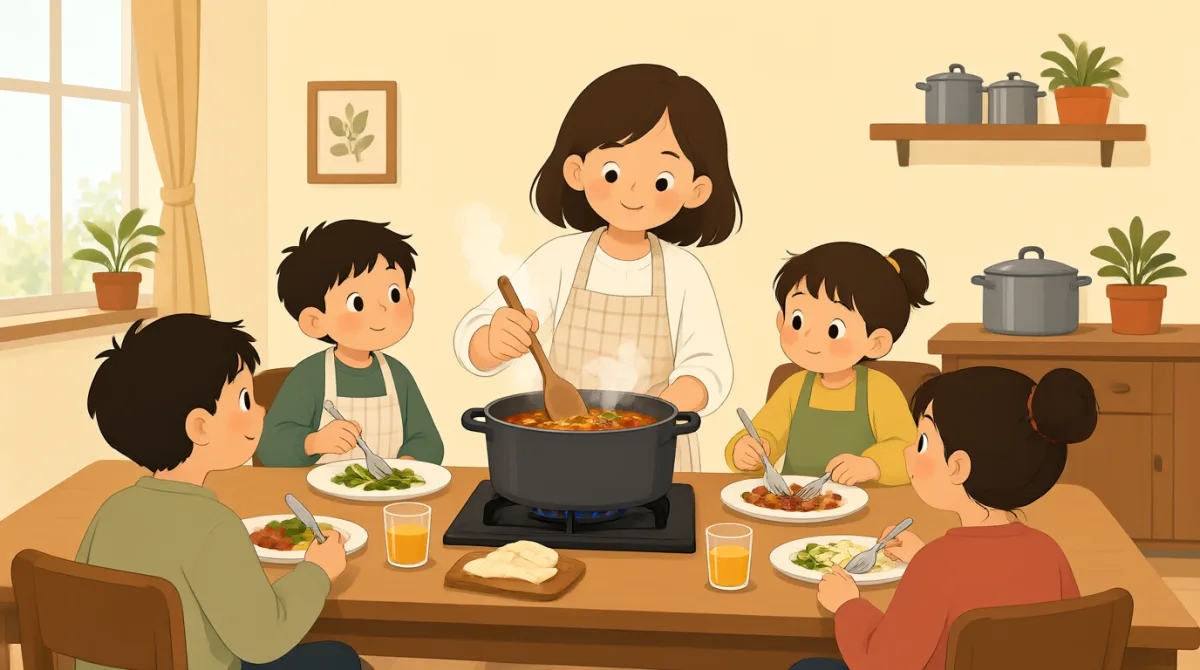

Now, read the recipe. First, pour two cups of water into the pot.
Ahora, lean la receta. Primero, viertan dos tazas de agua en la olla.

Should I add the tomatoes now, or wait until the water gets hot?
¿Agrego los tomates ahora o espero a que el agua se caliente?
Wait until it boils. Then add the tomatoes, beans, and a little salt.
Espera hasta que hierva. Luego agrega los tomates, los frijoles y un poco de sal.

How long should we cook everything? I don't want to burn lunch.
¿Cuánto tiempo tenemos que cocinar todo? No quiero quemar el almuerzo.
Cook it for ten minutes. Stir it gently every few minutes.
Cocínalo durante diez minutos. Revuélvelo suavemente cada pocos minutos.
The soup is bubbling now. Should I turn the heat down?
La sopa ya está burbujeando. ¿Bajo el fuego?
Yes, turn it down to low. Keep stirring so nothing sticks.
Sí, bájalo al mínimo. Sigue revolviendo para que nada se pegue.
I stirred it, and the beans feel soft. Can we taste it now?
Ya lo revolví, y los frijoles están blandos. ¿Podemos probarlo ahora?
Sure. Take a small spoonful, and tell me if it needs more salt.
Claro. Prueba una cucharadita y dime si le hace falta más sal.
Vocabulario8
- pour two cups of waterverter dos tazas de agua
This means to put two cups of water into the pot. You can use “pour” when adding a liquid to a container.
Significa echar dos tazas de agua en la olla. Puedes usar “pour” cuando agregas un líquido a un recipiente.
- until it boilshasta que hierva
This means to wait until the water gets very hot and starts bubbling. You can say “until it boils” when explaining when to do something.
Significa esperar hasta que el agua esté muy caliente y empiece a burbujear. Puedes decir “until it boils” para explicar cuándo hacer algo.
- add the tomatoesagregar los tomates
This means to put the tomatoes into the pot. Use “add” when putting an ingredient into food.
Significa poner los tomates en la olla. Usa “add” cuando incorporas un ingrediente a la comida.
- stir it gentlyrevolver suavemente
This means to mix the food slowly and carefully with a spoon. You can use “stir gently” when giving cooking instructions.
Significa mezclar la comida despacio y con cuidado con una cuchara. Puedes usar “stir gently” para dar instrucciones de cocina.
- turn it down to lowbajar el fuego al mínimo
This means to lower the heat to a low setting. You can use this phrase when a dish needs to cook more slowly.
Significa bajar el fuego a una intensidad baja. Puedes usar esta frase cuando un plato necesita cocinarse más despacio.
- sticksse pega
Here, “sticks” means food gets attached to the bottom of the pot. You can say “so nothing sticks” when explaining why you should stir.
Aquí, “sticks” significa que la comida se queda pegada al fondo de la olla. Puedes decir “so nothing sticks” para explicar por qué hay que revolver.
- a small spoonfuluna cucharadita
This means a small amount of food that fits on a spoon. Use it when tasting food or serving a little.
Significa una pequeña cantidad de comida que cabe en una cuchara. Se usa para probar la comida o servir un poco.
- needs more saltnecesita más sal
This means the food may need extra salt to taste better. You can use this phrase when asking someone to check the flavor.
Significa que quizá haga falta agregar sal para que la comida tenga mejor sabor. Puedes usar esta frase para pedirle a alguien que compruebe el sabor.
Frases clave8
- 1
First, pour two cups of water into the pot.
Primero, vierte dos tazas de agua en la olla.
This gives a clear first step in a recipe. You can reuse the pattern “First, pour [amount] of [liquid] into the [container].”
Esta frase indica claramente el primer paso de una receta. Puedes reutilizar el patrón “First, pour [amount] of [liquid] into the [container].” (Primero, vierte [cantidad] de [líquido] en el/la [recipiente]).
- 2
Should I add the tomatoes now, or wait until the water gets hot?
¿Agrego los tomates ahora o espero a que el agua se caliente?
This is a useful way to ask whether to do something now or later. Replace “add the tomatoes” with another task to ask about the right time.
Esta es una forma útil de preguntar si debes hacer algo ahora o más tarde. Cambia “add the tomatoes” por otra tarea para preguntar cuál es el momento adecuado.
- 3
Cook it for ten minutes.
Cocínalo durante diez minutos.
This tells someone how long to cook something. You can use “Cook it for [time]” to give a simple cooking instruction.
Esta frase indica cuánto tiempo hay que cocinar algo. Puedes usar “Cook it for [time]” (Cocínalo durante [tiempo]) para dar una instrucción sencilla de cocina.
- 4
Stir it gently every few minutes.
Revuélvelo suavemente cada pocos minutos.
This gives both the action and how often to do it. You can change “gently” or “every few minutes” to give different instructions.
Esta frase indica tanto qué hacer como con qué frecuencia. Puedes cambiar “gently” o “every few minutes” para dar instrucciones diferentes.
- 5
Yes, turn it down to low.
Sí, bájalo al mínimo.
This is a short, practical instruction for lowering the heat. You can replace “low” with another heat setting, such as “medium.”
Esta es una instrucción breve y práctica para bajar el fuego. Puedes reemplazar “low” por otra intensidad, como “medium.”
- 6
Keep stirring so nothing sticks.
Sigue revolviendo para que nada se pegue.
This explains what to keep doing and why. Use “Keep [verb]-ing so [result]” to give a helpful reminder.
Esta frase explica qué debes seguir haciendo y por qué. Usa “Keep [verb]-ing so [result]” para dar un recordatorio útil.
- 7
Can we taste it now?
¿Podemos probarlo ahora?
This is a simple way to ask if it is okay to try some food. You can replace “taste it” with another action to ask permission.
Esta es una forma sencilla de preguntar si está bien probar algo de comida. Puedes reemplazar “taste it” por otra acción para pedir permiso.
- 8
Take a small spoonful, and tell me if it needs more salt.
Prueba una cucharadita y dime si le hace falta más sal.
This gives someone two clear steps: taste a little and say what the food needs. You can replace “more salt” with another ingredient or seasoning.
Esta frase da dos pasos claros: probar un poco y decir qué necesita la comida. Puedes reemplazar “more salt” por otro ingrediente o condimento.