Going to a Repair Shop
Ir a un taller de reparación
Emma takes her phone to a repair shop and shows David the cracked screen. He asks a few questions about the phone.
Emma lleva su teléfono a un taller de reparación y le muestra a David la pantalla rota. Él le hace algunas preguntas sobre el teléfono.
Diálogo8
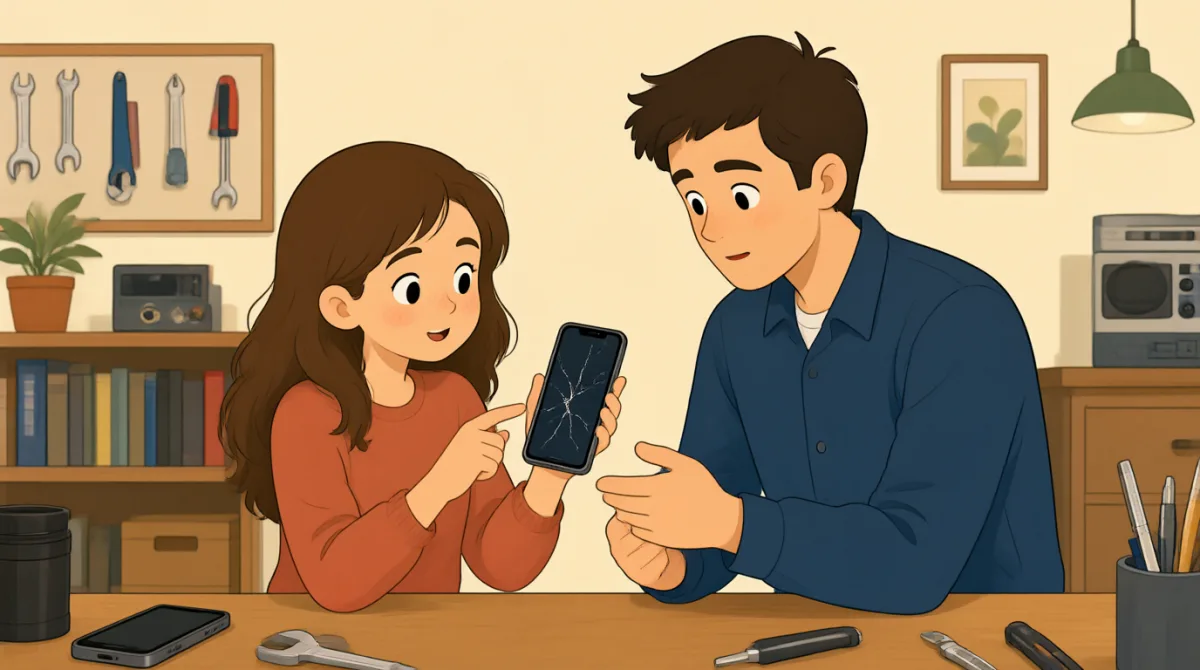

Hi, I dropped my phone on the sidewalk, and the screen cracked.
Hola, se me cayó el teléfono en la acera y se rompió la pantalla.

I’m sorry that happened. Can I take a look at it?
Siento que te haya pasado. ¿Puedo echarle un vistazo?
Sure. Here it is. The screen still works, but there are cracks.
Claro. Aquí está. La pantalla todavía funciona, pero tiene grietas.
Thanks. What kind of phone is it?
Gracias. ¿Qué tipo de teléfono es?
It’s an older iPhone. I’m not sure which model.
Es un iPhone más antiguo. No estoy segura de qué modelo es.
That’s okay. I can check the model in your phone’s settings.
No pasa nada. Puedo comprobar el modelo en los ajustes del teléfono.
Will you need my passcode to check it?
¿Necesitarás mi código para comprobarlo?
No, I can find the model without opening your apps.
No, puedo encontrar el modelo sin abrir tus aplicaciones.
Vocabulario8
- dropped my phonese me cayó el teléfono
This means the phone fell from my hand or another place. Use “I dropped my…” to explain how something fell.
Significa que el teléfono se cayó de mi mano o de algún otro lugar. Usa “I dropped my…” para explicar cómo se cayó algo.
- on the sidewalken la acera
The sidewalk is the path beside a street for people to walk on. This phrase tells where something happened.
La acera es el camino junto a la calle por donde caminan las personas. Esta expresión indica dónde ocurrió algo.
- crackedroto
Here, “cracked” means the screen has lines or breaks in it. Use it to describe damage to glass.
Aquí, “cracked” significa que la pantalla tiene líneas o grietas. Usa esta palabra para describir daños en el vidrio.
- take a look at itecharle un vistazo
This means to examine or check something. You can say “Can I take a look at it?” when asking to see an item.
Significa examinar o revisar algo. Puedes decir “Can I take a look at it?” cuando pides ver un objeto.
- What kind of phone is it?¿Qué tipo de teléfono es?
This question asks about the phone’s type or brand. You can reuse “What kind of… is it?” to ask about other things.
Esta pregunta se refiere al tipo o la marca del teléfono. Puedes reutilizar “What kind of… is it?” para preguntar por otras cosas.
- older iPhoneiPhone más antiguo
This means an iPhone that is not a recent model. Use “older” to describe something made or bought some time ago.
Se refiere a un iPhone que no es un modelo reciente. Usa “older” para describir algo que se fabricó o se compró hace algún tiempo.
- check the modelcomprobar el modelo
This means find out the exact type or version of the phone. You can use “check” when asking someone to find information.
Significa averiguar el tipo o la versión exactos del teléfono. Puedes usar “check” cuando le pides a alguien que busque información.
- passcodecódigo de acceso
A passcode is a secret number or code used to unlock a phone. You may need it to open the phone, but not always to check basic information.
Un código de acceso es un número o código secreto que se usa para desbloquear un teléfono. Puede que lo necesites para abrir el teléfono, pero no siempre para consultar información básica.
Frases clave8
- 1
I dropped my phone on the sidewalk, and the screen cracked.
Se me cayó el teléfono en la acera y se rompió la pantalla.
This sentence explains what happened and what was damaged. Use “I dropped my…” to describe an accident, then say what happened next.
Esta oración explica qué pasó y qué se dañó. Usa “I dropped my…” para describir un accidente y luego di qué pasó después.
- 2
Can I take a look at it?
¿Puedo echarle un vistazo?
This is a polite way to ask to examine something. Replace “it” with the item you want to check.
Esta es una forma cortés de pedir permiso para examinar algo. Sustituye “it” por el objeto que quieres revisar.
- 3
The screen still works, but there are cracks.
La pantalla todavía funciona, pero tiene grietas.
This explains that something works even though it is damaged. Use “still works, but…” to describe a problem with a positive detail.
Esta oración explica que algo funciona aunque esté dañado. Usa “still works, but…” para describir un problema junto con un aspecto positivo.
- 4
What kind of phone is it?
¿Qué tipo de teléfono es?
This is a simple question about the type of phone. You can change “phone” to another item, such as “What kind of computer is it?”
Esta es una pregunta sencilla sobre el tipo de teléfono. Puedes cambiar “phone” por otro objeto, por ejemplo: “What kind of computer is it?”.
- 5
I’m not sure which model.
No estoy segura de qué modelo es.
Use this when you do not know the exact model or version. You can also say “I’m not sure which…” to explain that you do not know a detail.
Usa esta frase cuando no sabes el modelo o la versión exactos. También puedes decir “I’m not sure which…” para explicar que desconoces un detalle.
- 6
I can check the model in your phone’s settings.
Puedo comprobar el modelo en los ajustes del teléfono.
This sentence explains how the repair worker can find the phone model. Use “I can check…” to offer to find information.
Esta oración explica cómo puede averiguar el técnico el modelo del teléfono. Usa “I can check…” para ofrecerte a buscar información.
- 7
Will you need my passcode to check it?
¿Necesitarás mi código de acceso para comprobarlo?
This is a polite way to ask if someone needs your passcode for a task. Use “Will you need my…?” to ask about something required.
Esta es una forma cortés de preguntar si alguien necesita tu código de acceso para hacer algo. Usa “Will you need my…?” para preguntar si hace falta algo.
- 8
No, I can find the model without opening your apps.
No, puedo encontrar el modelo sin abrir tus aplicaciones.
This reassures the customer that the worker can find the information without opening the apps. Use “without + -ing” to explain what is not necessary.
Esta respuesta tranquiliza al cliente: el técnico puede encontrar la información sin abrir las aplicaciones. Usa “without + -ing” para explicar qué no hace falta hacer.