Going to a Repair Shop
Wizyta w serwisie naprawczym
Emma takes her phone to a repair shop and shows David the cracked screen. He asks a few questions about the phone.
Emma zanosi telefon do serwisu i pokazuje Davidowi pęknięty ekran. David zadaje jej kilka pytań o telefon.
Dialog8
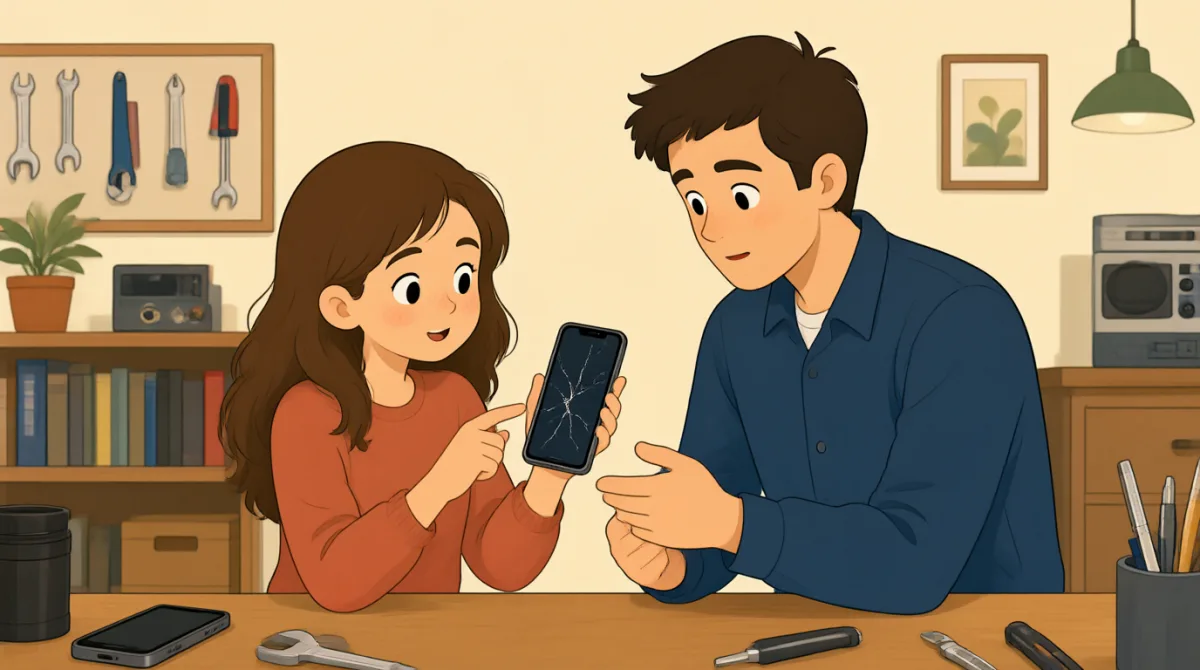

Hi, I dropped my phone on the sidewalk, and the screen cracked.
Cześć, upuściłam telefon na chodnik i ekran pękł.

I’m sorry that happened. Can I take a look at it?
Przykro mi, że tak się stało. Mogę na niego zerknąć?
Sure. Here it is. The screen still works, but there are cracks.
Jasne. Proszę, oto on. Ekran nadal działa, ale są na nim pęknięcia.
Thanks. What kind of phone is it?
Dziękuję. Jaki to telefon?
It’s an older iPhone. I’m not sure which model.
To starszy iPhone. Nie wiem, jaki to model.
That’s okay. I can check the model in your phone’s settings.
W porządku. Mogę sprawdzić model w ustawieniach telefonu.
Will you need my passcode to check it?
Będzie potrzebny mój kod, żeby go sprawdzić?
No, I can find the model without opening your apps.
Nie, mogę sprawdzić model bez otwierania aplikacji.
Słownictwo8
- dropped my phoneupuściłam telefon
This means the phone fell from my hand or another place. Use “I dropped my…” to explain how something fell.
To znaczy, że telefon wypadł mi z ręki albo spadł z innego miejsca. Użyj „I dropped my…”, żeby wyjaśnić, jak coś upadło.
- on the sidewalkna chodniku
The sidewalk is the path beside a street for people to walk on. This phrase tells where something happened.
Chodnik to ścieżka przy ulicy, po której chodzą piesi. To wyrażenie mówi, gdzie coś się wydarzyło.
- crackedpęknięty
Here, “cracked” means the screen has lines or breaks in it. Use it to describe damage to glass.
Tutaj „cracked” oznacza, że na ekranie są rysy lub pęknięcia. Używaj tego słowa, żeby opisać uszkodzone szkło.
- take a look at itzerknąć na to
This means to examine or check something. You can say “Can I take a look at it?” when asking to see an item.
To znaczy dokładnie coś obejrzeć lub sprawdzić. Możesz powiedzieć „Can I take a look at it?”, gdy pytasz, czy możesz obejrzeć jakąś rzecz.
- What kind of phone is it?Jaki to telefon?
This question asks about the phone’s type or brand. You can reuse “What kind of… is it?” to ask about other things.
To pytanie dotyczy rodzaju lub marki telefonu. Możesz wykorzystać „What kind of… is it?”, pytając o inne rzeczy.
- older iPhonestarszy iPhone
This means an iPhone that is not a recent model. Use “older” to describe something made or bought some time ago.
To iPhone, który nie jest najnowszym modelem. „Older” używamy do opisu czegoś, co zostało wyprodukowane lub kupione jakiś czas temu.
- check the modelsprawdzić model
This means find out the exact type or version of the phone. You can use “check” when asking someone to find information.
To znaczy ustalić dokładny typ lub wersję telefonu. Możesz użyć „check”, gdy prosisz kogoś o znalezienie jakiejś informacji.
- passcodekod dostępu
A passcode is a secret number or code used to unlock a phone. You may need it to open the phone, but not always to check basic information.
Kod dostępu to tajny numer lub kod używany do odblokowania telefonu. Może być potrzebny, żeby otworzyć telefon, ale nie zawsze, by sprawdzić podstawowe informacje.
Kluczowe zdania8
- 1
I dropped my phone on the sidewalk, and the screen cracked.
Upuściłam telefon na chodnik i ekran pękł.
This sentence explains what happened and what was damaged. Use “I dropped my…” to describe an accident, then say what happened next.
To zdanie wyjaśnia, co się stało i co zostało uszkodzone. Użyj „I dropped my…”, żeby opisać wypadek, a potem powiedz, co stało się dalej.
- 2
Can I take a look at it?
Mogę na to zerknąć?
This is a polite way to ask to examine something. Replace “it” with the item you want to check.
To uprzejmy sposób, by zapytać, czy można coś obejrzeć. Zastąp „it” nazwą rzeczy, którą chcesz sprawdzić.
- 3
The screen still works, but there are cracks.
Ekran nadal działa, ale są na nim pęknięcia.
This explains that something works even though it is damaged. Use “still works, but…” to describe a problem with a positive detail.
To zdanie mówi, że coś działa pomimo uszkodzenia. Użyj „still works, but…”, by opisać problem, wspominając jednocześnie o czymś pozytywnym.
- 4
What kind of phone is it?
Jaki to telefon?
This is a simple question about the type of phone. You can change “phone” to another item, such as “What kind of computer is it?”
To proste pytanie o rodzaj telefonu. Możesz zastąpić „phone” inną rzeczą, na przykład „What kind of computer is it?”.
- 5
I’m not sure which model.
Nie wiem, jaki to model.
Use this when you do not know the exact model or version. You can also say “I’m not sure which…” to explain that you do not know a detail.
Użyj tego, gdy nie znasz dokładnego modelu lub wersji. Możesz też powiedzieć „I’m not sure which…”, żeby wyjaśnić, że nie znasz jakiegoś szczegółu.
- 6
I can check the model in your phone’s settings.
Mogę sprawdzić model w ustawieniach telefonu.
This sentence explains how the repair worker can find the phone model. Use “I can check…” to offer to find information.
To zdanie wyjaśnia, jak pracownik serwisu może znaleźć model telefonu. Użyj „I can check…”, by zaproponować znalezienie informacji.
- 7
Will you need my passcode to check it?
Będzie potrzebny mój kod dostępu, żeby to sprawdzić?
This is a polite way to ask if someone needs your passcode for a task. Use “Will you need my…?” to ask about something required.
To uprzejmy sposób, by zapytać, czy ktoś potrzebuje twojego kodu dostępu do wykonania jakiegoś zadania. Użyj „Will you need my…?”, pytając o coś, co może być potrzebne.
- 8
No, I can find the model without opening your apps.
Nie, mogę sprawdzić model bez otwierania aplikacji.
This reassures the customer that the worker can find the information without opening the apps. Use “without + -ing” to explain what is not necessary.
To zapewnienie klienta, że pracownik może znaleźć tę informację bez otwierania aplikacji. Użyj „without + -ing”, by wyjaśnić, co nie jest konieczne.