Going to a Repair Shop
Besuch in einer Handywerkstatt
Emma takes her phone to a repair shop and shows David the cracked screen. He asks a few questions about the phone.
Emma bringt ihr Handy in eine Reparaturwerkstatt und zeigt David das gesprungene Display. Er stellt ihr ein paar Fragen zum Handy.
Dialog8
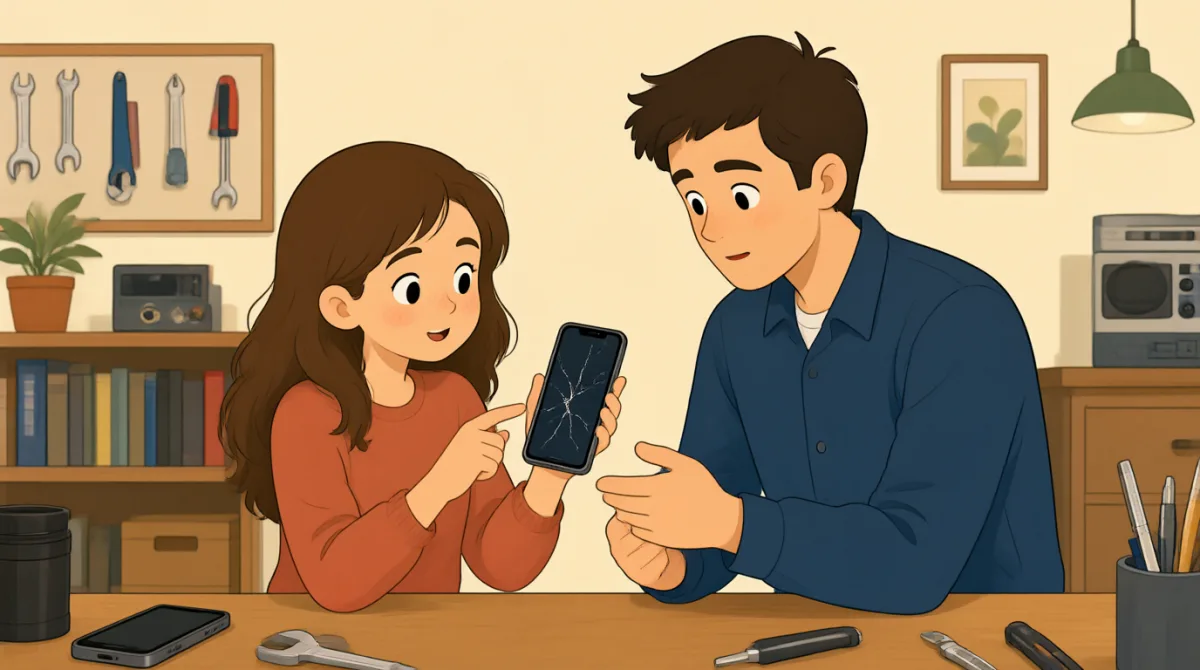

Hi, I dropped my phone on the sidewalk, and the screen cracked.
Hallo, mir ist mein Handy auf den Gehweg gefallen, und das Display ist gesprungen.

I’m sorry that happened. Can I take a look at it?
Oh, das tut mir leid. Darf ich es mir mal ansehen?
Sure. Here it is. The screen still works, but there are cracks.
Klar. Hier, bitte. Das Display funktioniert noch, aber es hat Risse.
Thanks. What kind of phone is it?
Danke. Was ist das für ein Handy?
It’s an older iPhone. I’m not sure which model.
Es ist ein älteres iPhone. Ich weiß nicht genau, welches Modell.
That’s okay. I can check the model in your phone’s settings.
Kein Problem. Ich kann das Modell in den Einstellungen Ihres Handys nachsehen.
Will you need my passcode to check it?
Brauchen Sie meinen Code, um das nachzusehen?
No, I can find the model without opening your apps.
Nein, ich kann das Modell herausfinden, ohne Ihre Apps zu öffnen.
Wortschatz8
- dropped my phonemir ist mein Handy heruntergefallen
This means the phone fell from my hand or another place. Use “I dropped my…” to explain how something fell.
Das bedeutet, dass das Handy mir aus der Hand oder von einem anderen Ort heruntergefallen ist. Mit „I dropped my…“ erklärst du, wie etwas heruntergefallen ist.
- on the sidewalkauf dem Gehweg
The sidewalk is the path beside a street for people to walk on. This phrase tells where something happened.
Ein Gehweg ist der Weg neben einer Straße, auf dem Menschen gehen. Diese Wendung sagt, wo etwas passiert ist.
- crackedgesprungen
Here, “cracked” means the screen has lines or breaks in it. Use it to describe damage to glass.
Hier bedeutet „cracked“, dass das Display Risse hat oder kaputtgegangen ist. Mit diesem Wort beschreibst du Schäden an Glas.
- take a look at itsich etwas ansehen
This means to examine or check something. You can say “Can I take a look at it?” when asking to see an item.
Das bedeutet, etwas zu untersuchen oder zu überprüfen. Du kannst „Can I take a look at it?“ sagen, wenn du darum bittest, dir etwas ansehen zu dürfen.
- What kind of phone is it?Was ist das für ein Handy?
This question asks about the phone’s type or brand. You can reuse “What kind of… is it?” to ask about other things.
Mit dieser Frage erkundigst du dich nach dem Typ oder der Marke des Handys. Du kannst „What kind of… is it?“ auch für andere Dinge verwenden.
- older iPhoneälteres iPhone
This means an iPhone that is not a recent model. Use “older” to describe something made or bought some time ago.
Das bedeutet, dass das iPhone kein aktuelles Modell ist. Mit „older“ beschreibst du etwas, das vor einiger Zeit hergestellt oder gekauft wurde.
- check the modeldas Modell herausfinden
This means find out the exact type or version of the phone. You can use “check” when asking someone to find information.
Das bedeutet, den genauen Typ oder die Version des Handys herauszufinden. Mit „check“ kannst du sagen, dass jemand Informationen nachschauen soll.
- passcodeCode
A passcode is a secret number or code used to unlock a phone. You may need it to open the phone, but not always to check basic information.
Ein Passcode ist eine geheime Zahlen- oder Zeichenfolge, mit der man ein Handy entsperrt. Du brauchst ihn möglicherweise, um das Handy zu öffnen, aber nicht immer, um grundlegende Informationen nachzusehen.
Wichtige Sätze8
- 1
I dropped my phone on the sidewalk, and the screen cracked.
Mir ist mein Handy auf den Gehweg gefallen, und das Display ist gesprungen.
This sentence explains what happened and what was damaged. Use “I dropped my…” to describe an accident, then say what happened next.
Dieser Satz erklärt, was passiert ist und was dabei beschädigt wurde. Mit „I dropped my…“ beschreibst du einen Unfall und sagst dann, was danach passiert ist.
- 2
Can I take a look at it?
Darf ich es mir mal ansehen?
This is a polite way to ask to examine something. Replace “it” with the item you want to check.
So bittest du höflich darum, etwas untersuchen zu dürfen. Ersetze „it“ durch den Gegenstand, den du überprüfen möchtest.
- 3
The screen still works, but there are cracks.
Das Display funktioniert noch, aber es hat Risse.
This explains that something works even though it is damaged. Use “still works, but…” to describe a problem with a positive detail.
Damit erklärst du, dass etwas trotz eines Schadens noch funktioniert. Mit „still works, but…“ beschreibst du ein Problem und nennst zugleich etwas Positives.
- 4
What kind of phone is it?
Was ist das für ein Handy?
This is a simple question about the type of phone. You can change “phone” to another item, such as “What kind of computer is it?”
Das ist eine einfache Frage nach dem Handymodell. Du kannst „phone“ durch einen anderen Gegenstand ersetzen, zum Beispiel in „What kind of computer is it?“.
- 5
I’m not sure which model.
Ich weiß nicht genau, welches Modell.
Use this when you do not know the exact model or version. You can also say “I’m not sure which…” to explain that you do not know a detail.
Das kannst du sagen, wenn du das genaue Modell oder die Version nicht kennst. Mit „I’m not sure which…“ kannst du auch ausdrücken, dass du ein bestimmtes Detail nicht weißt.
- 6
I can check the model in your phone’s settings.
Ich kann das Modell in den Einstellungen Ihres Handys nachsehen.
This sentence explains how the repair worker can find the phone model. Use “I can check…” to offer to find information.
Dieser Satz erklärt, wie die Person in der Werkstatt das Handymodell herausfinden kann. Mit „I can check…“ bietest du an, Informationen nachzusehen.
- 7
Will you need my passcode to check it?
Brauchen Sie meinen Code, um das nachzusehen?
This is a polite way to ask if someone needs your passcode for a task. Use “Will you need my…?” to ask about something required.
So fragst du höflich, ob jemand für eine Aufgabe deinen Code braucht. Mit „Will you need my…?“ fragst du, ob etwas benötigt wird.
- 8
No, I can find the model without opening your apps.
Nein, ich kann das Modell herausfinden, ohne Ihre Apps zu öffnen.
This reassures the customer that the worker can find the information without opening the apps. Use “without + -ing” to explain what is not necessary.
Damit versichert die Person in der Werkstatt der Kundin, dass sie die Information finden kann, ohne die Apps zu öffnen. Mit „without + -ing“ erklärst du, was nicht nötig ist.