Going to a Repair Shop
Đến tiệm sửa chữa
Emma takes her phone to a repair shop and shows David the cracked screen. He asks a few questions about the phone.
Emma mang điện thoại đến tiệm sửa chữa và cho David xem màn hình bị nứt. Anh hỏi cô vài câu về chiếc điện thoại.
Hội thoại8
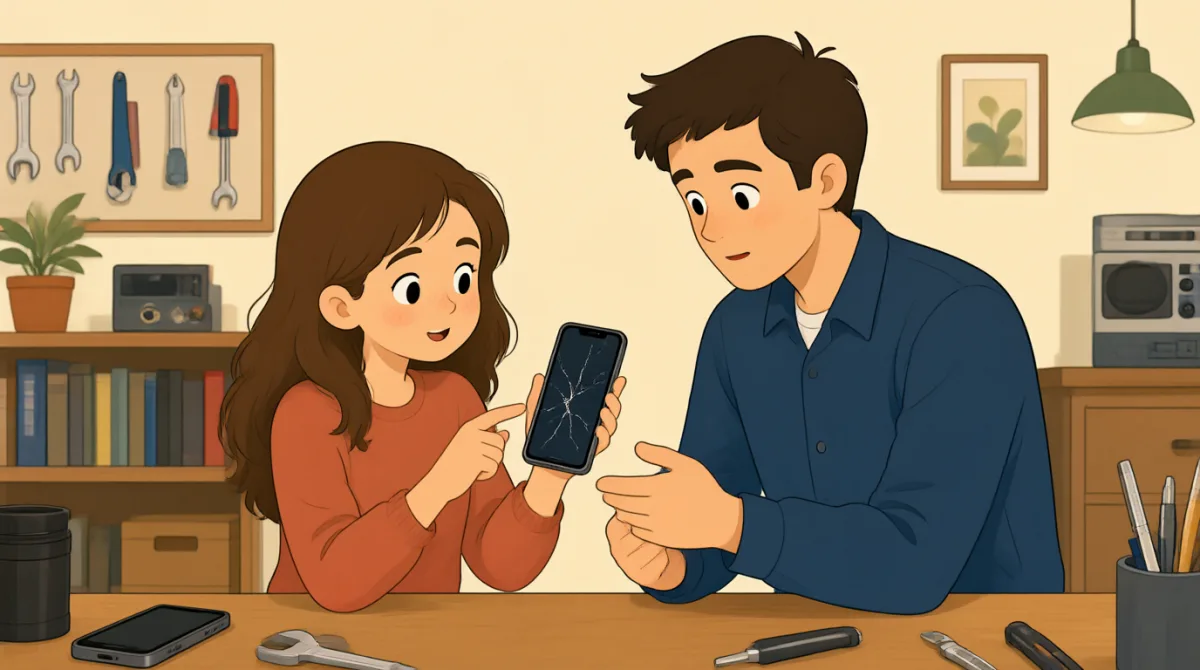

Hi, I dropped my phone on the sidewalk, and the screen cracked.
Chào anh, tôi làm rơi điện thoại xuống vỉa hè nên màn hình bị nứt.

I’m sorry that happened. Can I take a look at it?
Tôi rất tiếc khi nghe vậy. Tôi xem thử được không ạ?
Sure. Here it is. The screen still works, but there are cracks.
Được ạ. Đây này. Màn hình vẫn dùng được, nhưng có những vết nứt.
Thanks. What kind of phone is it?
Cảm ơn chị. Điện thoại của chị là loại nào ạ?
It’s an older iPhone. I’m not sure which model.
Đây là iPhone đời cũ. Tôi không chắc là mẫu nào.
That’s okay. I can check the model in your phone’s settings.
Không sao ạ. Tôi có thể kiểm tra mẫu máy trong phần cài đặt của điện thoại.
Will you need my passcode to check it?
Anh có cần mật mã của tôi để kiểm tra không?
No, I can find the model without opening your apps.
Không ạ, tôi có thể tìm mẫu máy mà không cần mở các ứng dụng của chị.
Từ vựng8
- dropped my phonelàm rơi điện thoại
This means the phone fell from my hand or another place. Use “I dropped my…” to explain how something fell.
Cụm này có nghĩa là điện thoại rơi khỏi tay bạn hoặc từ một vị trí nào đó. Dùng “I dropped my…” để giải thích một món đồ đã rơi như thế nào.
- on the sidewalktrên vỉa hè
The sidewalk is the path beside a street for people to walk on. This phrase tells where something happened.
Vỉa hè là lối đi bên cạnh đường phố dành cho người đi bộ. Cụm này cho biết sự việc xảy ra ở đâu.
- crackedbị nứt
Here, “cracked” means the screen has lines or breaks in it. Use it to describe damage to glass.
Ở đây, “cracked” có nghĩa là màn hình có những đường nứt hoặc bị vỡ. Dùng từ này để miêu tả đồ thủy tinh bị hư hại.
- take a look at itxem thử
This means to examine or check something. You can say “Can I take a look at it?” when asking to see an item.
Cụm này có nghĩa là xem xét hoặc kiểm tra thứ gì đó. Bạn có thể nói “Can I take a look at it?” khi muốn hỏi xem một món đồ.
- What kind of phone is it?Điện thoại là loại nào vậy?
This question asks about the phone’s type or brand. You can reuse “What kind of… is it?” to ask about other things.
Câu hỏi này hỏi về loại hoặc thương hiệu điện thoại. Bạn có thể dùng lại mẫu “What kind of… is it?” để hỏi về những thứ khác.
- older iPhoneiPhone đời cũ
This means an iPhone that is not a recent model. Use “older” to describe something made or bought some time ago.
Cụm này có nghĩa là một chiếc iPhone không thuộc mẫu mới ra gần đây. Dùng “older” để miêu tả thứ được sản xuất hoặc mua từ khá lâu.
- check the modelkiểm tra mẫu máy
This means find out the exact type or version of the phone. You can use “check” when asking someone to find information.
Cụm này có nghĩa là tìm ra chính xác loại hoặc phiên bản của điện thoại. Bạn có thể dùng “check” khi nhờ ai đó tìm thông tin.
- passcodemật mã
A passcode is a secret number or code used to unlock a phone. You may need it to open the phone, but not always to check basic information.
Mật mã là một dãy số hoặc mã bí mật dùng để mở khóa điện thoại. Có thể bạn cần mật mã để mở điện thoại, nhưng không phải lúc nào cũng cần để kiểm tra những thông tin cơ bản.
Câu trọng tâm8
- 1
I dropped my phone on the sidewalk, and the screen cracked.
Tôi làm rơi điện thoại xuống vỉa hè nên màn hình bị nứt.
This sentence explains what happened and what was damaged. Use “I dropped my…” to describe an accident, then say what happened next.
Câu này giải thích chuyện gì đã xảy ra và món đồ nào bị hư hại. Dùng “I dropped my…” để miêu tả một tai nạn, rồi nói tiếp chuyện gì xảy ra sau đó.
- 2
Can I take a look at it?
Tôi xem thử được không ạ?
This is a polite way to ask to examine something. Replace “it” with the item you want to check.
Đây là cách lịch sự để xin phép xem xét thứ gì đó. Hãy thay “it” bằng món đồ bạn muốn kiểm tra.
- 3
The screen still works, but there are cracks.
Màn hình vẫn dùng được, nhưng có những vết nứt.
This explains that something works even though it is damaged. Use “still works, but…” to describe a problem with a positive detail.
Câu này cho biết thứ gì đó vẫn hoạt động dù đã bị hư hại. Dùng “still works, but…” để nêu một điểm tích cực bên cạnh vấn đề.
- 4
What kind of phone is it?
Điện thoại của anh/chị là loại nào ạ?
This is a simple question about the type of phone. You can change “phone” to another item, such as “What kind of computer is it?”
Đây là câu hỏi đơn giản về loại điện thoại. Bạn có thể thay “phone” bằng một món đồ khác, chẳng hạn như “What kind of computer is it?”.
- 5
I’m not sure which model.
Tôi không chắc là mẫu nào.
Use this when you do not know the exact model or version. You can also say “I’m not sure which…” to explain that you do not know a detail.
Dùng câu này khi bạn không biết chính xác mẫu hoặc phiên bản nào. Bạn cũng có thể nói “I’m not sure which…” để giải thích rằng mình không biết một chi tiết nào đó.
- 6
I can check the model in your phone’s settings.
Tôi có thể kiểm tra mẫu máy trong phần cài đặt của điện thoại.
This sentence explains how the repair worker can find the phone model. Use “I can check…” to offer to find information.
Câu này giải thích cách nhân viên sửa chữa có thể tìm ra mẫu điện thoại. Dùng “I can check…” để đề nghị tìm thông tin.
- 7
Will you need my passcode to check it?
Anh có cần mật mã của tôi để kiểm tra không?
This is a polite way to ask if someone needs your passcode for a task. Use “Will you need my…?” to ask about something required.
Đây là cách lịch sự để hỏi xem ai đó có cần mật mã của bạn để làm một việc hay không. Dùng “Will you need my…?” để hỏi về thứ cần thiết.
- 8
No, I can find the model without opening your apps.
Không, tôi có thể tìm mẫu máy mà không cần mở các ứng dụng của chị.
This reassures the customer that the worker can find the information without opening the apps. Use “without + -ing” to explain what is not necessary.
Câu này trấn an khách hàng rằng nhân viên có thể tìm thông tin mà không cần mở các ứng dụng. Dùng “without + -ing” để giải thích việc gì đó không cần thiết phải làm.