The Kettle Breaks
Der Wasserkocher geht kaputt
A few months later, Emma's kettle stops heating. She checks the warranty papers and asks Mia what to do next.
Ein paar Monate später erhitzt Emmas Wasserkocher das Wasser nicht mehr. Sie sieht in den Garantieunterlagen nach und fragt Mia, was sie als Nächstes tun soll.
Dialog9
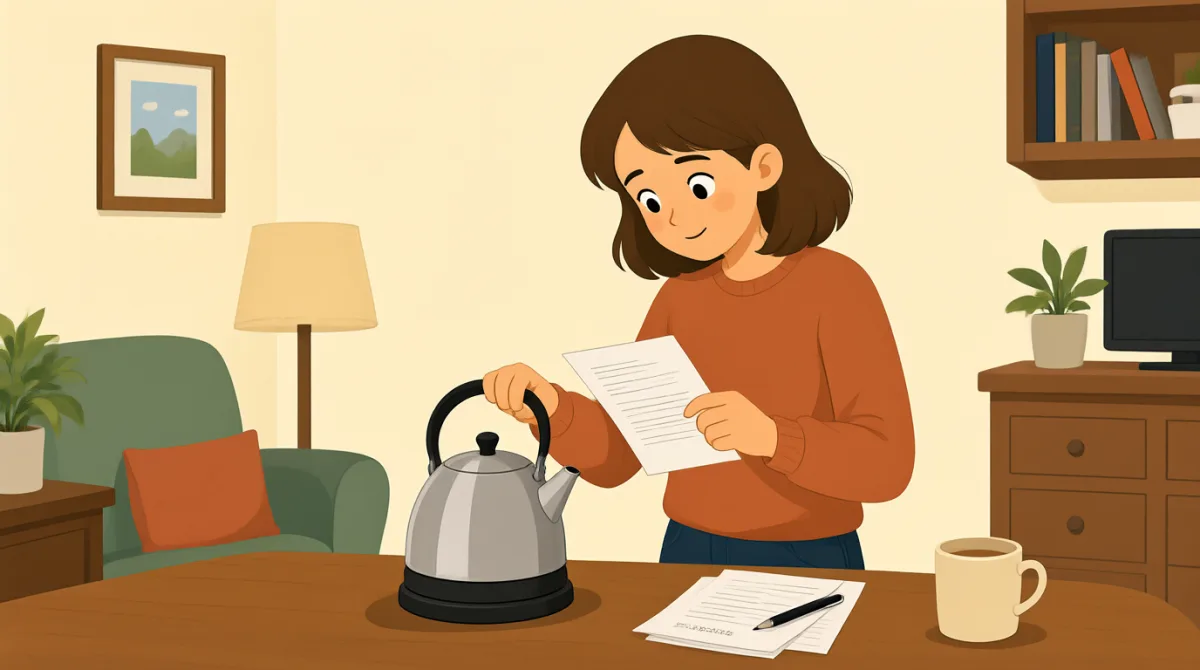

My kettle stopped heating this morning. It was working fine last night.
Mein Wasserkocher hat heute Morgen aufgehört zu heizen. Gestern Abend hat er noch einwandfrei funktioniert.

Oh no. How long have you had it?
Oh nein. Wie lange hast du ihn schon?
A few months. I think it still has a warranty.
Ein paar Monate. Ich glaube, er hat noch Garantie.
Did you check the warranty papers? They should say what to do.
Hast du in den Garantieunterlagen nachgesehen? Da sollte stehen, was du tun musst.
I did. It says the warranty covers problems with the kettle.
Ja. Da steht, dass die Garantie Probleme mit dem Wasserkocher abdeckt.
Good. Does it tell you where to call or take it?
Gut. Steht da, wo du anrufen oder ihn hinbringen sollst?
It says to call customer service before I bring it to the store.
Da steht, ich soll beim Kundenservice anrufen, bevor ich ihn in den Laden bringe.
Then call them today. Keep your receipt and warranty papers nearby.
Dann ruf heute dort an. Leg deinen Kassenbon und die Garantieunterlagen bereit.
I will. I hope they can fix it for free.
Mach ich. Hoffentlich können sie ihn kostenlos reparieren.
Wortschatz8
- stopped heatinghat aufgehört zu heizen
This means the kettle no longer gets hot. Use “stopped” plus an -ing verb to say that something no longer does an action.
Das bedeutet, dass der Wasserkocher nicht mehr heiß wird. Mit „stopped“ plus einem Verb auf „-ing“ sagst du, dass etwas eine Handlung nicht mehr ausführt.
- a few monthsein paar Monate
This means several months, but not a long time. You can use it to say how long you have had something.
Das bedeutet mehrere Monate, aber keine besonders lange Zeit. Du kannst damit sagen, wie lange du etwas schon hast.
- warranty papersGarantieunterlagen
These are documents that explain what the warranty covers and what to do if a product has a problem.
Das sind Dokumente, in denen steht, was die Garantie abdeckt und was du tun kannst, wenn ein Produkt ein Problem hat.
- covers problemsdeckt Probleme ab
This means the warranty includes certain problems and may help pay to fix them. You can use “covers” to ask what protection a warranty provides.
Das bedeutet, dass die Garantie bestimmte Probleme einschließt und möglicherweise dabei hilft, die Reparaturkosten zu übernehmen. Mit „covers“ kannst du fragen, welchen Schutz eine Garantie bietet.
- customer serviceKundenservice
This is the team you contact when you need help with a product or service. You can call customer service to ask what to do.
Das ist die Abteilung, an die du dich wendest, wenn du Hilfe zu einem Produkt oder einer Dienstleistung brauchst. Du kannst beim Kundenservice anrufen und fragen, was du tun sollst.
- bring it to the storeihn in den Laden bringen
This means to take the kettle to the store. Use “bring it to” when explaining where you need to take something.
Das bedeutet, den Wasserkocher zum Laden zu bringen. „Bring it to“ verwendest du, wenn du erklärst, wohin du etwas bringen musst.
- keep your receiptden Kassenbon aufbewahren
This means to save your proof of purchase. You may need it when returning or getting help with a product.
Das bedeutet, deinen Kaufbeleg aufzubewahren. Du brauchst ihn vielleicht, wenn du ein Produkt zurückgeben oder Hilfe dafür bekommen möchtest.
- for freekostenlos
This means without paying any money. You can use it to ask whether a repair or service has no cost.
Das bedeutet, dass du nichts dafür bezahlen musst. Damit kannst du fragen, ob eine Reparatur oder Dienstleistung nichts kostet.
Wichtige Sätze7
- 1
My kettle stopped heating this morning.
Mein Wasserkocher hat heute Morgen aufgehört zu heizen.
Use this sentence to explain a problem with an appliance. You can replace “kettle” and “heating” with another item and problem.
Mit diesem Satz kannst du ein Problem mit einem Haushaltsgerät erklären. Du kannst „kettle“ und „heating“ durch ein anderes Gerät und ein anderes Problem ersetzen.
- 2
How long have you had it?
Wie lange hast du ihn schon?
This is a useful way to ask how long someone has owned or used something. Use “How long have you had” with an item.
So kannst du fragen, wie lange jemand etwas schon besitzt oder benutzt. Verwende „How long have you had“ zusammen mit dem Gegenstand.
- 3
I think it still has a warranty.
Ich glaube, er hat noch Garantie.
Use this sentence when you believe a product may still be covered by a warranty. Replace “it” with the product you are talking about.
Diesen Satz verwendest du, wenn du glaubst, dass für ein Produkt vielleicht noch Garantie gilt. Ersetze „it“ durch das Produkt, von dem du sprichst.
- 4
Did you check the warranty papers?
Hast du in den Garantieunterlagen nachgesehen?
This is a simple way to ask whether someone looked at the warranty information. You can replace “warranty papers” with another document.
So kannst du einfach fragen, ob jemand die Garantieinformationen gelesen hat. Du kannst „warranty papers“ durch ein anderes Dokument ersetzen.
- 5
It says to call customer service before I bring it to the store.
Da steht, ich soll beim Kundenservice anrufen, bevor ich ihn in den Laden bringe.
Use this to explain instructions you found in a document. You can change the actions and destination to match the instructions.
Mit diesem Satz erklärst du Anweisungen, die du in einem Dokument gefunden hast. Du kannst die Handlungen und den Zielort an die Anweisungen anpassen.
- 6
Keep your receipt and warranty papers nearby.
Leg deinen Kassenbon und die Garantieunterlagen bereit.
This is a helpful instruction to save important documents where you can find them. Replace the documents with anything someone may need for a call or visit.
Das ist eine hilfreiche Aufforderung, wichtige Dokumente so aufzubewahren, dass du sie schnell findest. Du kannst die Dokumente durch alles ersetzen, was jemand für einen Anruf oder einen Besuch brauchen könnte.
- 7
I hope they can fix it for free.
Hoffentlich können sie ihn kostenlos reparieren.
Use this sentence to express hope that someone will repair something at no cost. Replace “they” and “it” with the people and item you mean.
Mit diesem Satz drückst du die Hoffnung aus, dass jemand etwas kostenlos repariert. Ersetze „they“ und „it“ durch die Personen und den Gegenstand, die du meinst.