Asking About Museum Rules
Nach den Museumsregeln fragen
Emma asks Grace if she can take photos in the gallery. Grace explains the rules and points out a sign.
Emma fragt Grace, ob sie in der Galerie fotografieren darf. Grace erklärt ihr die Regeln und zeigt auf ein Schild.
Dialog8
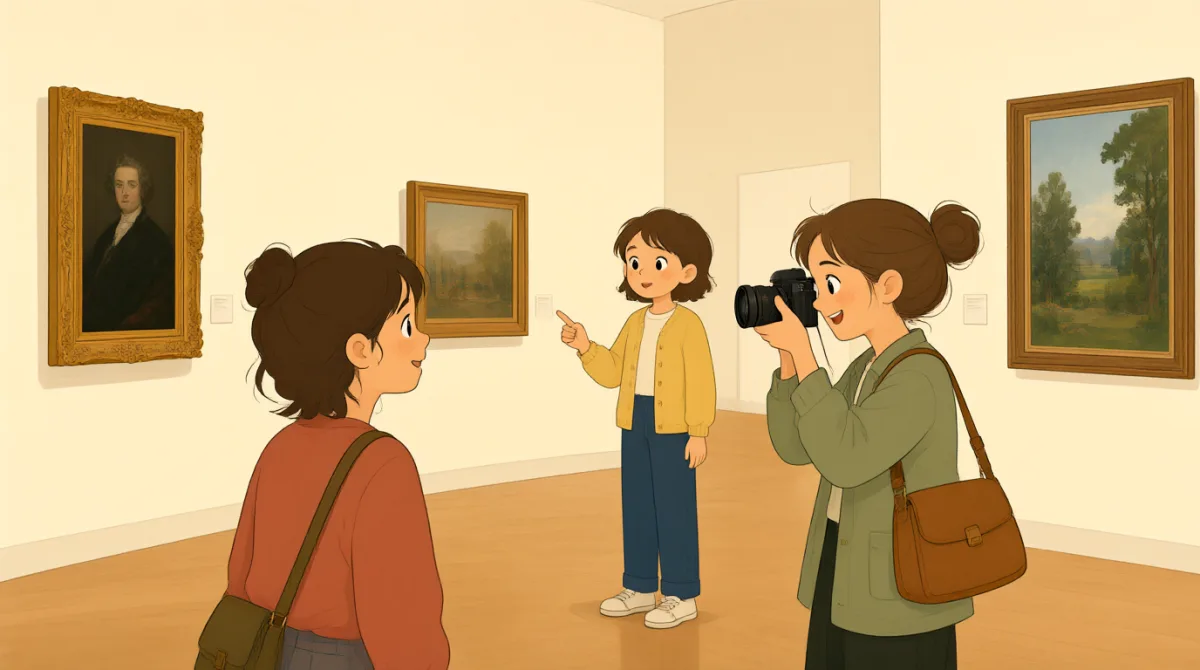

Excuse me, can I take photos in this gallery?
Entschuldigung, darf ich in dieser Galerie fotografieren?

You can take photos, but please don’t use the flash.
Du darfst fotografieren, aber bitte ohne Blitz.
Okay. Can I take a picture of this painting?
Okay. Darf ich dieses Gemälde fotografieren?
Yes, that’s fine. Just stay behind the line, please.
Ja, das ist in Ordnung. Bleib bitte einfach hinter der Linie.
I see a sign over there. Does it say no flash?
Da drüben steht ein Schild. Steht da, dass Blitzen verboten ist?
Yes, and it also says not to touch the paintings.
Ja, und da steht auch, dass man die Gemälde nicht berühren darf.
Got it. I’ll turn off my flash and keep my distance.
Alles klar. Ich schalte den Blitz aus und halte Abstand.
Thank you. Enjoy looking around, and let me know if you need help.
Danke. Viel Spaß beim Umschauen, und sag mir Bescheid, wenn du Hilfe brauchst.
Wortschatz7
- take photosfotografieren
To use a camera to make pictures. You can ask, “Can I take photos here?”
Mit einer Kamera Bilder machen. Du kannst fragen: “Can I take photos here?” (Darf ich hier fotografieren?)
- use the flashden Blitz benutzen
To use the bright light on a camera when taking a photo. In this gallery, visitors can take photos but must not use the flash.
Das helle Licht einer Kamera beim Fotografieren verwenden. In dieser Galerie dürfen Besucher fotografieren, aber nicht blitzen.
- stay behind the linehinter der Linie bleiben
To remain on the side of a line that is farther from an object. Museums use lines to keep visitors at a safe distance from artworks.
Auf der Seite einer Linie bleiben, die weiter von einem Gegenstand entfernt ist. In Museen gibt es Linien, damit Besucher einen sicheren Abstand zu Kunstwerken halten.
- signdas Schild
A notice that gives information or instructions. You can ask what a sign says if you are unsure about a rule.
Ein Hinweis, der Informationen oder Anweisungen gibt. Wenn du dir bei einer Regel nicht sicher bist, kannst du fragen, was auf einem Schild steht.
- not to touchnicht berühren
A way to say that someone must not put their hands on something. Signs often say not to touch museum paintings or displays.
Damit sagt man, dass jemand etwas nicht mit den Händen anfassen darf. Auf Schildern steht oft, dass man Gemälde oder Ausstellungsstücke im Museum nicht berühren darf.
- turn offausschalten
To stop a device or feature from working. You can say, “I’ll turn off my flash,” when you want to follow a no-flash rule.
Ein Gerät oder eine Funktion abstellen. Du kannst sagen: “I’ll turn off my flash,” (Ich schalte meinen Blitz aus), wenn du dich an ein Blitzverbot halten möchtest.
- keep my distanceAbstand halten
To stay far enough away from a person or object. In a gallery, keeping your distance can help protect the paintings.
Weit genug von einer Person oder einem Gegenstand entfernt bleiben. In einer Galerie kann Abstand dazu beitragen, die Gemälde zu schützen.
Wichtige Sätze8
- 1
Excuse me, can I take photos in this gallery?
Entschuldigung, darf ich in dieser Galerie fotografieren?
Use this polite question to ask if an activity is allowed. Replace “take photos” or “this gallery” to ask about other rules or places.
Mit dieser höflichen Frage erkundigst du dich, ob etwas erlaubt ist. Ersetze “take photos” oder “this gallery”, um nach anderen Regeln oder Orten zu fragen.
- 2
You can take photos, but please don’t use the flash.
Du darfst fotografieren, aber bitte ohne Blitz.
This sentence gives permission and then explains a restriction. Use “You can…, but please don’t…” to describe what is allowed and what is not.
Dieser Satz erlaubt etwas und nennt anschließend eine Einschränkung. Mit “You can…, but please don’t…” kannst du sagen, was erlaubt und was nicht erlaubt ist.
- 3
Can I take a picture of this painting?
Darf ich dieses Gemälde fotografieren?
Use this question to ask permission before taking a photo of a specific thing. Replace “this painting” with another object or place.
Mit dieser Frage bittest du um Erlaubnis, ein bestimmtes Motiv zu fotografieren. Ersetze “this painting” durch einen anderen Gegenstand oder Ort.
- 4
Just stay behind the line, please.
Bleib bitte einfach hinter der Linie.
This is a polite way to give a simple instruction. You can use “stay behind…” to tell someone where to stand.
So kannst du höflich eine einfache Anweisung geben. Mit “stay behind…” sagst du jemandem, wo er stehen soll.
- 5
Does it say no flash?
Steht da, dass Blitzen verboten ist?
Use this question to check what a sign says. Replace “no flash” with another rule you want to confirm.
Mit dieser Frage erkundigst du dich, was auf einem Schild steht. Ersetze “no flash” durch eine andere Regel, die du bestätigen lassen möchtest.
- 6
Yes, and it also says not to touch the paintings.
Ja, und da steht auch, dass man die Gemälde nicht berühren darf.
This sentence confirms one rule and adds another. Use “It also says…” to mention extra information on a sign or notice.
Dieser Satz bestätigt eine Regel und fügt eine weitere hinzu. Mit “It also says…” kannst du zusätzliche Informationen auf einem Schild oder Hinweis erwähnen.
- 7
I’ll turn off my flash and keep my distance.
Ich schalte den Blitz aus und halte Abstand.
Use “I’ll” to say what you will do next. This sentence is useful for showing that you understand and will follow instructions.
Mit “I’ll” sagst du, was du als Nächstes tun wirst. Dieser Satz eignet sich, um zu zeigen, dass du die Anweisungen verstanden hast und befolgen wirst.
- 8
Enjoy looking around, and let me know if you need help.
Viel Spaß beim Umschauen, und sag mir Bescheid, wenn du Hilfe brauchst.
This is a friendly way to welcome someone and offer help. Use “Let me know if you need help” in places such as museums, shops, or hotels.
So heißt du jemanden freundlich willkommen und bietest Hilfe an. “Let me know if you need help” kannst du zum Beispiel in Museen, Geschäften oder Hotels verwenden.