Asking About Museum Rules
Preguntar por las normas del museo
Emma asks Grace if she can take photos in the gallery. Grace explains the rules and points out a sign.
Emma le pregunta a Grace si puede sacar fotos en la galería. Grace le explica las normas y le señala un cartel.
Diálogo8
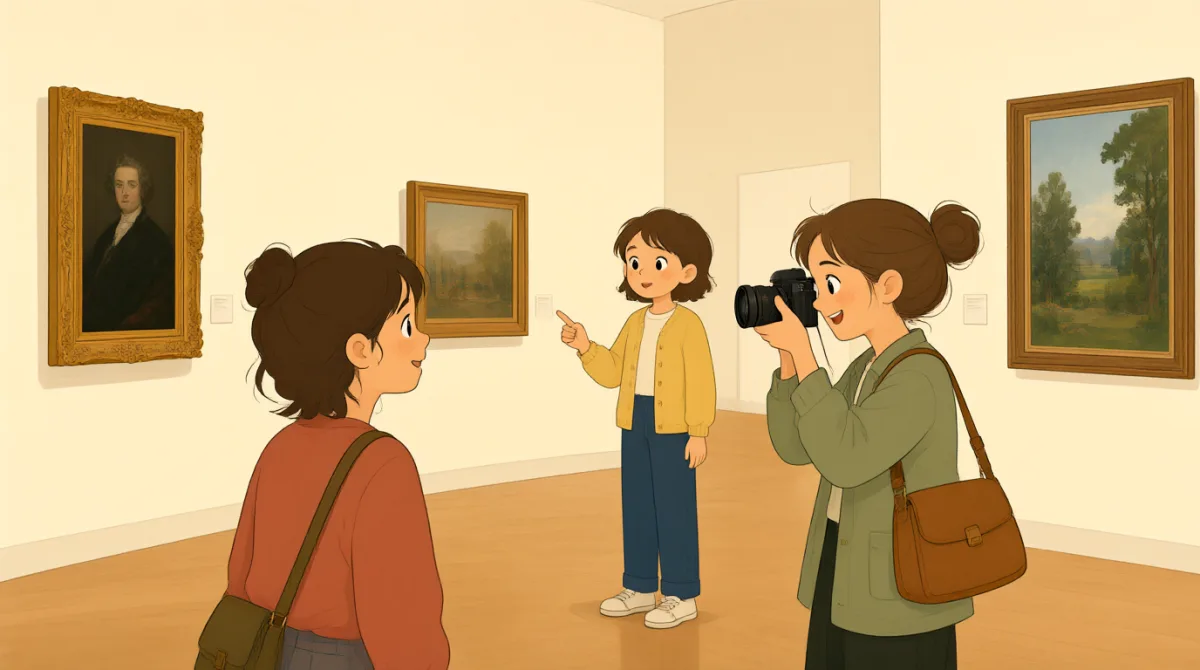

Excuse me, can I take photos in this gallery?
Disculpa, ¿puedo sacar fotos en esta galería?

You can take photos, but please don’t use the flash.
Puedes sacar fotos, pero por favor no uses el flash.
Okay. Can I take a picture of this painting?
Vale. ¿Puedo sacar una foto de este cuadro?
Yes, that’s fine. Just stay behind the line, please.
Sí, no hay problema. Solo quédate detrás de la línea, por favor.
I see a sign over there. Does it say no flash?
Veo un cartel allí. ¿Dice que no se puede usar el flash?
Yes, and it also says not to touch the paintings.
Sí, y también dice que no se deben tocar los cuadros.
Got it. I’ll turn off my flash and keep my distance.
Entendido. Apagaré el flash y mantendré la distancia.
Thank you. Enjoy looking around, and let me know if you need help.
Gracias. Disfruta del recorrido y avísame si necesitas ayuda.
Vocabulario7
- take photossacar fotos
To use a camera to make pictures. You can ask, “Can I take photos here?”
Usar una cámara para hacer fotografías. Puedes preguntar: “Can I take photos here?” (¿Puedo sacar fotos aquí?).
- use the flashusar el flash
To use the bright light on a camera when taking a photo. In this gallery, visitors can take photos but must not use the flash.
Usar la luz brillante de una cámara al sacar una foto. En esta galería, los visitantes pueden sacar fotos, pero no deben usar el flash.
- stay behind the linequedarse detrás de la línea
To remain on the side of a line that is farther from an object. Museums use lines to keep visitors at a safe distance from artworks.
Permanecer en el lado de una línea que está más lejos de un objeto. Los museos usan líneas para mantener a los visitantes a una distancia segura de las obras de arte.
- signcartel
A notice that gives information or instructions. You can ask what a sign says if you are unsure about a rule.
Un aviso que da información o instrucciones. Si no tienes claro alguna norma, puedes preguntar qué dice un cartel.
- not to touchno tocar
A way to say that someone must not put their hands on something. Signs often say not to touch museum paintings or displays.
Una forma de decir que alguien no debe poner las manos sobre algo. En los carteles suele indicarse que no se deben tocar los cuadros ni las exposiciones del museo.
- turn offapagar
To stop a device or feature from working. You can say, “I’ll turn off my flash,” when you want to follow a no-flash rule.
Hacer que un dispositivo o una función deje de funcionar. Puedes decir “I’ll turn off my flash” (Apagaré el flash) para indicar que vas a respetar una norma que prohíbe usarlo.
- keep my distancemantener la distancia
To stay far enough away from a person or object. In a gallery, keeping your distance can help protect the paintings.
Mantenerse lo bastante lejos de una persona o un objeto. En una galería, mantener la distancia puede ayudar a proteger los cuadros.
Frases clave8
- 1
Excuse me, can I take photos in this gallery?
Disculpa, ¿puedo sacar fotos en esta galería?
Use this polite question to ask if an activity is allowed. Replace “take photos” or “this gallery” to ask about other rules or places.
Usa esta pregunta cortés para averiguar si una actividad está permitida. Cambia “take photos” o “this gallery” para preguntar por otras normas o lugares.
- 2
You can take photos, but please don’t use the flash.
Puedes sacar fotos, pero por favor no uses el flash.
This sentence gives permission and then explains a restriction. Use “You can…, but please don’t…” to describe what is allowed and what is not.
Esta frase da permiso y luego explica una restricción. Usa “You can…, but please don’t…” para decir qué está permitido y qué no.
- 3
Can I take a picture of this painting?
¿Puedo sacar una foto de este cuadro?
Use this question to ask permission before taking a photo of a specific thing. Replace “this painting” with another object or place.
Usa esta pregunta para pedir permiso antes de sacar una foto de algo en particular. Cambia “this painting” por otro objeto o lugar.
- 4
Just stay behind the line, please.
Solo quédate detrás de la línea, por favor.
This is a polite way to give a simple instruction. You can use “stay behind…” to tell someone where to stand.
Esta es una forma cortés de dar una instrucción sencilla. Puedes usar “stay behind…” para decirle a alguien dónde ponerse.
- 5
Does it say no flash?
¿Dice que no se puede usar el flash?
Use this question to check what a sign says. Replace “no flash” with another rule you want to confirm.
Usa esta pregunta para comprobar qué dice un cartel. Cambia “no flash” por otra norma que quieras confirmar.
- 6
Yes, and it also says not to touch the paintings.
Sí, y también dice que no se deben tocar los cuadros.
This sentence confirms one rule and adds another. Use “It also says…” to mention extra information on a sign or notice.
Esta frase confirma una norma y añade otra. Usa “It also says…” para mencionar información adicional de un cartel o aviso.
- 7
I’ll turn off my flash and keep my distance.
Apagaré el flash y mantendré la distancia.
Use “I’ll” to say what you will do next. This sentence is useful for showing that you understand and will follow instructions.
Usa “I’ll” para decir lo que harás a continuación. Esta frase sirve para mostrar que entiendes las instrucciones y que las seguirás.
- 8
Enjoy looking around, and let me know if you need help.
Disfruta del recorrido y avísame si necesitas ayuda.
This is a friendly way to welcome someone and offer help. Use “Let me know if you need help” in places such as museums, shops, or hotels.
Esta es una forma amable de dar la bienvenida a alguien y ofrecerle ayuda. Usa “Let me know if you need help” en lugares como museos, tiendas u hoteles.