Following the Recipe
Dem Rezept folgen
The class follows the recipe and adds the ingredients to a pot. Grace explains when to stir and how long to cook the food.
Der Kurs folgt dem Rezept und gibt die Zutaten in einen Topf. Grace erklärt, wann man umrühren und wie lange man das Essen kochen soll.
Dialog9
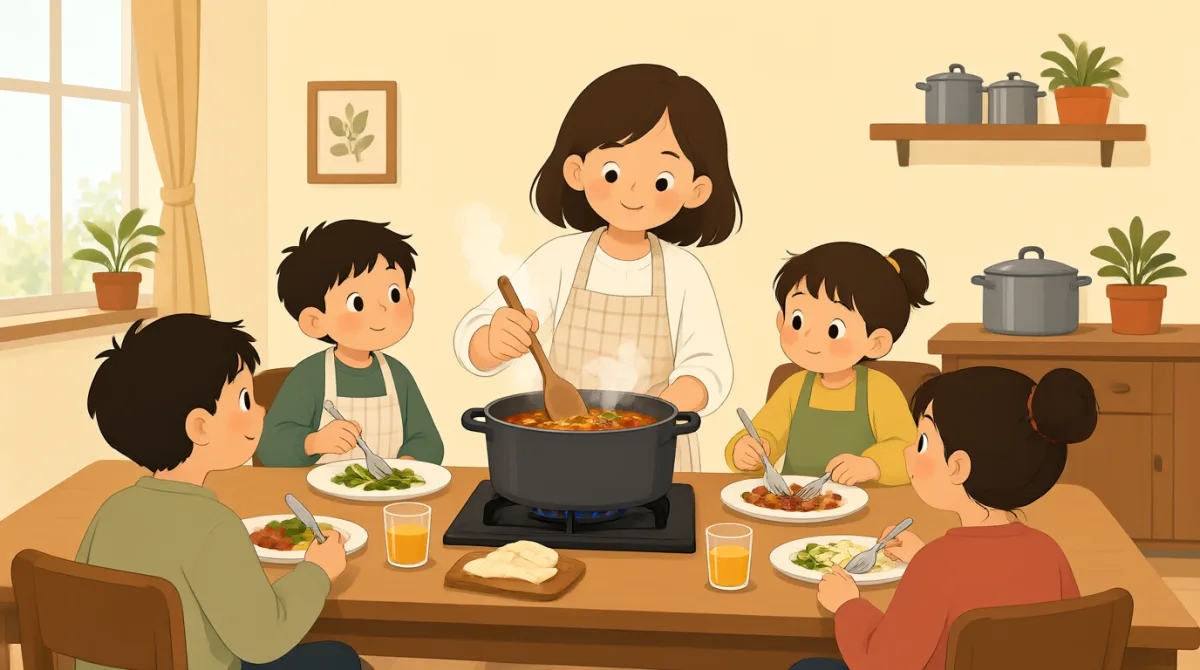

Now, read the recipe. First, pour two cups of water into the pot.
Lest jetzt das Rezept. Gebt zuerst zwei Tassen Wasser in den Topf.

Should I add the tomatoes now, or wait until the water gets hot?
Soll ich die Tomaten jetzt dazugeben oder warten, bis das Wasser heiß ist?
Wait until it boils. Then add the tomatoes, beans, and a little salt.
Wartet, bis es kocht. Dann gebt die Tomaten, Bohnen und ein bisschen Salz dazu.

How long should we cook everything? I don't want to burn lunch.
Wie lange sollen wir alles kochen? Ich will das Mittagessen nicht anbrennen lassen.
Cook it for ten minutes. Stir it gently every few minutes.
Kocht es zehn Minuten lang. Rührt alle paar Minuten vorsichtig um.
The soup is bubbling now. Should I turn the heat down?
Die Suppe blubbert jetzt. Soll ich die Hitze runterdrehen?
Yes, turn it down to low. Keep stirring so nothing sticks.
Ja, stellt die Hitze auf niedrige Stufe. Rührt weiter um, damit nichts anbrennt.
I stirred it, and the beans feel soft. Can we taste it now?
Ich habe umgerührt, und die Bohnen fühlen sich weich an. Können wir jetzt probieren?
Sure. Take a small spoonful, and tell me if it needs more salt.
Klar. Probier einen kleinen Löffel voll und sag mir, ob noch Salz fehlt.
Wortschatz8
- pour two cups of waterzwei Tassen Wasser hineingießen
This means to put two cups of water into the pot. You can use “pour” when adding a liquid to a container.
Das bedeutet, zwei Tassen Wasser in den Topf zu geben. „pour“ verwendest du, wenn du eine Flüssigkeit in ein Gefäß gießt.
- until it boilsbis es kocht
This means to wait until the water gets very hot and starts bubbling. You can say “until it boils” when explaining when to do something.
Das bedeutet, zu warten, bis das Wasser sehr heiß ist und Blasen wirft. Mit „until it boils“ kannst du erklären, wann etwas getan werden soll.
- add the tomatoesdie Tomaten dazugeben
This means to put the tomatoes into the pot. Use “add” when putting an ingredient into food.
Das bedeutet, die Tomaten in den Topf zu geben. „add“ verwendest du, wenn du eine Zutat zum Essen gibst.
- stir it gentlyvorsichtig umrühren
This means to mix the food slowly and carefully with a spoon. You can use “stir gently” when giving cooking instructions.
Das bedeutet, das Essen langsam und vorsichtig mit einem Löffel zu verrühren. „stir gently“ kannst du in Kochanweisungen verwenden.
- turn it down to lowdie Hitze auf niedrige Stufe stellen
This means to lower the heat to a low setting. You can use this phrase when a dish needs to cook more slowly.
Das bedeutet, die Hitze auf eine niedrige Stufe zu stellen. Diese Wendung kannst du verwenden, wenn ein Gericht langsamer garen soll.
- sticksanbrennt
Here, “sticks” means food gets attached to the bottom of the pot. You can say “so nothing sticks” when explaining why you should stir.
Hier bedeutet „sticks“, dass das Essen am Topfboden haften bleibt. „so nothing sticks“ kannst du sagen, um zu erklären, warum man umrühren soll.
- a small spoonfulein kleiner Löffel voll
This means a small amount of food that fits on a spoon. Use it when tasting food or serving a little.
Das bedeutet eine kleine Menge Essen, die auf einen Löffel passt. Du kannst den Ausdruck verwenden, wenn du etwas probierst oder eine kleine Portion servierst.
- needs more saltnoch mehr Salz braucht
This means the food may need extra salt to taste better. You can use this phrase when asking someone to check the flavor.
Das bedeutet, dass das Essen vielleicht noch etwas Salz braucht, damit es besser schmeckt. Mit dieser Wendung kannst du jemanden bitten, den Geschmack zu prüfen.
Wichtige Sätze8
- 1
First, pour two cups of water into the pot.
Gebt zuerst zwei Tassen Wasser in den Topf.
This gives a clear first step in a recipe. You can reuse the pattern “First, pour [amount] of [liquid] into the [container].”
Damit gibst du den ersten Schritt eines Rezepts klar an. Das Muster „First, pour [amount] of [liquid] into the [container].“ kannst du wiederverwenden: Nenne zuerst die Menge und die Flüssigkeit, die in ein Gefäß gegossen werden soll.
- 2
Should I add the tomatoes now, or wait until the water gets hot?
Soll ich die Tomaten jetzt dazugeben oder warten, bis das Wasser heiß ist?
This is a useful way to ask whether to do something now or later. Replace “add the tomatoes” with another task to ask about the right time.
So kannst du fragen, ob du etwas jetzt oder später tun sollst. Ersetze „add the tomatoes“ durch eine andere Aufgabe, um nach dem richtigen Zeitpunkt zu fragen.
- 3
Cook it for ten minutes.
Kocht es zehn Minuten lang.
This tells someone how long to cook something. You can use “Cook it for [time]” to give a simple cooking instruction.
Damit sagst du jemandem, wie lange etwas kochen soll. Mit „Cook it for [time]“ kannst du eine einfache Kochanweisung geben.
- 4
Stir it gently every few minutes.
Rührt alle paar Minuten vorsichtig um.
This gives both the action and how often to do it. You can change “gently” or “every few minutes” to give different instructions.
Damit nennst du sowohl die Handlung als auch, wie oft sie ausgeführt werden soll. Du kannst „gently“ oder „every few minutes“ ändern, um andere Anweisungen zu geben.
- 5
Yes, turn it down to low.
Ja, stellt die Hitze auf niedrige Stufe.
This is a short, practical instruction for lowering the heat. You can replace “low” with another heat setting, such as “medium.”
Das ist eine kurze, praktische Anweisung, um die Hitze zu reduzieren. Du kannst „low“ durch eine andere Hitzestufe ersetzen, zum Beispiel durch „medium“.
- 6
Keep stirring so nothing sticks.
Rührt weiter um, damit nichts anbrennt.
This explains what to keep doing and why. Use “Keep [verb]-ing so [result]” to give a helpful reminder.
Damit erklärst du, was jemand weiter tun soll und warum. Mit „Keep [verb]-ing so [result]“ kannst du eine hilfreiche Erinnerung geben.
- 7
Can we taste it now?
Können wir jetzt probieren?
This is a simple way to ask if it is okay to try some food. You can replace “taste it” with another action to ask permission.
So kannst du einfach fragen, ob du etwas vom Essen probieren darfst. Ersetze „taste it“ durch eine andere Handlung, um um Erlaubnis zu bitten.
- 8
Take a small spoonful, and tell me if it needs more salt.
Probier einen kleinen Löffel voll und sag mir, ob noch Salz fehlt.
This gives someone two clear steps: taste a little and say what the food needs. You can replace “more salt” with another ingredient or seasoning.
Damit gibst du jemandem zwei klare Schritte: eine kleine Menge probieren und sagen, was dem Essen noch fehlt. Du kannst „more salt“ durch eine andere Zutat oder Würze ersetzen.